
Best Air Source Heat Pump for UK Weather: 2026 Performance Guide
- James

- 3 days ago
- 12 min read
Updated: 1 day ago
The highest efficiency rating on a spec sheet might actually be the worst indicator of how a unit performs on a foggy Tuesday in Manchester. Most manufacturers test their systems in dry, sub-zero conditions, but the British climate presents a different challenge altogether. Finding the best air source heat pump for UK weather requires looking past peak laboratory figures to find a system that masters our high humidity and frequent defrost cycles. It's a critical distinction that determines whether you'll be truly comfortable when January arrives.
We understand the hesitation that comes with such a significant transition. You want the reassurance of a warm home without the constant worry of noise complaints from neighbours or spiralling electricity costs. This guide promises to cut through the technical jargon to show you which models actually thrive in our damp-cold environment, helping you slash your carbon footprint and secure lower long-term energy bills. With the Boiler Upgrade Scheme now offering a £7,500 grant and the removal of EPC barriers as of April 2026, there has never been a more vital time to understand your options. We will preview the top-performing 2026 models, explain the benefits of R290 refrigerants, and show you how to navigate the 0% VAT incentives available until 2027.
Key Takeaways
Precision design is paramount. Understand why advanced evaporator technology is essential for managing the UK's unique "damp cold" conditions that often baffle standard efficiency ratings.
Comfort should be effortless. Evaluate the latest high-temperature units to determine if your existing radiators can provide consistent warmth without the need for disruptive home alterations.
Reliability defines the leaders. Compare the winter resilience and acoustic performance of Mitsubishi, Vaillant, and Daikin to select the best air source heat pump for UK weather.
Total energy independence is the goal. Explore how pairing your installation with Solar PV and battery storage creates a self-sustaining ecosystem that protects you from price volatility.
Expertise secures your investment. Recognise the vital importance of MCS-accredited system design in tailoring your solution to regional climate variations whilst ensuring eligibility for financial support.
Table of Contents
Why UK Weather Demands a Specific Type of Air Source Heat Pump
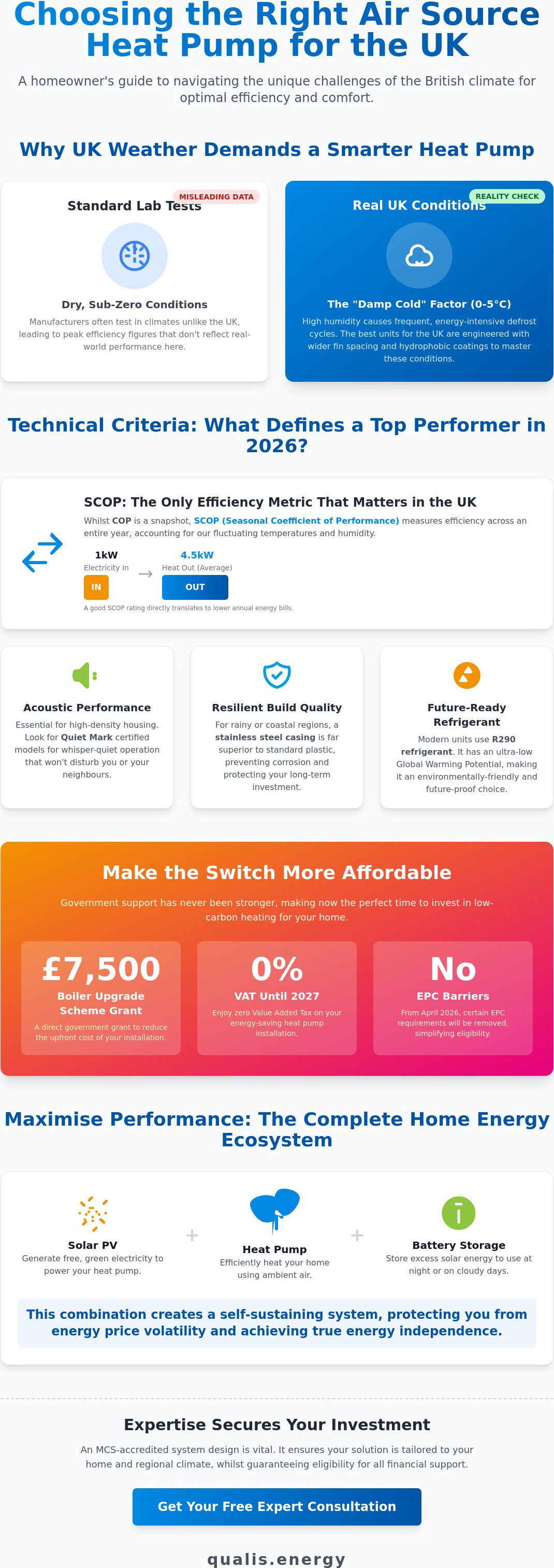
Efficiency isn't a static number. In the UK, the real test of a heating system happens between 0°C and 5°C, where the air is heavy with moisture. This damp cold is a uniquely British challenge that often catches out generic systems designed for drier, colder climates. Finding the best air source heat pump for UK weather means prioritising a unit that can handle high humidity without constant interruptions. Cheap imports frequently struggle here. They lack the sophisticated icing management required to keep a home in Sheffield or Nottingham warm during a persistent winter frost.
The outdoor unit relies on its evaporator coil to pull heat from the environment. Understanding How Air Source Heat Pumps Work highlights that as moist air passes over these cold coils, water vapour naturally condenses and freezes. If a system isn't built for this, it spends too much energy melting its own ice rather than heating your water. Modern 2026-generation units have solved this with wider fin spacing and hydrophobic coatings that shed moisture before it can solidify. It's a leap forward in engineering that ensures consistent performance regardless of the drizzle outside.
The "Damp Cold" Factor: Humidity and Frost
High humidity causes frost to accumulate rapidly on outdoor coils, forcing the unit into a defrost cycle. During this process, the heat pump temporarily reverses its operation to melt the ice, which can sap efficiency if the system's logic is poorly optimised. Latent heat is the energy released or absorbed by a substance during a change of state, such as when water vapour in the British air turns into frost on your heat pump's coils. Advanced units use predictive sensors to ensure defrosting only happens when absolutely necessary, preserving your comfort and your bank balance.
Myth-Busting: Do Heat Pumps Work in -10°C?
Sceptics often point to extreme cold as a weakness, yet heat pumps are the standard in Scandinavia, where temperatures regularly plummet far below UK averages. Modern systems utilise "Vapor Injection" technology to boost performance by injecting a small amount of refrigerant back into the compressor. This allows 2026-gen units to maintain high flow temperatures even when the mercury hits -15°C. Our rare British cold snaps don't stand a chance against this level of engineering. You won't be left in the cold when the next "Beast from the East" arrives.
Technical Criteria: What Defines the Best Performance in 2026?
Technical excellence in 2026 isn't just about raw power. It's about intelligence. Choosing the best air source heat pump for UK weather requires a shift in how we evaluate performance data. We're moving beyond laboratory snapshots and looking at how these systems behave over an entire British year. From the salty air of the coast to the high-density housing of our city centres, the hardware must be as resilient as it is efficient.
SCOP vs COP: Measuring Real-World UK Efficiency
Whilst COP (Coefficient of Performance) gives you a glimpse of efficiency at a single moment, it's often misleading. It doesn't account for the fluctuating humidity we discussed in the previous section. SCOP (Seasonal Coefficient of Performance) is the only metric that truly matters. A SCOP of 4.5 means that for every 1kW of electricity consumed, the unit delivers 4.5kW of heat on average throughout the year. This directly slashes your annual electricity bill compared to older, less sophisticated models. According to UK government guidance on heat pumps, these efficiency gains are central to the national transition towards low-carbon heating.
Noise levels are equally vital. In high-density UK housing, a loud unit can jeopardise planning permission and frustrate neighbours. You should look for Quiet Mark certified models that operate at whisper-quiet levels even under load. Build quality also dictates longevity. If you live in a rainy or coastal region, stainless steel casings are far superior to standard plastic, preventing corrosion and protecting your investment. If you're unsure which build suits your specific property, you can speak with our specialists to explore durable options tailored to your location.
Refrigerant Choice: The Rise of R290 (Propane)
The most significant shift in 2026 is the adoption of R290 refrigerant, commonly known as propane. It's the gold standard for environmental responsibility due to its incredibly low Global Warming Potential. Crucially for UK homeowners, R290 units like the Vaillant aroTHERM Plus can reach flow temperatures of 75°C without needing an inefficient immersion heater. This is a game-changer for Victorian terraces or 1930s semis. It means you can often keep your existing radiators whilst still enjoying the efficiency of a modern heat pump.
The Top-Rated Heat Pumps for the UK Climate in 2026
Selecting the right hardware is a decision that defines your home's comfort for the next decade. In the current market, three manufacturers have distinguished themselves by engineering solutions specifically for our temperate, maritime climate. Mitsubishi, Vaillant, and Daikin don't just sell units; they provide refined thermal management systems stress-tested in British conditions. For those seeking the best air source heat pump for UK weather, these brands represent the pinnacle of reliability and winter resilience. They've moved beyond generic designs to create hardware that acknowledges our unique humidity levels and architectural heritage.
A defining feature of the 2026 lineup is "Smart Grid Ready" integration. This technology allows your heat pump to communicate with energy providers, automatically drawing power when renewable generation is high and tariffs are at their lowest. It's a visionary approach to resource management that turns your home into a proactive participant in the national energy transition. This intelligence, combined with robust warranties often extending to seven or ten years, ensures your investment remains protected as the UK energy landscape evolves. It's about total peace of mind for the long term.
The Efficiency Leader: Vaillant aroTHERM Plus
The Vaillant aroTHERM Plus has become a staple for suburban semi-detached homes across South Yorkshire and the Midlands. Its popularity stems from an incredibly quiet operation, making it ideal for residential areas where noise levels are a primary concern for planning. By utilising R290 refrigerant, it achieves high flow temperatures whilst maintaining exceptional efficiency in humid conditions. Following Energy Saving Trust advice, many homeowners prioritise this model for its balance of environmental credentials and practical domestic comfort. It's a system designed to disappear into the background of daily life whilst providing consistent, reliable warmth.
The Cold-Weather Specialist: Daikin Altherma 3 HT
For properties where radiator upgrades are impractical, the Daikin Altherma 3 HT is the definitive solution. It delivers water at 70°C even when outdoor temperatures drop significantly, ensuring older UK homes stay comfortable during the deepest winter. Daikin’s heritage in precision air conditioning informs their superior frost management logic. Their 2026 software updates have further refined how the unit handles damp air, reducing the frequency of defrost cycles. This ensures that even during a biting frost, the best air source heat pump for UK weather continues to operate at peak performance without sacrificing efficiency or comfort.
Maximising Performance: Beyond the Unit Itself
Hardware alone cannot guarantee a warm home. Even the best air source heat pump for UK weather will underperform if the house is leaking heat like a sieve. True efficiency is found at the intersection of high-grade technology and intelligent system design. Integrating renewable energy into your property isn't just about comfort; it's a strategic move to bolster long-term property value whilst contributing to a cleaner national infrastructure. Your heat pump should be viewed as the heart of a wider, self-sustaining ecosystem.
This holistic approach ensures that every kilowatt of energy is used with purpose. By coordinating your heating with other low-carbon technologies, you move from being a passive consumer to an active manager of your home's resources. It's a visionary way to live that prioritises both environmental responsibility and financial foresight. If you're ready to see how these systems work in tandem, you can explore our integrated energy solutions to find the perfect fit for your home.
Fabric First: Insulation and Draught-Proofing
Insulation is the most cost-effective partner for any heat pump. Before installing new hardware, ensuring your loft has adequate insulation and your windows are draught-proofed will significantly reduce the required unit size. Precise heat loss calculations are essential. They prevent the common mistake of over-sizing the unit, which leads to "short-cycling" and unnecessary wear. For a typical 1930s or 1950s UK semi, these simple fabric upgrades allow the heat pump to run at lower, more efficient flow temperatures throughout the winter months.
The Synergy of Solar PV and Battery Storage
The real magic happens when you pair an air source heat pump with Solar PV and battery storage. During the day, your solar panels capture energy that can be stored in a domestic battery. This stored power then runs your heat pump during peak evening hours, effectively shielding you from high electricity prices. Under 2026 SEG tariffs, this combination offers a formidable return on investment. Modern AI-driven controllers now organise this process automatically; they scan weather forecasts to decide when to store energy and when to heat your water, ensuring total convenience with zero manual effort.
This integrated approach is a standard upheld by European specialists such as Commodus, who focus on the seamless combination of heating, air conditioning, and solar solutions to optimise domestic energy consumption.
Professional Installation: The Final Piece of the Efficiency Puzzle
The hardware is only the beginning. Even the best air source heat pump for UK weather cannot perform in a vacuum; it requires a bespoke design that respects the unique thermal dynamics of your specific property. Unlike a standard boiler swap, which is often a reactive replacement, an air source heat pump installation is a proactive engineering project. It demands a level of precision that only experienced, local specialists can provide. By choosing installers who understand the micro-climates of Nottingham and Sheffield, you ensure your system is calibrated for the actual humidity and temperature profiles of the East Midlands rather than a generic national average.
Reliability is built on consistent care. Once your system is operational, maintaining its efficiency requires a commitment to professional air source heat pump servicing. This ongoing support protects your investment and ensures that the technical criteria discussed earlier, such as SCOP and defrost logic, continue to meet their laboratory-rated potential in the real world. It's the difference between a transactional purchase and a long-term partnership in sustainable living. We view every installation as a critical step in a national transition, where your domestic comfort contributes to a larger, visionary mission of resource management.
Why MCS Accreditation and Local Expertise Matter
MCS accreditation serves as the industry’s hallmark of quality. It isn't just a badge; it's a rigorous guarantee that your heat loss calculations are accurate and your system is correctly sized for your home. Local expertise is equally vital. Installers based in the North and Midlands possess a granular understanding of regional weather patterns, ensuring that the outdoor unit is positioned to minimise wind chill and maximise air intake. This regional knowledge, paired with a local maintenance team, ensures that help is always nearby should you need to optimise your system's performance. It removes the effort for the client, providing a narrative of completeness and reliability.
Accessing the Boiler Upgrade Scheme (BUS) in 2026
The financial landscape for low-carbon heating has never been more supportive. As of May 2026, the Boiler Upgrade Scheme provides a substantial £7,500 grant towards your installation. For households currently using oil or LPG, a special one-year uplift announced on April 21, 2026, has increased this support to £9,000. Crucially, as of April 28, 2026, the requirement for a valid Energy Performance Certificate (EPC) to be eligible for the BUS has been removed, significantly simplifying the path to approval. Your MCS-accredited installer will manage the entire application process on your behalf, ensuring you secure these incentives whilst they remain available. With the scheme now extended to 2030, the opportunity to transition to the best air source heat pump for UK weather is clear, accessible, and professionally facilitated.
Secure Your Home's Thermal Future
Transitioning to low-carbon heating is more than a simple appliance upgrade; it's a definitive step towards a more resilient and sustainable way of living. We've established that mastering the unique challenges of the British "damp cold" requires a system that prioritises sophisticated defrost logic and high-temperature flow. By integrating smart controls with solar and battery storage, you're not just heating your home; you're future-proofing your property against an evolving energy market. Identifying the best air source heat pump for UK weather is the foundation of this personal energy transition.
Achieving peak performance requires a partner who understands the local landscape. Our MCS Accredited Installers are specialists in Nottingham and Sheffield climates, providing expert design for maximum efficiency tailored to your specific architectural needs. We manage the complexity so you can enjoy the comfort. Book your expert heat pump consultation with Qualis Energy today and begin your journey towards a warmer, greener future. It's time to lead the change in your community.
Frequently Asked Questions
Do air source heat pumps really work in the UK winter?
Yes, modern air source heat pumps are engineered to operate effectively even when temperatures drop as low as -25°C. These systems are specifically designed to master the UK's high humidity, ensuring that warmth is delivered consistently throughout the winter months. By selecting the best air source heat pump for UK weather, you ensure your home remains a sanctuary of comfort regardless of the frost outside.
How much does it cost to run a heat pump in a 3-bedroom UK house?
Running costs vary based on your property's insulation and the unit's seasonal efficiency. For a typical three-bedroom house in 2026, annual running costs are estimated to be between £855 and £1,700. These figures reflect the high performance of current generation units, which can produce five times more heat energy than the electrical energy they consume.
Will I need to replace all my radiators for a heat pump to work?
You don't always need to replace your radiators. High-temperature models can reach flow temperatures of 75°C, which often allows them to work seamlessly with existing heating emitters. A professional heat loss calculation during the design phase will determine if specific rooms require larger radiators to maintain peak efficiency at lower flow temperatures.
How noisy is an air source heat pump for my neighbours?
Modern units are remarkably quiet. Most 2026 models operate at decibel levels similar to a quiet conversation or a domestic fridge, typically between 45 and 55 dB. This makes them perfectly suitable for high-density residential areas where noise management is a priority for planning permissions and maintaining positive neighbour relations.
How long does an air source heat pump last in the UK climate?
A well-maintained air source heat pump typically lasts between 15 and 20 years. This longevity significantly exceeds the average lifespan of a traditional gas boiler, which usually requires replacement after 10 to 12 years. Regular professional servicing ensures the system continues to operate reliably throughout its service life.
Can a heat pump provide hot water as well as heating?
Yes, heat pumps provide both space heating and domestic hot water. The system connects to a dedicated hot water cylinder, which stores water heated by the pump for use in showers, baths, and taps. This provides a complete, low-carbon solution that meets your home's entire thermal demand throughout the year.
What happens to a heat pump when it snows?
Snow doesn't stop the system from working. Units are installed on raised feet to prevent snow from blocking the air intake, and the internal defrost logic automatically clears any ice build-up on the coils. Your home stays warm whilst the system manages the external conditions independently, ensuring total convenience with zero manual effort.
Is an air source heat pump cheaper than a gas boiler in 2026?
Operational costs are increasingly competitive in 2026 as the UK transitions away from fossil fuels. Whilst gas prices remain volatile, the high efficiency of the best air source heat pump for UK weather allows it to deliver more heat per unit of energy. When combined with the £7,500 Boiler Upgrade Scheme grant and 0% VAT on installations, the long-term financial argument for heat pumps is compelling.


Comments