
Air Source Heat Pump Installers: Finding Trusted UK Experts in 2026
- James

- 7 hours ago
- 13 min read
The best installer isn't just a plumber; they're a visionary energy architect who designs for your home’s specific thermal behaviour. It's a bold claim, but in 2026, the difference between a freezing January and a cosy, low-carbon home rests entirely on the expertise of your chosen air source heat pump installers. You probably agree that while the national transition to renewable energy is vital, your primary concern is whether a new system will actually deliver heat when you need it most. The fear of unreliable contractors and the complexity of the £7,500 Boiler Upgrade Scheme (BUS) grant often make homeowners pause, even when the potential for lower energy bills is clear.
We're here to ensure your transition is seamless, efficient, and fully funded. This guide reveals how to identify genuine experts who provide a complete turnkey service, moving you logically from the initial technical survey through to final handover. You'll learn how to evaluate MCS credentials and guarantee your system meets the 2.8 SCOP requirement for maximum efficiency. We'll show you how to find a partner who handles every detail so you won't need to lift a finger, allowing you to hold high the renewable energy flag with total confidence in your home's warmth and your family's comfort.
Key Takeaways
Learn how to bridge the "performance gap" by choosing experts who treat your heating system as a precision instrument rather than a simple boiler swap.
Master the 2026 evaluation checklist to ensure your air source heat pump installers hold the essential MCS and F-Gas credentials required for government grant eligibility.
Compare national providers against local independent specialists to find the best fit for your property's specific architectural character and regional climate.
Discover the "turnkey" approach to the Boiler Upgrade Scheme, ensuring you secure maximum funding without having to manage complex paperwork yourself.
Understand how combining your heat pump with solar PV and battery storage can transform your home into a self-sustaining energy hub.
Table of Contents
Why Choosing the Right Air Source Heat Pump Installers is Critical
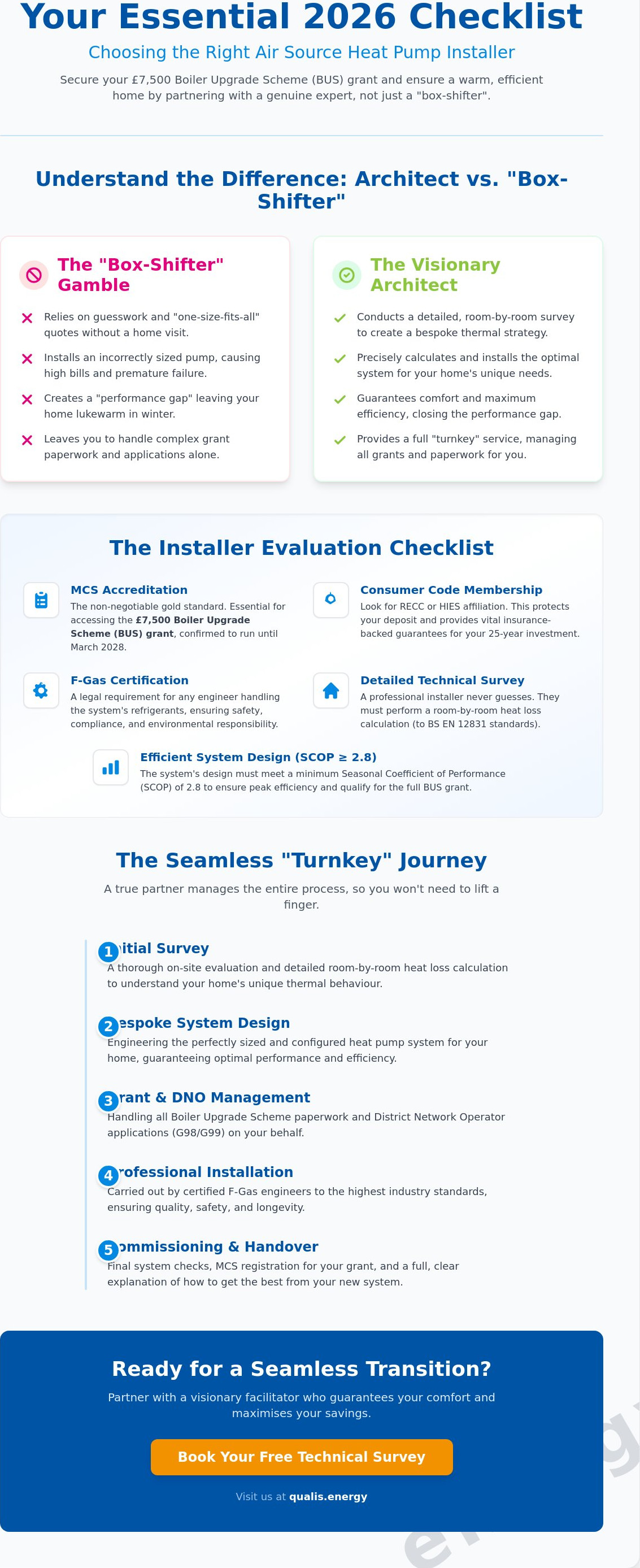
The transition to renewable energy is the most significant upgrade your home will ever undergo. It’s a shift from the outdated combustion of the past to the intelligent thermodynamics of the future. However, a "performance gap" often exists between the theoretical efficiency of a system and its actual behaviour in a British winter. This gap is almost always the result of poor design. When air source heat pump installers fail to account for specific pipework diameters or radiator surface areas, the result is a system that works too hard, costs too much, and leaves your living room lukewarm. A heat pump is a precision instrument, not a "plug-and-play" boiler replacement. To understand what an air source heat pump is and how it functions, one must appreciate that it relies on low-temperature flow to achieve maximum efficiency.
Engineering excellence is the only way to bridge this gap. At Qualis Energy, we hold high the renewable energy flag by refusing to cut corners on technical specifications. The UK’s building stock is incredibly diverse, ranging from draughty Victorian terraces with solid brick walls to airtight modern detached homes. Each requires a bespoke thermal strategy. Without a deep understanding of these structural nuances, an installer cannot guarantee the comfort your family deserves.
The Risk of "Box-Shifting" Installers
Some companies prioritise high-volume sales over bespoke engineering. These "box-shifters" often provide one-size-fits-all quotes without ever stepping foot inside your property. This is a major red flag. If an installer doesn't perform a detailed room-by-room heat loss calculation, they are simply guessing the size of the unit you need. An oversized pump will "cycle" on and off constantly, wearing out the compressor; an undersized one will leave you freezing when the temperature drops below zero. The long-term financial impact of such errors can run into thousands of pounds in wasted electricity and premature equipment failure.
The Visionary Facilitator: What to Look For
You need a partner who acts as a visionary facilitator, managing the entire journey from the initial site survey and DNO application through to the final MCS certification and handover. Trusted air source heat pump installers should provide a seamless "from-to" service that removes the burden of technical jargon and bureaucratic hurdles. At Qualis Energy, we ensure our clients won't need to lift a finger. We handle the complex G98 and G99 applications and the Boiler Upgrade Scheme paperwork, allowing you to focus on the domestic comfort of your new, green home. Our approach turns a complex industrial installation into a simple, reassuring upgrade for your family.
The 2026 Checklist for Evaluating Heat Pump Installers
Credentials are the bedrock of trust. When you search for air source heat pump installers, you aren't just looking for a technician; you're hiring a project manager for your home’s future. The industry has evolved significantly, and by 2026, the standards for entry are higher than ever. A reputable partner should demonstrate a clear "from-to" capability, taking you from a complex thermal query to a fully commissioned, grant-funded system without you needing to lift a finger.
Technical Credentials and Consumer Protection
MCS accreditation remains the non-negotiable gold standard. Without it, you cannot access the £7,500 Boiler Upgrade Scheme (BUS) grant, which is confirmed to run until March 2028. However, certification is merely the baseline. You must also ensure your installer belongs to a consumer code like RECC or HIES. These bodies protect your deposit and ensure you receive insurance-backed guarantees. For a 25-year investment in your property's infrastructure, these safeguards provide the peace of mind required to move forward with confidence. Additionally, check for F-Gas certification, which is a legal requirement for any professional handling the refrigerants essential to the system's operation.
The Survey: What Happens During a Professional Visit?
A visionary installer never relies on guesswork. During a professional site visit, the surveyor should perform a detailed room-by-room heat loss calculation in accordance with BS EN 12831. This involves measuring every window dimension, assessing insulation levels in the loft and walls, and calculating the surface area of existing radiators. This data-driven approach ensures your new system is sized perfectly for your home's unique thermal behaviour. They will also evaluate your outdoor space to ensure the unit has optimal airflow and meets "permitted development" noise requirements, whilst discussing your hot water usage to select the correct cylinder size for your family's needs.
Grant expertise is another critical factor. The best air source heat pump installers act as facilitators, managing the entire BUS application process on your behalf. They should be able to explain this step-by-step installation guide in plain English, ensuring you understand how the £7,500 discount is applied directly to your invoice. If you’re ready to see how these engineering standards apply to your own property, you can request a technical consultation with our team today.
Finally, look for manufacturer partnerships. Installers who are accredited by leading brands like Mitsubishi or Daikin often offer extended warranties that aren't available to the general trade. These partnerships signal that the installer has undergone specific factory training, ensuring your high-level technology is handled with the expertise it deserves. This blend of regulatory compliance and manufacturer-backed skill is what separates a standard contractor from a leader in the UK’s energy transition.
Navigating the Installer Landscape: National vs. Local Specialists
The UK’s energy landscape is shifting at an incredible pace. Choosing the right air source heat pump installers involves balancing the reach of a national corporation with the bespoke care of a local craftsman. National energy companies offer high brand visibility and the reassurance of a household name. However, their size often necessitates a "cookie-cutter" approach to design. They frequently rely on vast networks of subcontractors, which can lead to a fragmented experience where the surveyor, designer, and installer have never actually met. This lack of cohesion can be problematic for complex property types, such as agricultural barns or period terraces, where standard solutions simply won't suffice.
Local independent specialists provide a different value proposition. These teams possess deep roots in their communities and an intimate understanding of regional building styles. Because they live and work in the same areas as their clients, they carry a "local hero" accountability that national firms often lack. Qualis Energy occupies a unique position as a regional leader. We provide the high-level technical expertise and "turnkey EPC service" typically associated with national giants, whilst maintaining the personal touch and local accountability that homeowners value. We hold high the renewable energy flag by ensuring every project is managed with precision from start to finish.
The Benefits of Choosing Local Experts
Regional expertise extends beyond simple proximity. Local installers are familiar with specific environmental factors, such as local water hardness, which can significantly impact the longevity of your system’s heat exchanger. They also provide much faster response times for ongoing maintenance. Regular air source heat pump servicing is essential for protecting your investment, and having a specialist nearby ensures that help is always at hand. This community-mindedness creates a partnership that lasts long after the initial installation is complete.
Comparing Service Levels and Aftercare
The difference between a "fit and forget" contractor and a visionary facilitator is most apparent in the aftercare. Many air source heat pump installers vanish once the final commission is signed off. We believe that the handover is just the beginning of the journey. Maintaining a high Coefficient of Performance (COP) requires a long-term maintenance partnership. Our proactive approach includes monitoring system health and educating the next generation of homeowners on how to optimise their green credentials. By handling everything from the initial G98 application to yearly check-ups, we ensure our clients won't need to lift a finger, allowing them to focus on the simple joy of a warm home and lower energy bills.
Local Considerations for Nottingham, Sheffield, and the East Midlands
The East Midlands is a region of architectural contrasts. From the tightly packed Victorian terraces of Nottingham to the sprawling new developments in Newark, each property demands a unique engineering perspective. Expert air source heat pump installers must understand that a system designed for a modern, airtight home in Mansfield will fail if replicated in a solid-wall property in the Peak District. Regional climate factors play a decisive role. Systems must be specified to perform whilst facing biting Peak District winds or the heavy frosts common in South Yorkshire. This isn't just about heating; it's about resilient infrastructure that survives the harshest local winters. We also manage the specific G98 and G99 DNO applications required for our regional power grids, ensuring your home is ready for the future.
Local planning nuances often catch homeowners off guard. If you live in a conservation area like Southwell or Farnsfield, your installation might require specific permissions to ensure the external unit complements the local character. We manage these local authority checks as part of our turnkey service, ensuring your project remains compliant without you needing to lift a finger. For those searching for an air source heat pump near me in Chesterfield or Worksop, choosing a partner with regional roots is the only way to guarantee this level of detail.
Grants and Incentives in the East Midlands
The Boiler Upgrade Scheme (BUS) provides a £7,500 foundation for most residential projects until March 2028. However, homeowners in Barnsley, Rotherham, and Doncaster should also look for additional local authority initiatives. We act as your regional guide, identifying every available penny of funding to ensure your investment is as cost-effective as possible. Our goal is to change how the East Midlands thinks about energy, making the transition accessible to every household. By handling the complex grant paperwork from start to finish, we ensure you receive the full financial benefit of the national energy transition.
Case Studies: Local Success Stories
Our versatility is proven across a diverse range of local sites. We’ve successfully transitioned everything from industrial units in Lincoln to complex agricultural barns in Retford. Whether we are retrofitting "chicken sheds" with high-efficiency heating or helping a family in a detached home show off their green credentials, our standards remain unwavering. Selecting the right air source heat pump installers is about more than technology; it’s about a long-term commitment to the community. We hold high the renewable energy flag by delivering systems that work in the real world, not just on a spreadsheet. If you want a system designed for your specific local climate, you can book your East Midlands site survey today.
Qualis Energy: Your Partner in the National Energy Transition
Qualis Energy isn't just a contractor. We are a visionary partner in a critical national transition. Our mission is to change how the UK thinks about energy, moving away from a reliance on volatile fossil fuels toward a future of domestic independence and industrial resilience. As leading air source heat pump installers, we recognise that a heat pump is only one piece of the puzzle. The future of energy has arrived, and it's integrated. By combining high-level technical expertise with a grounded, supportive approach, we help families and businesses move from inspiration to implementation with total confidence.
We believe that every home deserves a bespoke thermal strategy. Whether you are looking after the children in a suburban semi-detached or managing a large agricultural site, our engineering standards remain unwavering. We hold high the renewable energy flag by ensuring every installation is a masterpiece of efficiency, designed specifically for the unique behaviour of your property.
A Holistic Approach to Renewables
In 2026, the "gold standard" for energy efficiency is no longer a standalone system. It's the synergy between heat, power, and storage. Combining air source heat pumps with battery storage allows you to capture energy when it's cheapest and use it when you need it most. For homeowners, this means a seamless transition to solar panels and installation that powers your heating for a fraction of the cost. Commercial enterprises in our regional industrial hubs can also maximise ROI through solar panels for business, turning vast roof spaces into productive energy assets. We're committed to educating the next generation, helping communities understand that green credentials are a long-term investment in our shared future.
Getting Started with Qualis Energy
Our comprehensive project management ensures you won't need to lift a finger. We’ve mapped out a narrative of completeness through our professional 5-step process:
Technical Survey: A rigorous room-by-room heat loss calculation to ensure perfect system sizing.
Bespoke Design: Creating a thermal strategy tailored to your property’s specific behaviour and radiators.
Grant Facilitation: Managing the £7,500 Boiler Upgrade Scheme application from start to finish.
Precision Installation: Expert engineering led by our MCS-certified team with full CDM project management.
Final Handover: A detailed walkthrough and maintenance plan so you feel in control of your technology.
We handle all regulatory hurdles, including G98 and G99 DNO applications, so your journey is entirely stress-free. From the initial survey to the final handover, we act as your visionary facilitator. Contact Qualis Energy today to start your journey and discover why we are the trusted choice for air source heat pump installers in the East Midlands and South Yorkshire.
Lead the Charge Toward a Smarter, Warmer Home
The future of energy has arrived, and it's built on precision engineering and trusted partnerships. We've explored why the "performance gap" is a risk you don't need to take and how specific local knowledge of the East Midlands is vital for a system that performs all year round. By choosing the right air source heat pump installers, you ensure your home transition is not just a technical upgrade, but a long-term investment in domestic comfort and financial stability.
Qualis Energy is proud to be your visionary facilitator in this national transition. As an MCS Accredited and NAPIT Registered installer, we bring high-level technical expertise to every project across Nottingham, Sheffield, and the surrounding regions. We handle the design, the DNO applications, and the £7,500 Boiler Upgrade Scheme grant so you won't need to lift a finger. Our team is dedicated to moving you logically from inspiration to implementation with total professional care.
Book your bespoke ASHP survey with Qualis Energy today to see how we can transform your property. Let's hold high the renewable energy flag together and create a warmer, greener home for the next generation.
Frequently Asked Questions
Do I need planning permission for an air source heat pump in the UK?
Most installations fall under "permitted development" rights and don't require planning permission. You must meet specific criteria, such as the unit being at least one metre from your property boundary and not exceeding a certain volume. Exceptions apply if you live in a listed building or a conservation area. We manage these local authority checks as part of our turnkey service to ensure your project is fully compliant before work begins.
How much does air source heat pump installation cost in 2026?
A standard installation in 2026 typically costs between £8,000 and £15,000 before any government incentives are applied. Once you factor in the £7,500 Boiler Upgrade Scheme (BUS) grant, the final cost for many homeowners sits between £500 and £7,500. This investment covers the high-efficiency unit, professional labour, and any necessary upgrades to your radiators or hot water cylinder to ensure optimal performance.
Can a heat pump really replace my gas boiler in an old house?
Yes, a heat pump can successfully replace a gas boiler in an older property if it's designed correctly by expert air source heat pump installers. The secret lies in a "low-temperature" system design. This often involves upgrading specific radiators to increase their surface area, allowing them to emit enough heat even when the water temperature is lower than what you'd expect from a traditional boiler.
What is the Boiler Upgrade Scheme (BUS) and am I eligible?
The Boiler Upgrade Scheme is a government initiative providing a £7,500 grant to help homeowners in England and Wales transition to renewable heating. You're eligible if you own your home and are replacing a fossil fuel system, such as a gas or oil boiler. The scheme is confirmed to run until March 2028, and we handle the entire application process on your behalf so you won't need to lift a finger.
How do I find an MCS certified installer near me?
You can search the official Microgeneration Certification Scheme (MCS) directory to find accredited professionals in your area. It's vital to choose an installer who isn't just certified but also offers a comprehensive "from-to" service. Look for regional specialists who manage everything from the initial thermal survey to long-term maintenance, as this ensures your system is designed specifically for your home's unique behaviour and local climate.
What is the difference between an air source heat pump and air conditioning?
An air source heat pump is a "wet" system designed to provide whole-home central heating and domestic hot water via radiators or underfloor heating. Air conditioning is typically a "dry" system that heats or cools the air directly. Whilst they use similar technology to move heat, only a heat pump is designed to completely replace your boiler and provide the high-volume hot water your family needs.
How long does the actual installation process take?
The physical installation usually takes between two and five days to complete. This timeframe includes removing your old boiler, installing the outdoor unit, and upgrading your hot water cylinder. If your project involves significant pipework changes or multiple radiator upgrades, it may take slightly longer. We provide a detailed project schedule during the design phase so you can plan your domestic routine with total confidence.
Will my electricity bill go up after installing a heat pump?
Your electricity usage will increase because the pump uses power to move heat from the air into your home, but your gas bill will vanish. Because modern heat pumps are incredibly efficient, often achieving 300% to 400% efficiency, your total energy spend should remain comparable to or lower than gas. You can maximise these savings by integrating your system with solar PV and battery storage to achieve true energy independence.


Comments