
.png)
RESIDENTIAL RADIATORS
RADIATORS
Replacing old dirty radiators with new or upgrading to meet your heat loss requirement when upgrading to a air source heat pump.

We now offer
flexible payments
Underfloor Heating
When switching to a heat pump, radiators often need to be resized because heat pumps run at much lower flow temperatures (45°C – 55°C) compared to gas boilers (70°C +).
1. Sizing Radiators for Heat Pumps
Because the water is "cooler," the radiator needs a larger surface area to emit the same amount of heat.
-
The "Rule of Thumb": New radiators for heat pumps are typically 2 to 2.5 times larger than those used with gas boilers.
-
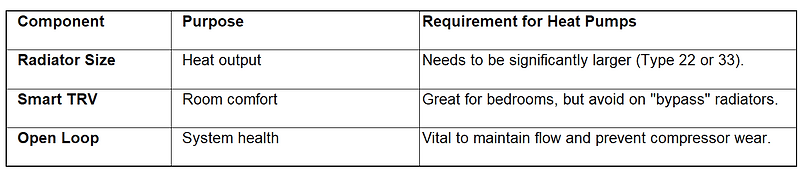
Types: Instead of a single panel (Type 11), you often move to a double panel with double fins (Type 22) or a triple panel (Type 33) to gain surface area without taking up massive amounts of wall length.
-
Delta T (ΔT): While gas systems are sized at ΔT 50, heat pumps are sized at ΔT 30 or 35.
2. TRVs vs. Smart TRVs
Thermostatic Radiator Valves (TRVs) control the temperature of individual rooms.
-
Standard TRVs: Use a wax or liquid element to shut off flow when the room reaches a set temperature. They are "dumb" and don't communicate with the heat source.
-
Smart TRVs: (e.g., Tado, Drayton Wiser, Honeywell Evohome)
-
Precision: Digital sensors prevent "overshooting" the temperature.
-
Calling for Heat: A smart TRV can tell the heat pump or boiler to turn on just for one room, rather than waiting for the main thermostat to trigger.
-
Scheduling: You can keep bedrooms cool during the day and warm them up 30 minutes before bed.
-
3. Open Loop Systems (The "No TRV" Rule)
With heat pumps, efficiency is driven by high flow rates and low temperatures. Closing too many TRVs can "strangle" the heat pump, causing it to error out or short-cycle.
-
What it is: An "Open Loop" means leaving the radiators in the main living areas (like the lounge and hallway) permanently open with no TRVs (or TRVs turned to max).
-
The Benefit: The heat pump uses the house itself as a "buffer." It allows the pump to move a constant volume of water, ensuring it operates at its highest COP (efficiency).
-
Integration: In an open-loop setup, you use Weather Compensation to control the temperature—the heat pump looks at the outside temp and adjusts the water temp accordingly, rather than relying on TRVs to "click" off.
Summary Table
Choosing between radiators and underfloor heating (UFH) often comes down to how you use your home and what heat source (boiler vs. heat pump) you have.
Quick Comparison
The "Heat Pump" Factor
If you are installing an Air Source Heat Pump, UFH is the superior choice. Because UFH covers a massive surface area, it can heat your home using water at just . Radiators, even large ones, usually need to do the same job, which makes the heat pump work harder and cost more to run.
The Hybrid Approach
Many modern UK homes use a "best of both" strategy:
-
Ground Floor: UFH in high-traffic, open-plan areas (kitchen/lounge) where the thermal mass of the floor keeps the temperature stable all day.
-
First Floor: Radiators in bedrooms. This allows you to quickly boost the heat before bed or in the morning without waiting hours for a floor to warm up.
Floor Finish Considerations
-
Radiators don't care what floor you have.
-
UFH performs best with tile or stone. If you want thick carpets or certain woods, you have to size the system specifically to "push" heat through those insulating layers.


Get in Touch
Reach out to us for inquiries, product details, or any assistance.
We're here to help.
Or give us a call on
0333 090 7546
Or send us a WhatsApp message
07356 273141
Or send us an email