
Solar Panels for Businesses: The 2026 Commercial Buying Guide
- James

- 2 days ago
- 12 min read
Your commercial roof is currently a silent liability. Whilst it provides shelter, it also represents thousands of pounds in lost revenue every year that it remains bare. In 2026, installing solar panels for businesses is no longer a peripheral sustainability project; it is a critical infrastructure strategy designed to combat volatile energy prices and rising TNUoS charges.
We understand the frustration of navigating complex DNO applications and the hesitation that comes with choosing a partner for such a significant transition. You deserve a clear path to energy independence that doesn't involve guesswork. This guide will demonstrate how to transform your facility into a high-yielding asset, leveraging the 100% Annual Investment Allowance and the current 0% VAT rate to secure a typical payback period of just three to five years. We will walk you through the technicalities of grid compliance, the strategic benefits of battery storage, and the steps required to ensure your installation delivers predictable electricity costs for the next quarter-century.
Key Takeaways
Learn how to mitigate grid volatility by integrating battery storage to power your operations during expensive peak periods.
Compare strategic funding models to find the right fit for your balance sheet, including the benefits of zero-upfront-cost Power Purchase Agreements (PPAs).
Navigate the essential compliance steps for large-scale projects, such as securing DNO approval and meeting UK planning requirements.
Discover how the right solar panels for businesses can secure long-term energy independence whilst significantly enhancing your corporate reputation.
Understand why proactive maintenance is vital for preventing component degradation and ensuring your investment yields maximum returns for decades.
Table of Contents
The Strategic Case for Business Solar Panels in 2026
Energy is no longer a passive utility that you can afford to ignore. It's a strategic asset. In 2026, the transition to photovoltaic systems has evolved from a niche environmental choice into a core financial imperative. Businesses across the UK are facing a new reality where total grid dependence is a significant liability. By installing solar panels for businesses, you aren't just "going green"; you're decoupling your profit margins from the whims of international wholesale markets and rising non-commodity charges.
We're witnessing a fundamental shift in how local enterprises view their infrastructure. You're moving from being a passive consumer to an active "prosumer". This means you generate, store, and manage your own power. It's a bold step toward national energy resilience. Taking control of your own generation capacity isn't just about saving money today. It's about ensuring your firm remains competitive in a landscape where energy security is a primary marker of business health.
Future-Proofing Against Energy Price Volatility
The 2026 energy market remains sensitive to global shifts. Relying solely on the grid exposes your firm to unpredictable price spikes and increasing transmission costs. Fixed-cost onsite generation provides a sanctuary of stability. When you generate your own electricity, your operational expenditure (OpEx) becomes predictable for the next 25 years. Every kilowatt-hour produced on your roof is a kilowatt-hour you don't have to buy at an inflated market rate. Delaying this transition only increases the lifetime cost of energy for your firm. The sun doesn't send an invoice; the grid does.
Enhancing Corporate Reputation and ESG Scores
Stakeholders now demand radical transparency. Whether you're a manufacturer in the East Midlands supply chain or a high-street retailer, your carbon footprint is under constant scrutiny. Environmental, Social, and Governance (ESG) reporting has become a standard requirement for securing major contracts and attracting investment. Proving your commitment to decarbonisation is essential for long-term growth.
Tangible Marketing: Displaying a "Solar-Powered" badge offers immediate, visible proof of your values.
Supply Chain Leadership: Meeting the strict carbon reduction targets of your larger corporate partners ensures you remain a preferred supplier.
Talent Acquisition: The modern workforce prioritises environmental responsibility. They want to work for leaders who take the climate transition seriously.
By investing in solar panels for businesses, you demonstrate a visionary commitment to both your community and the planet. This isn't merely about hardware on a roof. It's about the legacy your brand leaves behind and the message you send to every client, employee, and investor who walks through your doors.
Designing for Maximum ROI: PV Systems and Battery Storage
Design is the bridge between a simple installation and a high-performing financial asset. Sizing your system incorrectly is the fastest way to erode your return on investment. If the system is too small, you remain at the mercy of the grid; if it's too large without storage, you're exporting valuable energy for less than its worth. Precision in engineering ensures that solar panels for businesses are tailored to the unique load profile of your facility, whether you operate a cold-storage warehouse or a high-tech office hub. Modern monocrystalline modules, with efficiencies reaching 23% in 2026, provide the density required to maximise generation even on restricted roof spaces.
We prioritise Tier 1 technology to ensure long-term reliability. Whilst standard monocrystalline panels are the workhorse of the industry, bifacial modules are becoming increasingly popular for commercial sites with light-coloured or reflective roofing materials. These modules capture sunlight on both sides, significantly increasing the total energy yield per square metre. Choosing the right hardware is a fundamental step in our end-to-end implementation process, moving you from initial concept to a fully operational power plant.
The Synergy of Solar and Battery Storage
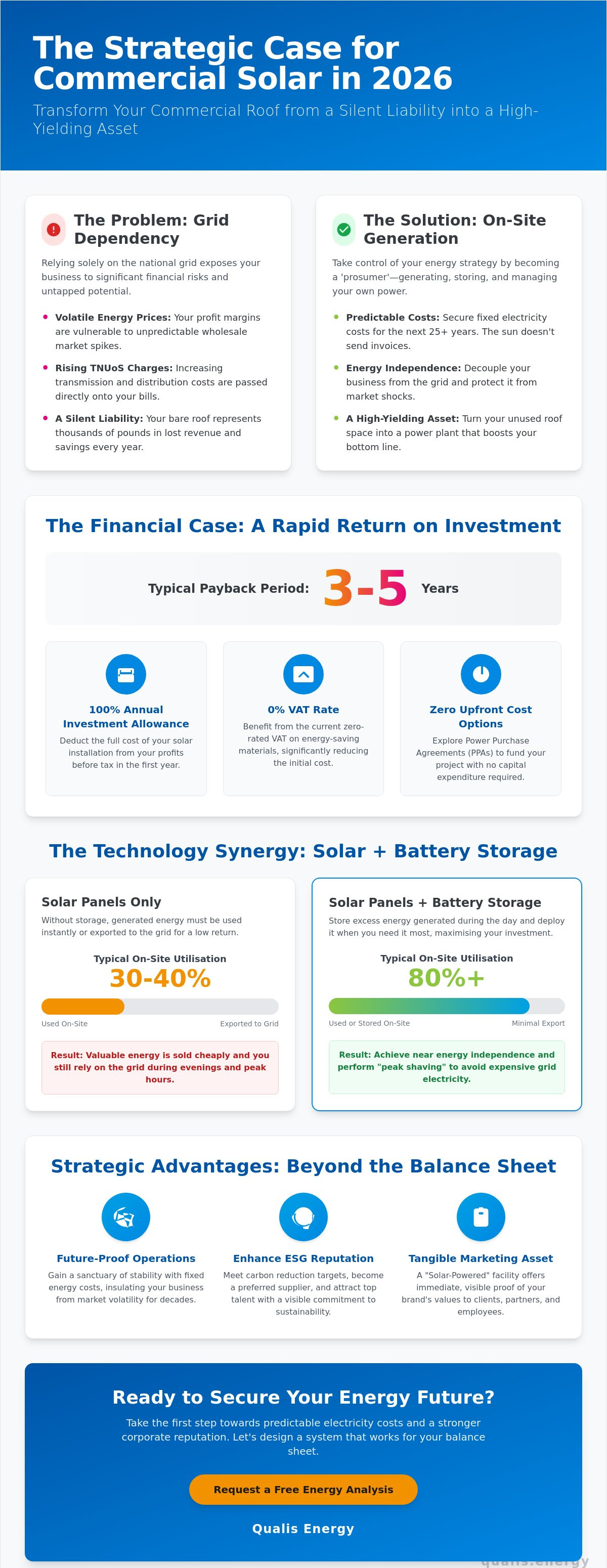
Batteries are the engine of self-consumption. Without them, most businesses only utilise about 30% to 40% of the energy they generate. Integrating battery storage allows you to capture peak midday generation and deploy it during evening shifts or early morning starts. This is particularly vital for "peak shaving", a strategy that reduces your reliance on the grid during expensive "red zone" DUoS periods. Whilst exploring Department of Energy solar funding and UK-specific grants, it becomes clear that the most resilient projects are those that can maintain critical infrastructure during grid outages through emergency backup capabilities.
Integrating Solar with Commercial HVAC
The true frontier of efficiency lies in the synergy between generation and thermal management. Integrating your PV array with an air source heat pump installation allows you to convert sunlight directly into heating and cooling. This eliminates the seasonal spikes that traditionally plague commercial energy bills. At Qualis Energy, we design integrated mechanical systems that treat your HVAC and solar as a single, harmonious unit. This holistic approach ensures that energy-intensive air conditioning during summer months is powered entirely by your own roof. This reduces the strain on your electrical connection and secures your position as a leader in the national transition to net zero.
If you're ready to see how these technologies could work together on your site, our team can help you map out your energy future with a detailed system design.
The Financial Framework: Funding, Incentives, and Export Tariffs
The financial architecture of a renewable project is just as critical as the engineering behind it. Investing in solar panels for businesses requires a clear choice between preserving immediate liquidity and maximising long-term yield. In 2026, the UK tax landscape is particularly favourable for firms ready to commit to onsite generation. With the main rate of Corporation Tax sitting at 25%, the Annual Investment Allowance (AIA) provides a powerful incentive; it allows you to deduct the full value of your solar investment, up to £1 million, from your profits in the first year. This effectively means the Treasury is subsidising a significant portion of your transition through tax relief. Furthermore, the 0% VAT rate on solar and battery storage remains active until 31 March 2027, offering a substantial upfront saving for eligible enterprises.
We view these incentives not as temporary perks, but as the foundation of a national shift toward industrial self-sufficiency. Beyond tax relief, businesses also benefit from the removal of the Climate Change Levy (CCL) on every kilowatt-hour they generate and consume themselves. At the current rate of 0.775p/kWh, these savings compound over the 25-year lifespan of the system. This creates a narrative of total fiscal control, where your roof becomes a hedge against the rising non-commodity charges that now inflate standard energy bills.
Direct Purchase vs. Power Purchase Agreements (PPA)
Choosing the right funding model is a balance of risk and reward. A direct purchase (Capex) offers the fastest route to a high return on investment, with typical payback periods now ranging from three to five years. You own the asset, claim the capital allowances, and enjoy "free" energy once the system has paid for itself. Conversely, a Power Purchase Agreement (PPA) allows you to host a system owned and maintained by a third party. You avoid the upfront cost entirely and simply buy the generated electricity at a rate significantly lower than the grid. This Opex-led model is ideal for businesses that prefer to preserve cash flow for core operational growth whilst still securing long-term price stability.
Revenue Generation via Export Tariffs
Your system should be a revenue generator even when your facility is closed. The Smart Export Guarantee (SEG) ensures that any surplus energy you send back to the grid is paid for by your supplier. In May 2026, fixed SEG rates typically range between 9p and 20p per kWh. However, businesses with battery storage can access variable time-of-use tariffs that can exceed 30p per kWh during peak evening periods. To access these premium rates, half-hourly metering is essential. Whilst these export payments provide a welcome secondary income stream, we always design for maximum self-consumption. Saving 20p to 23p by not buying a unit of grid electricity will always be more profitable than selling that same unit back for 15p.
Navigating the Installation Journey: Compliance and Local Logistics
Compliance is the hidden engine of a successful project. Choosing air source heat pump installers who also possess deep expertise in commercial PV is vital. These professionals understand the complex intersection of electrical and mechanical systems. Installing solar panels for businesses involves more than just bolting hardware to a roof; it requires a meticulous alignment with UK grid regulations and safety standards. We manage this entire process on your behalf, ensuring that every technical detail is mapped out before the first panel arrives on site.
A well-organised installation minimises disruption to your daily operations. We coordinate scaffolding, crane lifts, and electrical tie-ins around your business workflow to ensure your staff can remain focused on their core tasks. This commitment to professional project management is what distinguishes a visionary infrastructure partner from a simple hardware provider. If you are ready to begin your transition, you can request a technical site assessment to determine the best logistics for your facility.
G99 Applications and DNO Approval
The grid is a shared resource. For systems exceeding 3.68kW per phase, you must secure formal permission from your Distribution Network Operator (DNO) via a G99 application. This is where many projects stall. Whether you're dealing with Northern Powergrid in Sheffield or National Grid in Nottingham, local grid constraints can limit how much energy you're allowed to export. We handle these negotiations during the initial conceptual phases. This ensures your system is designed around what the grid can actually accept, preventing costly delays or forced redesigns after the hardware has been purchased.
Site Survey and Structural Integrity
Your roof must be ready for the weight of the future. A comprehensive site survey assesses the load-bearing capacity of your structure to ensure it can support large-scale arrays and the associated wind loading. Flat roofs often require ballasted mounting systems to avoid piercing the waterproof membrane, whilst pitched roofs might use direct-fix rails. Every commercial project must also adhere to CDM 2015 (Construction Design and Management) regulations. This ensures that health and safety is integrated into the design from day one, protecting your employees and our installation teams throughout the build and during future maintenance visits.
Most commercial rooftop solar falls under Permitted Development rights, which simplifies the process for many enterprises. However, if your building is listed or located in a conservation area, you'll likely need full planning permission. We provide the technical drawings and supporting data required to satisfy local planning authorities, ensuring your project meets all aesthetic and regulatory requirements without compromising on performance.
Securing Your Investment: Maintenance and the Qualis Energy Approach
Your roof has been transformed into a high-performing power plant. Now, you must protect that asset. Many providers treat renewable technology as a "fit and forget" solution, but ignoring your system can lead to significant yield losses over time. Dust, bird droppings, and industrial particulates, often referred to as "soiling", can reduce the efficiency of solar panels for businesses by up to 15% if left unmanaged. Just as regular air source heat pump servicing ensures mechanical longevity, a structured solar maintenance programme preserves the integrity of your electrical generation for its intended 25-year lifespan.
At Qualis Energy, we view ourselves as your long-term infrastructure partner. Our commitment doesn't end when the final module is secured. We provide professional monitoring portals that offer real-time visibility into your system's performance, allowing you to track every kilowatt-hour generated and consumed. This transparency is vital for accurate ESG reporting and ensures that any component degradation is identified and rectified before it impacts your bottom line. We move you logically from the initial installation into a phase of sustained, high-yield operation.
Proactive Maintenance and Asset Protection
Annual inspections go beyond a simple visual check. We utilise thermal imaging to detect hot spots in inverters and panels that could indicate internal failures or loose connections. For industrial sites across South Yorkshire where particulate matter is high, we establish bespoke cleaning schedules to keep generation at peak levels. The financial cost of system downtime far outweighs the price of a proactive service visit. Rapid response servicing is essential to ensure your site remains energy independent and your ROI stays on track. We handle the technicalities so you can focus on your core business operations.
Why Qualis Energy is Your Ideal Partner
We are grounded in the communities we serve, from Nottingham to Sheffield and beyond. Our expertise spans the entire spectrum of renewable technology. This means we don't just understand solar; we understand how it interacts with your air conditioning, battery storage, and heating systems. This integrated mechanical perspective allows us to design holistic solutions that other providers might miss. We manage the complexities of the national transition so you don't have to. If you're ready to secure your firm's energy future and transform your roof into a strategic financial asset, we invite you to request your bespoke commercial solar feasibility study today.
Securing Your Place in the National Energy Transition
The shift toward onsite generation is a defining moment for UK industry. You've seen how the right configuration of solar panels for businesses can deliver genuine energy independence whilst shielding your firm from the unpredictability of the grid. By leveraging current tax incentives and integrating smart battery storage, your facility stops being a source of overhead. Instead, it becomes a strategic financial engine that powers your growth for decades.
Our team manages the entire journey, ensuring your transition is seamless and your return on investment is protected for the next quarter-century. As MCS accredited installers specialising in integrated solar and air source heat pump systems, we provide the grounded, local expertise your project requires across Sheffield, Nottingham, and the East Midlands. Our end-to-end support removes the complexity of compliance and allows you to focus entirely on your core operations. You can book your bespoke commercial solar feasibility study with Qualis Energy today to begin this journey.
Taking control of your energy future is a bold statement of intent. It's time to lead your industry into a cleaner, more profitable era with a partner you can trust.
Frequently Asked Questions
How much do solar panels for businesses cost in the UK in 2026?
The total investment for a commercial system depends on the scale of your roof and the complexity of the electrical integration. Whilst we don't provide generic price lists, costs are typically influenced by the choice of Tier 1 modules and whether you include battery storage. You should view the initial expenditure through the lens of long-term OpEx reduction rather than just an upfront cost.
Do I need planning permission for commercial solar panels on my warehouse?
Most rooftop installations on industrial warehouses fall under Permitted Development rights and don't require a full planning application. There are exceptions if your premises are located in a conservation area or if the building is a listed structure. We always recommend a quick check with your local planning authority to ensure your specific site meets all criteria before work begins.
What is a G99 application and why does my business need one?
A G99 application is the formal process of requesting permission from your Distribution Network Operator (DNO) to connect your system to the national grid. This is a mandatory requirement for any installation exceeding 3.68kW per phase. It ensures that the local network can safely handle the amount of electricity your system might export during peak generation periods.
How long is the typical payback period for a commercial solar PV system?
The typical payback period for solar panels for businesses in the UK is currently between three and five years. This rapid return on investment is achieved through a combination of high self-consumption rates and the 100% Annual Investment Allowance. Once the system has paid for itself, your business enjoys significantly reduced electricity costs for the remainder of the system's 25-year lifespan.
Can solar panels power my business’s air conditioning and heat pumps simultaneously?
Yes, a well-designed solar array can provide the necessary power for both air conditioning and air source heat pumps. This synergy is particularly effective during the summer months when solar generation is at its peak and cooling demand is highest. By integrating these systems, you can run your entire HVAC infrastructure using clean, onsite generation rather than expensive grid electricity.
What maintenance is required for a large-scale commercial solar array?
Commercial systems require a proactive maintenance schedule that includes annual electrical testing and periodic cleaning of the panels. Removing industrial dust and "soiling" is vital to prevent yield losses that can impact your ROI. We also utilise thermal imaging during our service visits to identify any potential component issues before they lead to system downtime.
Is my business roof suitable for solar panels if it is over 20 years old?
A roof that is over 20 years old requires a comprehensive structural survey to assess its load-bearing capacity and general condition. Since solar panels for businesses are a 25-year investment, it's often sensible to perform any necessary roof repairs or reinforcements before the installation takes place. This ensures the underlying structure is as durable as the technology sitting on top of it.
Can I install solar panels if my business premises are leased rather than owned?
You can install solar on leased premises, but you must obtain formal consent from your landlord first. Many tenants find that Power Purchase Agreements (PPAs) are an ideal solution in these cases. This allows you to benefit from lower energy rates without the burden of upfront capital costs, whilst the landlord benefits from an upgraded, more sustainable building asset.


Comments