
Air Source Heat Pump Noise Problems UK: A 2026 Homeowner’s Guide to Quiet Comfort
- James

- 1 day ago
- 12 min read
Acoustic success in a sustainable home is a product of precision engineering and vibration isolation, not just the unit’s factory decibel rating. You might worry that switching to low-carbon heating means sacrificing the tranquillity of your garden or facing local council complaints. It's a common anxiety. If you are researching air source heat pump noise problems UK regulations and neighbourly relations are likely your primary concerns. We believe that domestic comfort should never come at the cost of your peace of mind or legal standing.
Silence is a standard, not a luxury. We agree that nobody should have to choose between a warm home and a quiet night's sleep. This guide promises to demystify the latest MCS 020 a) calculation standards introduced in March 2025 and show you how to maintain the 42 dB(A) mandatory limit. You'll discover how to identify potential sound issues before they start, whilst exploring the impact of the 2025 permitted development changes and learning how to secure a quiet, compliant system that benefits from the current 0% VAT and £7,500 Boiler Upgrade Scheme grant.
Key Takeaways
Distinguish between mechanical compressor hums and airborne fan sounds to understand what constitutes a healthy, normal operating profile for your system.
Navigate air source heat pump noise problems UK regulations by mastering the critical relationship between unit distance and the mandatory 42dB sound threshold.
Learn how to adapt your installation strategy for specific property types, from managing narrow side-returns on terraced homes to optimising placement on detached plots.
Discover the technical impact of high-quality anti-vibration mounts and acoustic enclosures in dampening decibels and protecting your relationship with neighbours.
Recognise why a bespoke, professionally designed system is essential for achieving full MCS compliance and ensuring your home remains a sanctuary of quiet comfort.
Table of Contents
Understanding Air Source Heat Pump Noise: What is Normal?
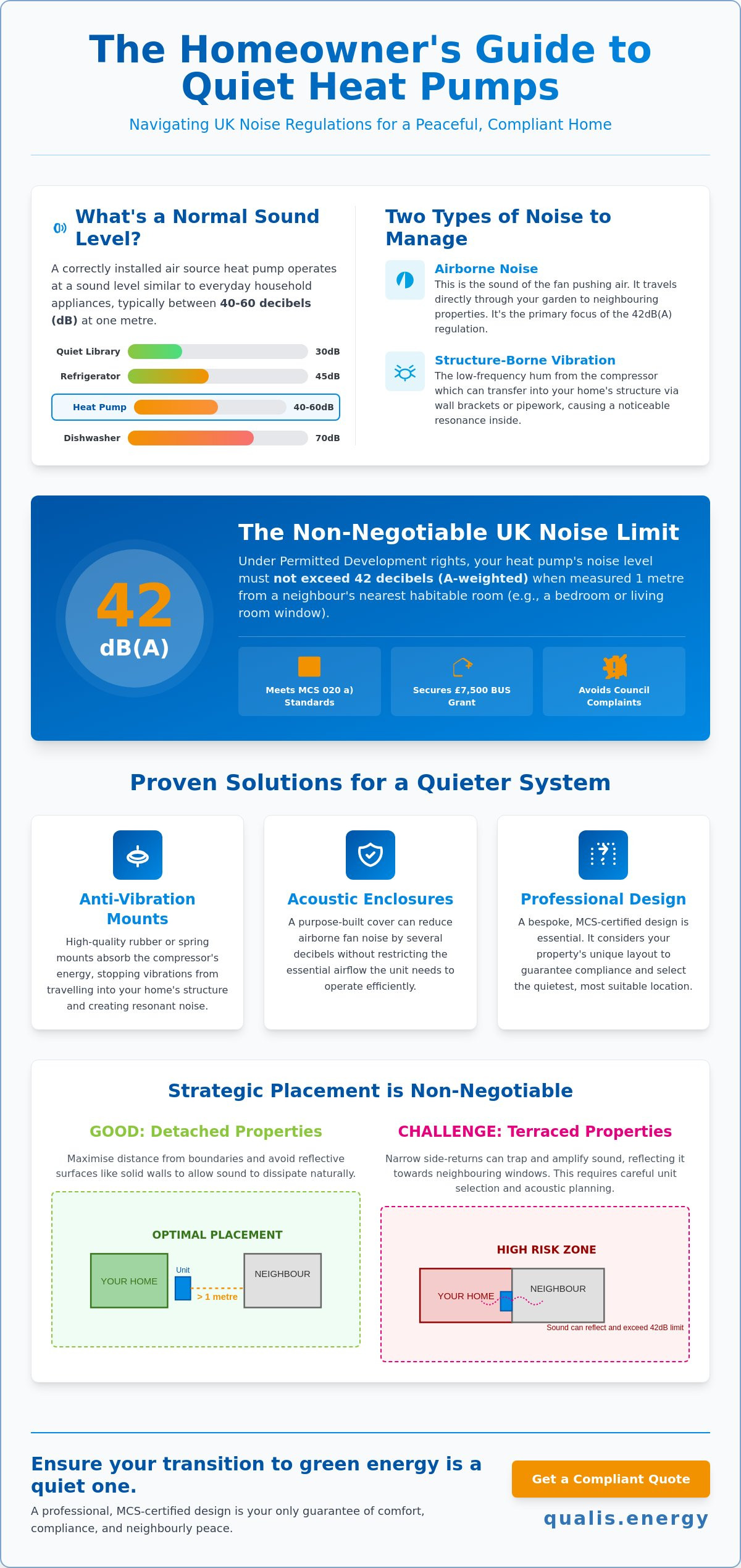
Heat pumps are sophisticated mechanical systems. They aren't silent, but they're remarkably quiet when compared to the heavy industrial machinery of the past. To understand the baseline of your system, you must first understand what an air source heat pump is and how its components interact. The sound profile you hear is a combination of two elements: a low-frequency mechanical hum from the compressor and the gentle rush of moving air generated by the fan. For most homeowners, this sound is comparable to a standard refrigerator or a modern dishwasher in mid-cycle, typically ranging between 40 and 60 decibels.
Sound levels are measurable, but perception is subjective. Modern engineering has focused heavily on reducing these decibels to ensure that green technology integrates seamlessly into our lives. When we discuss air source heat pump noise problems UK residents often worry about, we are usually referring to installations where the unit's natural operating sound hasn't been properly accounted for in the property's design. A well-installed unit should fade into the background of daily life, providing a steady, reassuring pulse of warmth without disrupting your household's peace.
Airborne Noise vs. Structure-Borne Vibration
Noise follows two distinct paths. Airborne noise is the sound that travels directly through the garden to a neighbour’s window. This is primarily the sound of the fan blades moving air. Structure-borne vibration is different; it occurs when the mechanical energy from the compressor transfers into the fabric of your building through wall brackets or pipework. If a unit isn't isolated correctly, this can create a resonance that makes a quiet unit feel much louder once you're inside. Managing these vibrations is a critical part of a professional installation programme.
The Impact of the Defrost Cycle
Winter introduces a unique acoustic profile. When temperatures drop, your unit will periodically enter a defrost cycle to clear ice from the heat exchanger. This is a functional necessity that ensures long-term efficiency. During this brief window, you might notice a change in pitch or a slight increase in volume as the unit reverses its internal process. Modern systems are designed to manage this transition discreetly amongst residential areas. Whilst the change in sound can be surprising at first, it's actually a sign of a healthy system protecting itself from the British elements. Understanding these nuances helps prevent unnecessary anxiety about air source heat pump noise problems UK winters might highlight.
UK Regulations and MCS Standards: The 42dB Threshold
Compliance is the cornerstone of a successful transition to low-carbon heating. In the UK, the legal framework for installing a unit without full planning permission falls under Permitted Development rights. To qualify, your system must adhere to the Microgeneration Certification Scheme (MCS) standards. The core requirement is that noise levels must not exceed 42 dB(A) when measured one metre from the nearest neighbour’s habitable room window. This threshold is non-negotiable. It ensures that your environmental commitment doesn't become a local disturbance.
Understanding the technicalities is vital for any homeowner. As of March 2025, the updated MCS 020 a) standard introduced a more rigorous calculation method. Whilst the legal limit remains 42 dB(A), the new calculation uses a stricter 37 dB input to account for sound power rather than just pressure. This nuance is often missed in general discussions; however, it's fundamental to securing your £7,500 Boiler Upgrade Scheme (BUS) grant. Accessing these funds requires an MCS-certified installation that proves acoustic compliance from the outset. You can find more detail in the UK government guidance on heat pump noise. Failing to meet these standards doesn't just risk your grant; it opens the door to statutory nuisance claims from the local council.
Planning Permission and Noise Assessments
Most installations proceed under Permitted Development, but specific constraints can trigger the need for formal planning permission. If your property is in a conservation area or if the unit size exceeds 1.5m³, the rules shift. A pre-installation noise assessment is the only way to guarantee peace of mind. We ensure every design we produce meets local Newark and Sheffield planning criteria, removing the guesswork for you. If you're concerned about your site's layout, it's wise to speak with an expert about a bespoke noise assessment.
Background Noise Levels: Rural vs. Urban
The environment surrounding your home dictates how sound is perceived. A 42dB hum might be unnoticeable in central Barnsley amongst the hum of traffic. That same sound can feel prominent in a quiet Nottinghamshire village at midnight. Environmental Health Officers often use the "background minus" principle to evaluate potential air source heat pump noise problems UK residents report. They look for tonal qualities, which are specific frequencies that stand out. These can trigger complaints even if you technically meet MCS decibel limits. Choosing a unit with a smooth acoustic profile is essential for maintaining harmonious relationships with your neighbours.
Noise Considerations for Different UK Property Types
Every property in the UK presents a unique acoustic landscape. Whilst detached homes offer the luxury of space, urban dwellings require a more surgical approach to placement. We don't view a smaller plot as a barrier; instead, it is a design challenge that requires technical precision. When assessing UK Regulations and MCS Standards, the geometry of your garden becomes as important as the decibel rating of the unit itself. Placement is everything. A unit positioned on a spacious detached plot can easily meet the 42dB threshold, but the same unit might struggle in a narrow side-return where sound has nowhere to go.
Hard surfaces are the enemy of acoustic comfort. Patios, brick walls, and concrete paths act as mirrors for sound waves, bouncing them back toward your property or your neighbour's windows. This "reverberation" can artificially inflate the noise level of even the quietest systems. We often recommend positioning units on soft ground or using gravel to help dissipate energy. For flats and apartments, the challenge moves to balconies or communal roofs. In these elevated positions, the lack of ground-level obstacles means sound can travel further, necessitating the use of high-specification vibration isolation to prevent the building's structure from acting like a speaker cabinet.
The Terraced House Challenge
Living in a terraced property doesn't mean you're excluded from the heat pump revolution. Some competitors claim these homes are unsuitable, but "ultra-quiet" units designed for tight spaces have changed the narrative. The primary risk in terraced environments is the "canyoning" effect, where sound waves reflect between two parallel walls in a narrow alley. We generally discourage mounting units on shared party walls to prevent vibration transfer directly into your neighbour's living space. Instead, we look for alternative locations such as the bottom of a garden or a reinforced flat roof extension to ensure air source heat pump noise problems UK homeowners fear are designed out from day one.
Acoustic "Shadows" and Reflection
Strategic positioning allows us to use the building itself as a natural sound barrier. By placing the unit in an "acoustic shadow," we use the mass of your home to block the line of sight between the fan and the neighbour's window. Whilst a solid brick wall can block noise, it can also reflect it if the unit is too close. Hedges and soft landscaping are surprisingly effective allies. Although they don't block low-frequency hums as well as a wall, they are excellent at diffusing high-frequency fan noise, breaking up the sound waves before they leave your boundary. This holistic approach ensures your transition to green energy remains a private, peaceful affair.
Proven Strategies to Reduce Heat Pump Noise and Vibration
Achieving a silent system requires a dual-track strategy. You must address both the sound moving through the air and the energy moving through the building’s fabric. Many air source heat pump noise problems UK homeowners encounter stem from a failure to separate these two distinct issues. Whilst a unit might be quiet in a laboratory, real-world performance depends on how it's anchored to your property. Mechanical isolation and acoustic shielding are the two pillars of a quiet installation. We treat every project as a bespoke engineering challenge to ensure your peace is preserved.
Vibration is energy looking for a path. If you bolt a heat pump directly to a wall bracket, that energy travels into your brickwork and manifests as a low-frequency hum inside your rooms. High-quality anti-vibration mounts, such as rubber feet or spring isolators, act as a physical break in this energy path. For the ultimate stability, we recommend an inertia base. This is a heavy concrete plinth that absorbs mechanical energy before it can travel. Using "Big Foot" frames rather than standard brackets keeps the unit off the walls entirely. Flexible pipe connectors are also essential. These prevent the unit's natural pulse from turning your central heating pipes into a resonance chamber that echoes through your home.
Mechanical Isolation Techniques
The difference between a standard installation and a professional one is often found in the mounting. Wall brackets are convenient, but they are prone to transmitting sound. We prefer ground-mounted frames that isolate the machinery from the living space. Ensuring pipework is properly clipped and lagged is another simple but vital step. This reduces "harmonic" noise, which occurs when pipes vibrate against their fixings at specific frequencies. These small technical details prevent the common rattles that can make a high-end unit sound unrefined.
Acoustic Barriers and Enclosures
Airborne noise requires a different approach. Specialised ASHP acoustic hoods can dampen decibels significantly. They must be engineered to balance sound insulation with critical airflow. If you restrict the air, you kill the efficiency. A bespoke timber screen lined with acoustic mineral wool offers a more aesthetic solution for gardens. It diffuses high-frequency fan noise whilst maintaining the necessary ventilation. Beyond the initial setup, consistent air source heat pump servicing is your best defence against mechanical rattles or loose panels that develop over time. A well-maintained system is a quiet system.
If you're ready to ensure your home's transition is as quiet as it is green, you can book a professional acoustic assessment with our team today.
Choosing a Professional Partner for a Quiet, Efficient Transition
Choosing the right partner is the final, most critical step in your journey toward sustainable heating. A "one-size-fits-all" approach is often the primary driver of the air source heat pump noise problems UK residents experience when systems aren't tailored to their specific plot. We don't just deliver hardware; we design bespoke thermal solutions that respect the unique geometry of your property. Our commitment to MCS compliance is just the starting point of our process. We believe in creating neighbour-friendly systems that uphold the highest standards of acoustic engineering. By integrating air source heat pump installation with state-of-the-art noise-minimisation technology, we ensure your journey from the initial site survey through to long-term maintenance is entirely seamless and stress-free.
The Qualis Acoustic Survey
Data drives every decision we make. Our comprehensive Qualis Acoustic Survey uses precise decibel mapping to find the perfect location for your unit, ensuring every boundary is respected and every regulation is met. We exclusively curate a selection of "Quiet Mark" certified manufacturers, including industry leaders like Mitsubishi and Vaillant, to guarantee baseline silence. This isn't just about reducing sound; it's about providing the robust documentation you need for planning compliance and absolute peace of mind. Our team handles the technical complexity so you can focus on the comfort of your home without worrying about the local council or your neighbours.
Future-Proofing Your UK Home
Building a sustainable future requires a holistic view of resource management. We often recommend combining Solar PV with your heat pump to create the ultimate low-carbon, low-noise household. This synergy allows you to generate your own power, further decoupling your home from the volatility of the energy market. Our presence in South Yorkshire, Nottingham, and Chesterfield means we're always nearby to offer ongoing support and maintenance. We take immense pride in facilitating this transition for our community, removing effort for the homeowner whilst demonstrating a long-term commitment to environmental advocacy. Your quiet, efficient future starts with a single, expert conversation.
Speak to a Qualis Energy expert today for a noise-compliant ASHP design
Securing Your Quiet Future in Sustainable Heating
Transitioning to a low-carbon home shouldn't involve a compromise on your domestic peace. By mastering the 42dB threshold and implementing advanced mechanical isolation, you can resolve the air source heat pump noise problems UK properties often face in high-density areas. We've explored how bespoke design and strategic placement transform a potentially intrusive system into a silent, efficient asset for your home. It's about more than just hardware; it's about a commitment to your long-term comfort and a harmonious relationship with your neighbours.
Our team of MCS Accredited Installers specialises in high-density urban installations across Nottinghamshire and South Yorkshire. We manage every technical detail to ensure your system remains a quiet, compliant, and welcome addition to the community. We're ready to guide you through this critical national transition with expertise and pride, removing the effort for you at every stage of the journey.
Request a Quiet-First Heat Pump Consultation
Embrace the future of home heating with the confidence that your peace of mind is fully protected.
Frequently Asked Questions
How loud is an air source heat pump compared to a gas boiler?
Modern units operate at noise levels between 40 and 60 decibels, which is comparable to a domestic refrigerator or a dishwasher in mid-cycle. Whilst a gas boiler is often located indoors and produces a quiet internal hum, a heat pump is situated outside. The sound profile is different, consisting of a steady fan whir rather than the occasional ignition click and rush of a boiler. When designed correctly, the external sound is rarely noticeable from inside the home.
Can my neighbour complain about the noise of my heat pump?
Your neighbour has the right to report a noise nuisance to the local council, but adhering to MCS 020 standards provides your strongest protection. If your installation meets the 42 dB(A) limit at their window, it's highly unlikely to be classified as a statutory nuisance. We find that most air source heat pump noise problems UK residents face are solved by proactive communication and professional acoustic mapping during the initial design phase to ensure all boundaries are respected.
Will an air source heat pump keep me awake at night?
A correctly installed system will not disrupt your sleep. The mandatory 42dB limit is measured outside your neighbour's window; by the time that sound passes through your own walls and double glazing, it's typically reduced to a level below the ambient background noise of a quiet bedroom. We use vibration isolation technology to ensure that mechanical energy doesn't enter the building's structure, keeping your internal environment peaceful and still throughout the night.
Do I need planning permission for a heat pump if it is near a boundary?
You don't usually need formal planning permission for units near a boundary in England. As of May 2025, updated Permitted Development rights allow for heat pump installations within 1 metre of a property's boundary. However, you must still meet the strict MCS noise calculations to qualify for these rights. If your property is in a conservation area or a listed building, different rules apply, so it's always best to verify your specific local requirements before proceeding.
How can I make my existing air source heat pump quieter?
Retrofitting high-quality anti-vibration mounts or a bespoke acoustic enclosure is the most effective way to quieten an existing system. Many air source heat pump noise problems UK homeowners experience are actually caused by loose panels or debris in the fan, which can be resolved through professional maintenance and servicing. Ensuring your unit is properly levelled on a heavy inertia base can also stop vibrations from resonating through the ground and into your living spaces.
Are some heat pump brands quieter than others?
Manufacturer engineering varies significantly, with some brands prioritising acoustic performance more than others. We specifically select "Quiet Mark" certified models from leading manufacturers like Mitsubishi and Vaillant because they use advanced fan blade geometry and insulated compressor compartments. These premium units are designed to operate at lower frequencies, making their sound profile much less intrusive in quiet residential neighbourhoods compared to older or budget-focused alternatives.
What is the 42dB rule for heat pumps in the UK?
The 42dB rule is the legal noise limit for installations under Permitted Development, measured one metre from the nearest neighbour's habitable room window. To prove you meet this, your installer must complete an MCS 020 calculation. Since March 2025, this calculation has become more stringent, often using a 37dB sound power input to ensure the final result at the neighbour's property never exceeds the mandatory 42 dB(A) threshold during normal operation.
Does the cold weather make heat pumps louder?
Heat pumps do work harder during a UK winter, which can lead to a temporary increase in noise. When temperatures drop, the fan may spin faster to extract more heat energy, and the unit will periodically enter a defrost cycle to clear ice from the coils. This cycle can produce a slight change in pitch or a short puffing sound. Modern units are engineered to manage these transitions smoothly, ensuring the increase in volume remains within acceptable residential limits.


Comments