
Government Grants for Solar Panels for Farms in Nottinghamshire: 2026 Funding Guide
- James

- 2 days ago
- 13 min read
With the UK officially surpassing two million solar installations in March 2026, the transition to renewable energy has moved from a quiet trend to a national standard. You have likely watched your neighbours across the East Midlands bolster their resilience whilst your own overheads, driven by the volatile cost of red diesel and grid electricity, continue to squeeze margins. Finding clear information on government grants for solar panels for farms Nottinghamshire can feel like a full-time job, especially when the landscape shifts faster than the seasons. We understand that you need more than just vague promises; you need a strategic roadmap to energy independence that respects your time and your bottom line.
It is frustrating to see major funding pots like the Improving Farm Productivity Grant close just as you are ready to invest. We agree that the bureaucracy of DEFRA and the uncertainty of rural grid connections should not stand in the way of your farm's future. This guide will help you discover the latest 2026 agricultural incentives, including the 0% VAT rate on energy-saving materials and upcoming land management opportunities, to help Nottinghamshire farms transition to solar energy and slash overheads. We will examine the shift from direct subsidies to long-term tax benefits, ensuring you have the expertise to demonstrate environmental stewardship to your entire supply chain.
Key Takeaways
Recognise why 2026 marks a pivotal shift for agricultural energy, moving from simple subsidies to strategic investments in high-capacity Solar PV and battery storage infrastructure.
Uncover how local councils distribute the Rural England Prosperity Fund and the impact this has on securing government grants for solar panels for farms Nottinghamshire.
Leverage the 0% VAT rate on energy-saving materials to achieve significant upfront savings whilst navigating the competitive, time-limited windows of national funding schemes.
Clarify the essential compliance requirements you must meet, including VAT registration status and the necessity of an up-to-date Energy Performance Certificate for farm dwellings.
Streamline your path to energy independence by following a logical application process that prioritises professional feasibility studies and competitive, accredited quotes.
Table of Contents
The 2026 Landscape for Agricultural Solar in Nottinghamshire
2026 is the year the agricultural sector moves beyond trial projects into full-scale energy independence. Securing government grants for solar panels for farms Nottinghamshire has become a priority for businesses looking to de-risk their operations. With the UK solar power landscape reaching a record 22.1 GW capacity in March 2026, the momentum is undeniable. Nottinghamshire farmers are increasingly looking at their land and buildings as power stations. This shift is driven by a need to lock in energy costs. Electricity prices and the cost of red diesel have become too unpredictable for traditional budgeting. Solar provides a fixed-cost solution that pays dividends for decades. It's a move from being a passive consumer to an active producer of a critical resource.
Why Nottinghamshire Farms are Favouring Solar
Nottinghamshire's agricultural landscape is uniquely suited for this transition. The county enjoys higher solar irradiance than many northern regions; this makes it a prime location for high-yield generation. Barns and outbuildings represent thousands of square metres of untapped asset space. Installing Solar PV on these existing structures avoids the loss of productive land whilst generating significant energy. Beyond the immediate financial favour, there is the growing pressure from supermarket supply chains. Major retailers now demand clear evidence of environmental stewardship and 'Net Zero' progress. Solar is the most visible way to demonstrate this commitment whilst simultaneously protecting your profit margins from market behaviour.
Defining Agricultural Solar Grants in 2026
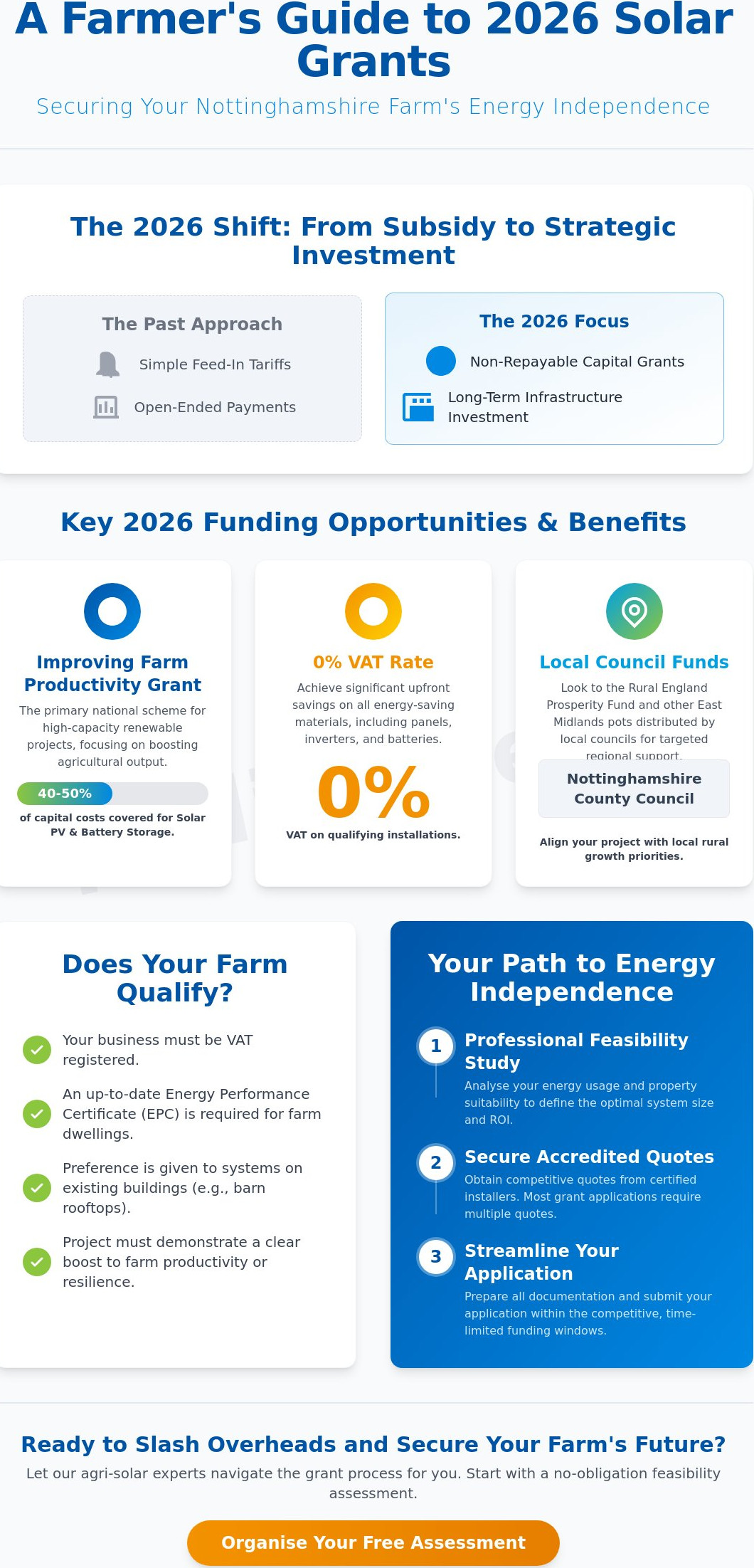
Understanding the technicalities of funding is crucial for a successful project. In 2026, the focus has shifted from simple feed-in tariffs to non-repayable capital contributions. These grants are designed to cover a portion of the upfront costs for renewable technology, including Solar PV and Battery Storage. Whilst national DEFRA schemes provide a broad foundation, local East Midlands pots often focus on rural prosperity and specific regional growth. Navigating government grants for solar panels for farms Nottinghamshire involves identifying which of these overlapping funds best fits your specific acreage and energy demand. The Improving Farming Scheme serves as the primary 2026 vehicle for providing capital grants to farms looking to upgrade their productivity through renewable energy. This infrastructure-focused approach ensures that public money builds long-term resilience rather than just offering a temporary fix for high bills.
Key Government Grants for Solar Panels for Farms in 2026
Securing government grants for solar panels for farms Nottinghamshire requires a proactive approach to the current funding calendar. Whilst the landscape for direct subsidies has become more competitive, the financial framework for 2026 remains robust for those who prepare early. The government has transitioned away from open-ended payments towards targeted capital injections that treat renewable energy as essential infrastructure. This means Nottinghamshire farms must align their energy goals with specific national and regional priorities to access non-repayable funding. By integrating these grants into a broader financial strategy, rural businesses can effectively eliminate the barrier of high upfront costs.
The Improving Farming Scheme: Solar Specifics
The primary vehicle for national support is the Improving Farm Productivity grant, which continues to shape the 2026 investment cycle. This scheme is specifically designed to support high-capacity renewable projects that demonstrate a clear boost to agricultural output. In 2026, intervention rates for solar-specific projects typically sit between 40% and 50% of the total capital costs. This represents a substantial contribution towards the panels, inverters, and necessary battery storage systems. For the current year, there is a clear preference for rooftop PV systems on existing barns and cold stores, as they preserve productive land whilst providing immediate power to energy-intensive operations. If you are planning a high-capacity installation, consulting with a specialist in commercial Solar PV ensures your project meets the technical standards required for these rigorous funding rounds.
Local Nottinghamshire Funding Pots
Regional support often provides the missing piece of the financial puzzle. The East Midlands Combined County Authority plays a vital role in how the Rural England Prosperity Fund (REPF) is distributed across our county. For farms in Newark, Mansfield, and Bassetlaw, local councils are prioritising grants that support rural business resilience and carbon reduction. These pots are often smaller than national DEFRA schemes but come with more flexible criteria for local enterprises. The Mayoral Renewables Fund is also emerging as a key supporter of the agricultural transition, specifically targeting projects that strengthen the local grid. It is essential to engage with your local district council early; they often have specific windows for "green business" capital grants that can be stacked with national tax incentives like the 0% VAT rate on energy-saving materials.
Generating your own power also opens the door to the Smart Export Guarantee (SEG). This is not a grant, but a mandatory tariff that ensures you earn revenue for every unit of excess solar energy you feed back into the grid. When combined with government grants for solar panels for farms Nottinghamshire, the SEG shortens the payback period significantly. It transforms your outbuildings from a cost centre into a consistent revenue stream, providing a hedge against the volatile market behaviour seen in the wider energy sector. This dual approach of capital grants and ongoing export income creates a stable foundation for long-term farm profitability.
Eligibility Criteria: Does Your Farm Qualify for Funding?
Many online resources confuse agricultural support with domestic energy schemes like ECO4. For a working farm, the criteria for government grants for solar panels for farms Nottinghamshire are strictly commercial. You aren't being assessed on household benefits; you're being assessed as a productive business entity. This distinction is vital. To access 2026 funding, your farm must operate as a VAT-registered business. Most schemes also require a minimum land holding, typically around five hectares, to ensure the project supports a genuine agricultural enterprise rather than a purely residential setup.
Compliance is the foundation of any successful application. An up-to-date Energy Performance Certificate (EPC) for your farm office or associated dwellings is often a mandatory benchmark. It provides the data needed to prove how solar will improve your operational efficiency. Furthermore, MCS accreditation for your installer is a non-negotiable requirement. Without this certification, your project will fail the initial screening process for almost any national or local grant. You must also demonstrate a clear link between the installation and your farm's productivity. This involves showing how solar energy will power specific agricultural processes, such as cold storage, grain drying, or automated milking systems, whilst reducing your long-term carbon footprint.
Technical Eligibility and Grid Constraints
Technical readiness is just as important as your financial paperwork. A G99 grid connection offer from the District Network Operator (DNO) is frequently required before a grant is even considered. This document proves that the local grid can handle the energy your system will produce. A professional feasibility study is another essential component for 2026 funding rounds. It acts as your project's blueprint, outlining the expected yield and return on investment. We've found that including Battery Storage in your proposal significantly strengthens an application. It shows the grant body that you're committed to maximising self-consumption and reducing your reliance on the national grid during peak times.
Financial and Regulatory Compliance
UK subsidy control rules are strict regarding the financial health of applicants. Your business must not be classified as an "undertaking in difficulty," meaning you must show a stable financial history to receive public funds. Perhaps the most critical regulation is the 'Additionality' rule. You cannot start any work, pay a deposit, or sign a binding contract before your grant has been officially awarded. If you jump the gun, you'll likely find your application rejected immediately. For a detailed look at the procurement process, you can explore our guide on Solar Panels for Business in Nottingham & Sheffield. Following these logical steps ensures that your journey towards energy independence is fully compliant and protected.
How to Apply: Navigating the 2026 Grant Process
Preparation is your strongest asset. Securing government grants for solar panels for farms Nottinghamshire is a logical but demanding journey that requires a proactive approach to documentation. You cannot simply decide to install and expect a cheque; you must build a robust business case that aligns with national productivity goals. The process is designed to ensure that public money supports viable, long-term infrastructure. By following a structured roadmap, you move from the conceptual phase to a fully funded reality with confidence.
The application journey follows five critical stages:
Step 1: Conduct a professional solar audit and feasibility study. This provides the data on energy yield and carbon savings that grant assessors demand.
Step 2: Obtain three competitive quotes from MCS-accredited installers. This ensures transparency and proves that your project offers fair market value.
Step 3: Secure planning permission or Lawful Development Certificates from your local council. This removes a major barrier to the Grant Funding Agreement.
Step 4: Submit your online application through the Rural Payments service. This portal is the primary gateway for DEFRA-led funding.
Step 5: Await the Grant Funding Agreement (GFA). You must have this document in hand before you purchase any equipment or sign a binding contract.
Nottinghamshire Planning Considerations
Local planning nuances can often slow a project down if they aren't managed early. Whilst many agricultural buildings fall under 'Permitted Development' rights for solar, councils like Rushcliffe or Ashfield may require a formal prior notification. This is particularly true if your farm is located within a Green Belt or a conservation area. If your barns are near Grade I or II listed buildings, a heritage statement will be essential to address any concerns regarding visual impact. Managing these local requirements early ensures that your application for government grants for solar panels for farms Nottinghamshire isn't delayed by red tape at the district level.
Maximising Your Application Success
Success in a competitive funding round depends on how well you articulate the benefits of your project. You must craft a compelling case for 'Business Productivity' by showing exactly how solar will allow your farm to grow or diversify. Aligning your proposal with the Nottinghamshire Local Nature Recovery Strategy can also provide a scoring advantage, as it demonstrates a commitment to the wider regional environment. Ultimately, the government's primary scoring metric is 'Value for Money,' so your application must prove that the public investment will deliver significant, measurable results for years to come. To ensure your project meets these high standards, contact our team for a professional solar audit and start your application on the right foot.
Qualis Energy: Expert Agri-Solar Partners in Nottinghamshire
Energy independence is now essential. At Qualis Energy, we act as your visionary facilitators, bridging the gap between complex industrial technology and the practical needs of your farm. We provide the technical expertise and grounded professionalism required to successfully navigate the requirements for government grants for solar panels for farms Nottinghamshire. From the initial conceptual feasibility study to the final implementation of high-capacity Solar PV and integrated Battery Storage, our team manages every step. We don't just install equipment; we build long-term resilience for rural businesses. Our end-to-end capability ensures that your journey is fully mapped out, removing the stress of technical compliance and project management.
Our approach is defined by a commitment to a larger mission. We understand that agricultural operations have unique power demands that standard installers often overlook. Whether you're managing intensive livestock units or large-scale cold storage, our specialist knowledge ensures your system is designed for maximum self-consumption. Once your installation is complete, our ongoing Maintenance & Servicing ensures your grant-funded investment performs at peak capacity for decades. We take pride in our role as community-focused advocates, helping you demonstrate environmental stewardship to your entire supply chain whilst significantly reducing your operational overheads.
Why Local Expertise Matters
Nottinghamshire’s rural landscape presents specific technical and regulatory challenges. We possess deep familiarity with East Midlands grid constraints and maintain proactive relationships with local District Network Operators (DNOs). This local insight is vital when securing the grid connection offers mentioned in previous sections. Our proven track record across Newark, Mansfield, Retford, and the wider county allows us to anticipate hurdles before they arise. For a broader perspective on the changing sector, explore our Renewable Energy in the UK: 2026 Guide to see how clean infrastructure is reshaping the national agricultural economy.
Take the Next Step for Your Farm
Securing government grants for solar panels for farms Nottinghamshire requires precise, high-level technical documentation. We remove the effort for you by providing the detailed audits, yield projections, and feasibility reports that grant assessors demand. Our team is proactive and highly organised, ensuring your application stands out for its technical rigour and clear value for money. We manage the granular details of project management so you can focus on running your farm. Don't let complex bureaucracy stall your progress towards a more profitable future. Book a site survey to assess your farm's solar potential today and let us handle the technical heavy lifting on your behalf. Contact Qualis Energy to start your solar transition and secure your farm’s energy future.
Securing Your Farm's Legacy through Renewable Infrastructure
The transition to a cleaner, more resilient agricultural sector is no longer a distant goal; it's a present-day necessity. Energy independence is your shield. By navigating the current landscape of government grants for solar panels for farms Nottinghamshire, you are doing more than just cutting costs. You're building a foundation that protects your margins from global market volatility. We have explored the shift towards capital-intensive funding and the vital importance of technical readiness. These steps ensure your farm remains a leader in environmental stewardship whilst satisfying the rigorous demands of modern supply chains.
Our local Nottinghamshire support team is ready to guide you through this critical national transition. We lead the way. As MCS accredited installers and specialists in commercial and agri-solar, we provide the expert hand needed to manage every technical detail on your behalf. We remove the effort from the application process, ensuring your project meets every regulatory benchmark. Secure your farm's energy future with Qualis Energy – Book a site survey today. Taking this step now ensures your business is prepared for the opportunities of 2026 and beyond. Your journey towards a sustainable, self-sufficient enterprise starts with a single, decisive action.
Frequently Asked Questions
Can I get a grant for solar panels if I'm a tenant farmer in Nottinghamshire?
Tenant farmers can certainly apply for funding, provided they have written agreement from their landlord and a secure tenancy that extends beyond the grant's monitoring period. Assessing your eligibility for government grants for solar panels for farms Nottinghamshire involves ensuring your lease matches the multi-year requirements of DEFRA or local authority schemes. This partnership between tenant and landlord is essential for securing long-term clean infrastructure on the holding.
How much of the total solar installation cost will a 2026 grant cover?
Previous intervention rates for schemes like the Improving Farm Productivity grant reached 25%, but local or future 2026 windows may offer different levels of support. Most agricultural grants aim to cover a significant portion of capital expenditure, including panels and battery storage. These rates are designed to bridge the gap between traditional energy costs and the initial investment required for high-capacity renewable technology, ensuring your farm's transition is financially viable.
Do I need planning permission for ground-mounted solar panels on my farm?
Ground-mounted solar installations almost always require full planning permission from your local district council. Unlike rooftop systems, which frequently benefit from Permitted Development rights, ground-mounted arrays have a larger visual and environmental impact on the landscape. We recommend engaging with councils like Newark and Sherwood early to manage these requirements and ensure your project adheres to local land-use policies and heritage considerations.
Is the Smart Export Guarantee (SEG) considered a government grant?
The Smart Export Guarantee is not a grant; it's a mandatory payment system where energy suppliers buy your surplus electricity. Whilst grants provide upfront capital to help with the installation of government grants for solar panels for farms Nottinghamshire, the SEG provides a continuous revenue stream. This ensures that every unit of energy your farm generates but doesn't consume contributes to your long-term financial resilience and shortens your payback period.
Can I combine multiple grants for the same solar project?
You generally cannot use two different government grants to fund the same specific piece of equipment due to strict "double funding" rules. However, you can often stack a capital grant with tax-based incentives like the 0% VAT rate or capital allowances. This strategic combination allows you to maximise the financial support available whilst remaining fully compliant with UK subsidy control regulations and regional funding criteria.
What happens if my grant application is rejected?
If your application is unsuccessful, you'll typically receive feedback outlining why it failed to meet the specific scoring criteria. You can often address these technical or financial points and reapply during the next funding window. Rejection is frequently a matter of timing or incomplete documentation rather than project viability; we help you refine your proposal to ensure it meets the highest standards for future rounds.
Do I have to pay the VAT on solar panel installations for my farm?
A 0% VAT rate on energy-saving materials, including solar panels and battery storage, has been extended through 2026. This represents a significant upfront saving for your business, as you don't have to pay the standard 20% VAT on the installation. It's a proactive government measure designed to accelerate the adoption of clean technology across the UK's agricultural landscape and reduce the barrier to entry.
How long does the application process typically take for agricultural grants?
The timeline from initial application to receiving a Grant Funding Agreement typically spans three to six months. This period allows for a thorough assessment of your feasibility study, financial standing, and technical specifications. Because you cannot start work before the grant is awarded, we advise beginning the planning and audit phase at least half a year before your intended installation date to avoid delays.


Comments