
Air Source Heat Pump Price Guide: 2026 Costs for Nottingham & Sheffield
- James

- May 6
- 12 min read
Updated: May 10
Last year, 125,037 UK homeowners made the switch to renewable heating, marking a 27% surge in adoption that signals the definitive end of the gas boiler era. We understand that whilst the vision of a greener home is inspiring, the reality of calculating an accurate air source heat pump price in 2026 often feels clouded by shifting grant levels and the fear of hidden costs for radiator upgrades. You're likely tired of vague national quotes that don't account for the specific architectural character of Nottingham and Sheffield properties. At Qualis Energy, we believe in holding high the renewable energy flag by providing the technical clarity you need to make an informed investment.
This guide provides a transparent breakdown of what East Midlands residents can expect to pay, including the current £7,500 Boiler Upgrade Scheme grant and the temporary £9,000 boost for oil or LPG users arriving in July 2026. We'll explore the total investment from initial survey to final handover, ensuring you understand the real-world ROI whilst promising that you won't need to lift a finger throughout the process. You'll discover how local design precision eliminates hidden pipework fees and why domestic manufacturing is finally making low-carbon comfort accessible for every household in our community.
Key Takeaways
Understand the comprehensive air source heat pump price by looking beyond the hardware to include bespoke system design and our promise of a friction-free installation.
Learn how to secure the £7,500 Boiler Upgrade Scheme grant or the temporary £9,000 uplift to significantly lower your initial capital outlay.
Determine which technical upgrades, such as larger radiators or thermal stores, are essential for maintaining comfort in older East Midlands properties.
Explore how Sheffield’s unique geography and the local climate impact your system’s seasonal performance and long-term energy savings.
Gain clarity on the 2026 ROI by comparing modern electricity tariffs against traditional fossil fuel costs and the long-term value of professional maintenance.
Understanding the Investment: Air Source Heat Pump Prices in 2026
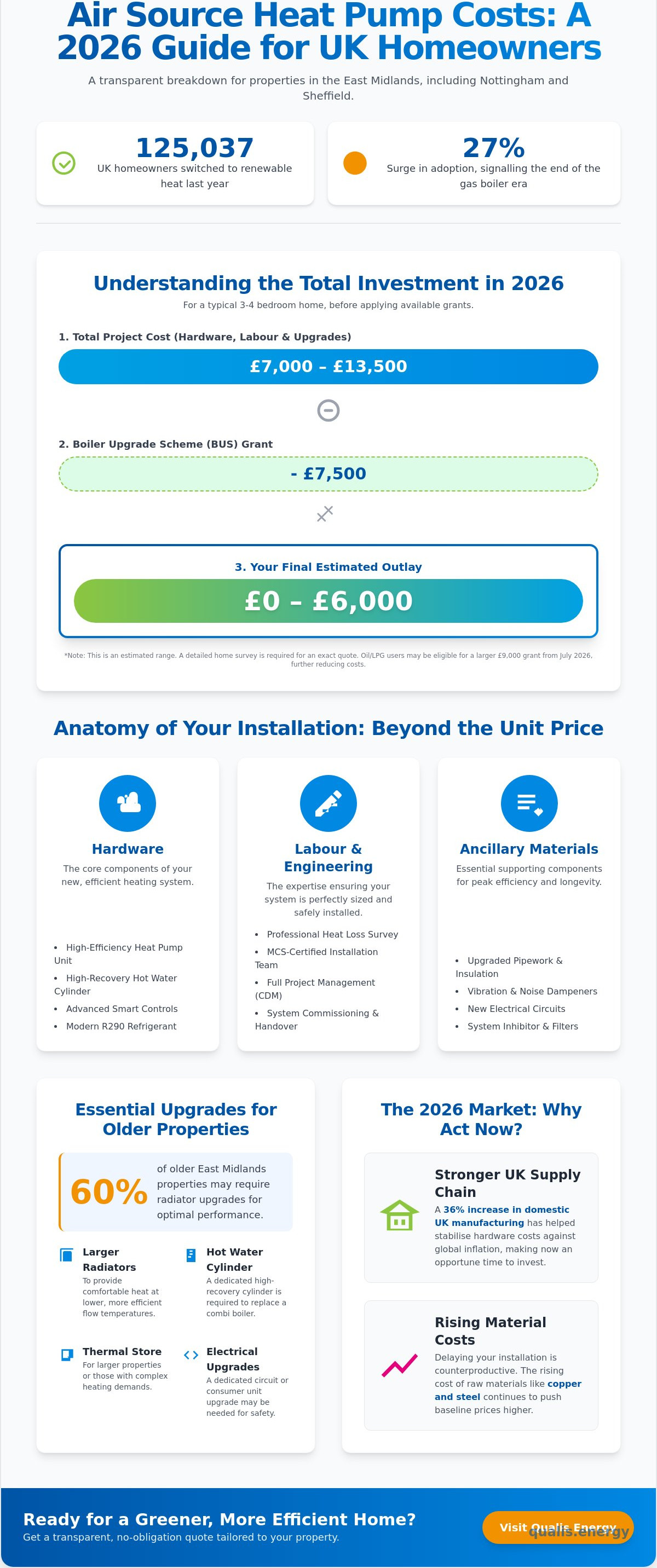
The national transition is no longer a distant goal; it's a present reality. In 2026, the average air source heat pump price for a typical three to four bedroom home in the UK ranges from £7,000 to £13,500 before the £7,500 Boiler Upgrade Scheme grant is applied. Whilst some providers tempt homeowners with a low 'sticker price', these quotes often ignore the essential system upgrades required for long-term reliability. We believe in total transparency. Our turnkey service means we handle every technical hurdle, from G98 applications to CDM project management, so you won't need to lift a finger whilst we transform your home's energy profile.
This year, the market has pivoted toward units using high-efficiency, natural refrigerants like R290. These advanced systems are designed to operate at higher temperatures, ensuring they can heat even the draughtiest Victorian terrace in Sheffield. Understanding how air source heat pumps work is the first step in appreciating why these units carry a slightly higher upfront cost but deliver vastly superior seasonal performance. By investing in the right technology today, you're securing your home against the volatility of future energy markets and holding high the flag for a sustainable future.
What makes up the total project price?
Your investment is split across three core pillars. First, the hardware, which includes the pump itself, a high-recovery cylinder, and advanced controls. Second, the labour and engineering expertise; a professional heat loss survey is the only way to ensure your system isn't wasting electricity. Finally, ancillary materials like upgraded pipework and insulation are vital. These components work together to ensure your system runs at peak efficiency, rather than just 'getting by' during a cold snap. We manage this entire journey, moving you logically from the initial design phase through to final handover.
The 2026 market outlook for the East Midlands
Regional pricing in Nottingham and Sheffield is currently shaped by improved supply chain stability. In 2026, a 36% increase in domestic UK manufacturing has helped mitigate the impact of global inflation on hardware costs. Whilst there is healthy competition amongst local installers, the high demand for skilled MCS-certified engineers means labour rates are unlikely to fall. Delaying your installation in hopes of a price drop is often counterproductive, as the rising cost of raw materials like copper and steel continues to push the baseline higher. Acting now allows you to lock in current grant levels and start seeing a return on your investment immediately.
The Anatomy of Installation Costs: Beyond the Unit Price
The hardware is merely the heartbeat of a much larger ecosystem. When calculating the total air source heat pump price, it's vital to look beyond the unit sitting in your garden. For homeowners in Nottingham suburbs like West Bridgford or Sherwood, the transition often requires a fundamental rethink of the home's internal distribution. Traditional gas boilers typically circulate water at 70°C, but heat pumps operate most efficiently at lower flow temperatures. This technical reality means that roughly 60% of older properties require larger radiators or high-output K3 models to maintain domestic comfort whilst keeping running costs low.
The infrastructure shift doesn't stop at the walls. Most modern homes in Sheffield have moved away from hot water cylinders in favour of combi boilers, yet a heat pump requires a dedicated high-recovery cylinder to provide consistent hot water. In some larger Victorian residences amongst the hills of the Peak District, we may even specify a thermal store to manage complex heating loads. There's also the often-overlooked electrical work. A heat pump draws significant current, sometimes necessitating a consumer unit upgrade or a new dedicated circuit to ensure your home's wiring is compliant with 2026 safety standards.
Retrofitting vs. New Build installations
Project complexity varies wildly based on your property's age and construction. Retrofitting a 1930s semi-detached in Barnsley involves lifting floorboards and potentially resizing pipework, which naturally carries a higher labour cost than a straightforward new build installation in Worksop. We also factor in 'making good' costs, such as plastering or joinery repairs, to ensure the finish matches the high standard of the technology itself. For those looking to maximise their energy independence, combining this work with solar panels and installation can significantly reduce the long-term running costs of the entire system.
Regulatory and compliance costs
Expertise carries a premium for a reason. To access the Boiler Upgrade Scheme grant, your installation must be MCS-certified, ensuring the system is designed to meet strict performance and safety criteria. We also handle the essential G98 and G99 DNO applications. These are regulatory notifications to the local electricity network operator, confirming that your home's connection can handle the new load. This administrative burden is part of our commitment to a turnkey experience; we manage the paperwork so you can focus on your family. If you're ready to see how these details apply to your home, you can request a bespoke technical survey from our team today.
Financial Support and Grants: Reducing the Upfront Burden
The future of domestic heating is subsidised. In 2026, the national commitment to net zero has made the air source heat pump price more accessible than ever before. Currently, the Boiler Upgrade Scheme (BUS) provides a £7,500 grant for most homeowners, but from July 2026, this figure increases to £9,000 for properties in rural Nottinghamshire or the Sheffield fringes currently relying on heating oil or LPG. This financial bridge is bolstered by the 0% VAT rating on energy-saving materials, a policy that effectively removes hundreds of pounds from your final invoice. We manage every aspect of these applications, ensuring you receive the maximum support without having to navigate the bureaucratic maze yourself.
Financial planning for a low-carbon home involves more than just grant hunting. You should also consider how regional 'green' lending products and modern electricity tariffs interact with your investment. According to the Energy Saving Trust guide to heat pumps, the efficiency of these systems leads to substantial long-term savings, particularly when replacing older, inefficient electric or fossil fuel systems. By holding high the renewable energy flag, we help our neighbours in Sheffield and Nottingham secure their energy future whilst protecting their household budgets from the volatility of gas prices. It's about moving from technical complexity to domestic comfort without the friction.
Maximising the Boiler Upgrade Scheme in 2026
To qualify for the BUS, your property must have a valid Energy Performance Certificate (EPC) with no outstanding recommendations for loft or cavity wall insulation. This ensures the heat pump operates at peak efficiency once installed. Once we've completed your technical survey, we apply for the voucher on your behalf. The process is streamlined; approval typically takes between 14 and 28 days, meaning it won't significantly delay your installation timeline. Our turnkey approach means we handle the digital voucher redemption, so the grant is simply deducted from your final quote.
Financing your transition to clean energy
If the upfront cost remains a concern, several 0% APR finance options are now available for residential heat pump installations in 2026. Many high-street lenders also offer 'Green Mortgages', providing lower interest rates or additional borrowing specifically for energy improvements. When you factor in the reduced running costs, the monthly savings on your energy bills often go a long way toward covering the finance repayments. It's a logical path from inspiration to implementation, turning a necessary home upgrade into a smart financial partnership that benefits both your pocket and the planet.
Local Considerations for Nottingham and Sheffield Homeowners
Geography dictates design. In the East Midlands, our damp, temperate winters mean a heat pump must be sized with precision to maintain a high Seasonal Coefficient of Performance (SCOP). A system that works in Cornwall may struggle on a frosty morning in the Hope Valley. This regional nuance directly influences the air source heat pump price, as we often specify slightly larger evaporators to ensure efficiency doesn't dip when the temperature does. We understand these local microclimates, from the sheltered streets of Nottingham to the exposed ridges of the Peak District.
Sheffield presents a unique challenge: the hills. Navigating steep driveways and varied elevations in areas like Crookes or Walkley requires more than just a delivery van. It demands meticulous logistics and sometimes specialised lifting equipment. Local expertise is vital here. Searching for heat pump installers near me ensures you're partnering with a team that has already solved the puzzle of your specific street's topography. We take pride in being a local hero, holding high the renewable energy flag whilst managing these logistical hurdles so you won't need to lift a finger.
Property types and their price profiles
Your home's era defines its thermal personality. Victorian and Edwardian terraces, common in Chesterfield and Nottingham, often have solid brick walls that require more energy to heat. The air source heat pump price for these archetypes typically includes the cost of high-temperature units to compensate for higher heat loss. Conversely, post-war semi-detached houses in Rotherham and Doncaster are the 'sweet spot' for value; they often have cavity walls that are easily insulated, allowing for standard, cost-effective models. For those in modern Newark estates, integrated systems are often the most affordable route, as these homes are built with low-temperature heating in mind from the ground up.
Local grid capacity and DNO factors
The electrical infrastructure under our feet plays a silent but critical role. In Nottinghamshire, we work closely with National Grid Electricity Distribution to ensure your home's connection is robust enough for a new heating load. Occasionally, a local substation might be near its capacity, which can add complexity to the G99 application process. Our deep knowledge of the East Midlands energy grid allows us to navigate these constraints proactively. We manage the entire dialogue with the DNO, moving you logically from the initial check to final approval. If you want a system designed specifically for the East Midlands, book your local site assessment with our expert engineers today.
Long-term Value: Running Costs, Maintenance, and the Qualis Approach
The true value of your investment reveals itself long after the initial installation is complete. In 2026, the air source heat pump price is increasingly offset by the widening gap between fossil fuel volatility and the stability of renewable energy tariffs. Whilst gas prices remain subject to global geopolitical shifts, electricity is increasingly powered by domestic wind and solar, making the running costs of a heat pump far more predictable. For those seeking the pinnacle of engineering and long-term reliability, we often recommend Mitsubishi heat pump air source systems. These units are celebrated for their longevity and exceptional performance in the British climate, providing a robust foundation for your home's energy future.
We don't just install hardware; we facilitate a national transition. At Qualis Energy, our role is that of a visionary facilitator, moving you from the uncertainty of old technology to the confident embrace of a low-carbon lifestyle. We hold high the renewable energy flag by offering a partnership that lasts the lifetime of your system. This means providing a narrative of completeness where every technical detail is managed by our experts. You won't need to lift a finger whilst we ensure your system operates at peak efficiency for decades to come, protecting both your domestic comfort and the planet's future.
Calculating your ROI in 2026
Financial returns are measured in more than just monthly pennies. For a typical three-bedroom semi-detached home in Mansfield, verified 2026 data suggests annual running costs range between £855 and £1,700, depending on your home's insulation and energy demands. Beyond these direct savings, the 'Carbon Value' of your home increases as the UK moves toward its 2030 targets. In the Sheffield property market, homes equipped with low-carbon heating systems are seeing a measurable appreciation in value, as savvy buyers prioritise energy security and green credentials over traditional boiler setups. It's a smart investment that pays dividends in both capital growth and environmental impact.
Maintenance: Protecting your 25-year investment
A heat pump is a precision instrument that requires professional care to maintain its manufacturer's warranty. Standard annual servicing is often simpler and more cost-effective than traditional gas boiler repairs, focusing on cleaning the evaporator coils, checking refrigerant levels, and optimising the control settings. Our maintenance packages provide Nottinghamshire families with total peace of mind, ensuring that minor adjustments prevent major issues. From the initial survey and design phases through to 24/7 technical support, our promise is one of unwavering reliability. We manage the granular details of project management and ongoing care so you can focus on what matters most, like looking after the children or enjoying your comfortable, carbon-neutral home.
Secure Your Home’s Energy Future Today
The transition to low-carbon heating is no longer a future prospect; it's a strategic choice for the modern homeowner. We've explored how the air source heat pump price in 2026 reflects a comprehensive shift from outdated fossil fuels to high-performance technology that protects your household budget. By understanding the interplay between regional climate factors in the East Midlands and the available financial incentives, you can move from inspiration to implementation with absolute confidence. Our team of MCS Accredited Installers specialises in complex East Midlands property retrofits, ensuring your system is designed for the specific demands of your home.
As your visionary facilitator, we provide a full turnkey service that includes expert grant management, so you won't need to lift a finger. We're here to hold high the renewable energy flag alongside you, transforming technical complexity into everyday domestic comfort. The era of the gas boiler is fading; the age of clean, efficient energy has arrived. It's time to join the 125,037 households that led the national transition last year.
Book your bespoke 2026 heat pump survey with Qualis Energy today and take the first step towards a warmer, greener home.
Frequently Asked Questions
How much does an air source heat pump cost for a 3-bedroom house in Nottingham?
The average air source heat pump price for a 3-bedroom house in Nottingham typically ranges from £7,000 to £13,500 before government incentives are applied. This total investment covers the outdoor unit, a high-recovery cylinder, and professional installation. For smaller properties, the final cost after the £7,500 grant can be as low as £500 to £2,500, depending on the complexity of the existing pipework.
Is the £7,500 Boiler Upgrade Scheme grant still available in 2026?
Yes, the Boiler Upgrade Scheme (BUS) remains a cornerstone of the UK's energy strategy in 2026 with a confirmed grant of £7,500. For residents in the East Midlands currently using heating oil or LPG, a temporary increase to £9,000 is available between July 2026 and March 2027. We manage the entire application process on your behalf, ensuring you won't need to lift a finger to secure this funding.
Will I need to replace all my radiators to install a heat pump in a Sheffield terrace?
You likely won't need to replace every radiator, but our technical surveys show that approximately 60% of radiators in older Sheffield terraces require resizing. This is because heat pumps operate at lower flow temperatures than traditional boilers. Upgrading to high-output K3 radiators ensures your home stays warm whilst the system maintains its peak efficiency during the coldest winter months.
How do air source heat pump running costs compare to a gas boiler in 2026?
Annual running costs for an air source heat pump in 2026 are estimated between £855 and £1,700, which is increasingly competitive against gas boilers. Whilst gas prices remain volatile, the high efficiency of a heat pump means it can produce three to four units of heat for every one unit of electricity used. This efficiency, known as the Coefficient of Performance, is what drives the long-term ROI for Nottinghamshire families.
Can I install an air source heat pump if I live in a conservation area in Newark?
Installing a heat pump in a Newark conservation area is entirely possible, though it often requires specific planning permission rather than falling under Permitted Development. We have extensive experience navigating local planning requirements and can provide the necessary technical drawings and noise assessments. Our turnkey service ensures all heritage considerations are met without compromising the system's performance or your home's aesthetic.
What is the typical payback period for an ASHP installation in the East Midlands?
The payback period varies based on the fuel you're replacing; those switching from oil or LPG often see a return on investment within 5 to 8 years. For gas users, the ROI is further bolstered by the 0% VAT rating on energy-saving materials and the projected appreciation in property value. In the 2026 Sheffield market, low-carbon heating is a significant asset that attracts energy-conscious buyers.
Does Qualis Energy offer finance options for heat pump installations?
Qualis Energy facilitates access to several 0% APR finance options and works alongside lenders providing 'Green Mortgages' for residential upgrades. These partnerships allow you to spread the air source heat pump price over manageable monthly repayments that are often offset by your energy bill savings. We view this as a financial partnership, helping you invest in your home's future without an immediate capital burden.
What happens if the temperature drops below freezing in Chesterfield?
Modern heat pumps are engineered to operate effectively even when temperatures in Chesterfield drop to -20°C. Units using advanced refrigerants like R290 maintain high flow temperatures regardless of the frost outside. We design every system with a specific 'bivalent point' to ensure your home remains a sanctuary of domestic comfort even during the most severe East Midlands cold snaps.


Comments