
ASHP Installation in Nottingham & Sheffield: A 2026 Step-by-Step Guide
- James

- 5 days ago
- 12 min read
What if your home's heating system didn't just fight the Nottinghamshire chill, but actively contributed to a cleaner, more resilient UK energy grid? The traditional gas boiler is no longer the heart of the British home; it's a relic of a carbon-heavy past. We understand that the prospect of an ASHP installation brings questions about winter performance in Sheffield and the complexity of the £7,500 Boiler Upgrade Scheme (BUS) paperwork. You want the comfort of a warm lounge without the stress of managing technical jargon or radiator upgrades yourself.
This guide empowers you to master the transition from initial property survey to final commissioning. We'll show you how to leverage the 0% VAT rate available until March 2027 and navigate the new 2026 MCS quality standards to ensure your investment delivers maximum ROI. From securing government grants to the moment we hand over your bespoke energy system, we're here to hold high the renewable energy flag for your household. You'll discover exactly how we manage the entire project so you don't have to lift a finger, moving your property from outdated infrastructure to visionary efficiency.
Key Takeaways
Understand why homeowners in Nottingham and Sheffield are leading the UK’s energy transition by adopting low-carbon heating solutions that future-proof their properties.
Learn how bespoke heat loss calculations and insulation assessments ensure your home remains perfectly warm whilst maximising the efficiency of your new system.
Master every stage of the ASHP installation process, from the initial removal of your old gas boiler to the precise commissioning of your outdoor unit.
Discover how integrating heat pumps with solar PV and battery storage creates a visionary energy ecosystem that significantly reduces reliance on the national grid.
Secure maximum financial support through the £7,500 Boiler Upgrade Scheme by choosing an MCS-accredited partner who manages all the complex paperwork for you.
Why Nottingham and Sheffield Homeowners are Prioritising ASHP Installation in 2026
The UK's energy infrastructure is undergoing a fundamental shift. In 2026, the era of the gas boiler is drawing to a close. For residents across the East Midlands and South Yorkshire, an ASHP installation has evolved from a niche environmental choice into the essential cornerstone of a modern home. This isn't just about replacing a white box in the kitchen; it's about claiming energy independence. Choosing a professional ASHP installation is no longer just an alternative choice; it is the primary route to a sustainable future.
Local homeowners are witnessing a significant change in the regional energy landscape. With gas levies increasing to fund the national decarbonisation strategy, the financial argument for heat pumps has never been stronger. Transitioning to a primary electric heating system allows you to decouple your home's comfort from volatile fossil fuel markets. It's a visionary move that protects your property's value whilst ensuring your family stays warm for decades to come. By future-proofing your home now, you're staying ahead of the curve and securing a cleaner environment for the next generation.
The Local Climate Advantage: Performance in South Yorkshire
Modern units are engineered to thrive in our specific conditions. Many homeowners in Sheffield and Chesterfield worry about how heat pumps handle damp, biting winters, yet the technology has never been more robust. To understand the efficiency, one must look at the Seasonal Coefficient of Performance (SCOP). SCOP is the ratio of heat output to electricity input over a year. Even when it's -5°C on the edge of the Peak District, a well-designed system maintains high efficiency. You can learn more about how air source heat pumps work and their thermal cycles to see why they outperform traditional combustion. In 2026, technology has reached a point where the cold weather myth is firmly debunked.
Grants and Incentives: The 2026 Landscape
The financial path to a greener home is well-paved. The Boiler Upgrade Scheme (BUS) remains a vital pillar for Nottinghamshire residents, providing a £7,500 grant that significantly offsets the upfront cost. In areas like Barnsley and Rotherham, additional local Green Home initiatives occasionally supplement these national funds, making the transition even more accessible. We understand that paperwork can be a source of anxiety. That's why Qualis Energy handles the entire application process from start to finish. Our commitment means you won't need to lift a finger to secure your funding. We manage the bureaucracy, moving you logically from the initial grant survey to final project handover, so you can focus on the comfort of your new home.
Pre-Installation: Assessing Your Property for a Heat Pump
A successful ASHP installation begins long before the first pipe is laid. It starts with a comprehensive understanding of your home's thermal DNA. In cities like Sheffield, where high-ceilinged Victorian and Edwardian terraces are common, a generic approach simply won't work. These heritage properties often have solid brick walls that behave differently to modern cavity-walled homes in newer developments. We conduct a rigorous assessment of your current insulation levels to determine exactly how much heat your property loses through its fabric. This technical foundation ensures your new system isn't just a replacement, but a precision-engineered upgrade.
Room-by-Room Heat Loss Calculations
We reject the "rule of thumb" sizing that plagues many inefficient setups. Sizing a system based on floor area alone is a recipe for high bills and cold nights. Instead, we perform a bespoke heat loss calculation for every individual room. This data determines the precise flow temperature required for your existing radiators. According to government guidance on heat pumps, using certified installers who adhere to strict MCS standards is vital. These standards mandate that we size your system for the coldest day of the year, ensuring consistent domestic comfort even when the South Yorkshire frost sets in. If you're unsure about your property's suitability, booking a technical site survey is the first step toward clarity.
Beyond the thermal calculations, we evaluate the physical footprint of the technology. Externally, the outdoor fan unit requires a level, vibration-absorbing base with adequate airflow. Internally, we must identify a suitable location for the new hot water cylinder and buffer tank. Whilst modern cylinders are highly insulated and compact, they often require more space than a traditional combi boiler. We map out these requirements during the design phase to ensure a seamless integration into your utility room or airing cupboard, moving the project logically from concept to a practical floor plan.
Planning Permission and Local Regulations
Most residents in Newark and Mansfield benefit from Permitted Development rights, meaning a full planning application is rarely necessary. However, specific considerations apply to those living in conservation areas or listed buildings in Southwell and Farnsfield. We manage these regulatory hurdles on your behalf, ensuring every ASHP installation remains fully compliant with local authority bylaws. Noise is a frequent concern amongst neighbours, but modern units from manufacturers like Mitsubishi and Daikin operate at whisper-quiet levels. These units are designed to meet strict decibel limits, often producing less sound than a standard domestic fridge, which guarantees peace and quiet for both you and your community.
The ASHP Installation Journey: A Step-by-Step Guide
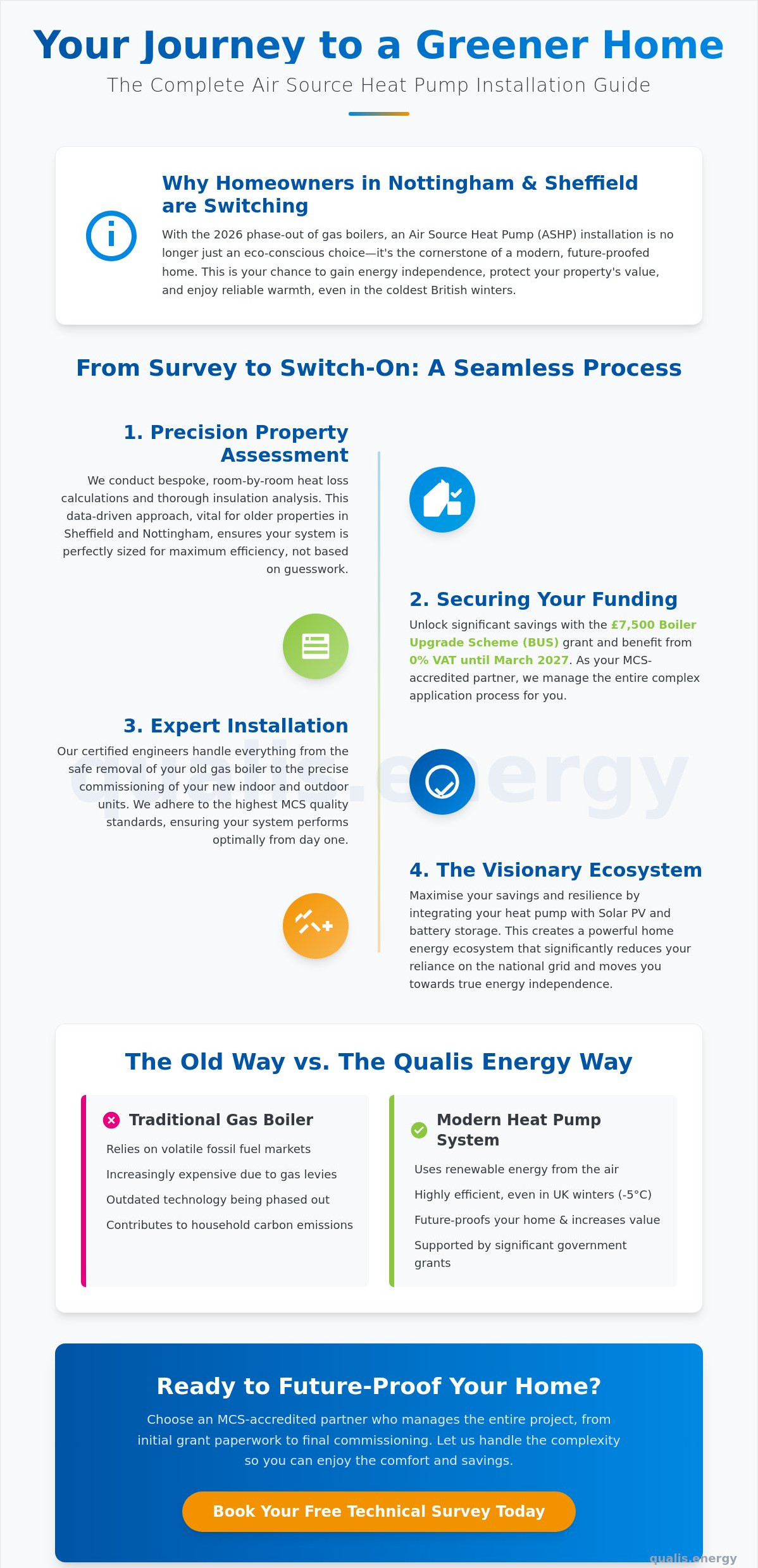
The transition from a fossil-fuel past to a renewable future is a structured, meticulous process. We don't just swap a box; we re-engineer your home's thermal heart. Your ASHP installation journey begins with the decommissioning and removal of your existing gas or oil boiler. This is handled with surgical precision to ensure your property remains clean and protected. Once the old system is cleared, we move to the external phase, installing the outdoor unit on a level, vibration-absorbing base. This foundation is critical to prevent noise transfer and ensure the longevity of the evaporator fan, keeping the unit whisper-quiet for your neighbours in Nottingham and Sheffield.
With the outdoor unit secured, the focus shifts to the internal infrastructure. We integrate a high-performance hot water cylinder and, where necessary, a buffer tank to maintain constant system pressure. This is followed by the electrical integration, where our experts configure the wiring and advanced control systems. For a broader perspective on these technical stages, you can refer to this step-by-step heat pump installation guide provided by the Energy Saving Trust. Finally, the system undergoes rigorous commissioning, including air purging and performance testing, to ensure every component operates at peak efficiency from day one.
Upgrading Radiators and Pipework
Efficiency is won or lost in the distribution of heat. Because heat pumps operate at lower flow temperatures than gas boilers, they require a larger surface area to emit the same amount of warmth. This often means upgrading to larger, "low temperature" radiators. In many Nottinghamshire homes built between 1970 and 1990, we frequently encounter 10mm microbore pipework. We assess this carefully; whilst it's sometimes compatible, we often recommend upgrading to 15mm or 22mm copper pipework to ensure the heat pump doesn't have to work unnecessarily hard. For those seeking the gold standard, integrating your ASHP installation with underfloor heating provides the most consistent and efficient thermal experience possible.
The Commissioning and Handover Process
The final stage is where technology meets domestic behaviour. We don't just leave you with a new system; we calibrate the weather compensation curve specifically for your home's orientation and insulation levels. This ensures the unit automatically adjusts its output based on the external temperature, whether it's a biting frost in the Peak District or a mild morning in the Trent Valley. Our comprehensive Handover Pack includes your essential MCS certificates, warranty documents, and user manuals. We'll spend time training you on the controller, explaining how to maintain a steady ambient temperature without "fiddling" with settings, which is the key to maintaining your ROI. Our promise is simple: we manage the complexity so you don't have to lift a finger.
Maximising Efficiency: Integrating ASHP with Solar and Batteries
The future of domestic heating isn't found in a single appliance; it lives within a connected ecosystem. An ASHP installation is a powerful tool on its own, but it reaches its full visionary potential when harmonised with solar PV and battery storage. This combination represents the "Holy Grail" of home energy, moving your property from a passive consumer to an active, efficient generator. By synchronising these technologies, you aren't just heating your home. You're orchestrating a sophisticated energy strategy that significantly outperforms standalone systems in terms of long-term ROI.
Integrated systems allow for a level of control that was previously impossible for the average homeowner in Nottingham or Sheffield. Smart controls now act as the brain of the house, automatically directing energy where it's needed most. When the sun is at its zenith, the system prioritises heating your hot water cylinder or charging your battery. This proactive management ensures that every kilowatt-hour generated on your roof is utilised effectively, rather than being sold back to the grid for a fraction of its value. It is the ultimate expression of energy independence.
Solar PV Synergy
Success relies on precise technical calculation. We determine exactly how many solar panels are required to offset the seasonal electrical demand of your heat pump, ensuring your system remains as carbon-neutral as possible throughout the year. For detailed regional insights into local generation, explore our Solar Panels and Installation: The 2026 Nottingham & Sheffield Homeowner’s Guide. For larger, high-output integrated systems, we handle all G98 and G99 DNO applications on your behalf. We navigate the complex grid connection paperwork so you don't have to lift a finger, moving your project smoothly from design to live generation.
Battery Storage and Time-of-Use Tariffs
Battery storage acts as the essential bridge between generation and consumption. It allows you to capture surplus solar energy during the day and deploy it during the expensive peak evening window when the grid is under the most pressure. Intelligent inverters manage this flow seamlessly, prioritising stored energy or cheap off-peak electricity to run your heat pump. Load shifting can reduce operational costs by up to 40% by avoiding peak-time tariffs entirely. This smart management ensures that whilst you're looking after the children or preparing a family meal, your home is running on clean, low-cost energy harvested from your own roof. If you're ready to master your home's energy future, contact our local team to design a bespoke integrated package.
Choosing the Right Partner for Your Transition
The future of energy is a partnership. Choosing a contractor for your ASHP installation is a 25-year decision that impacts both your domestic comfort and your long-term financial security. It isn't just about the hardware; it's about the technical expertise and the enduring support that follows. MCS accreditation is non-negotiable in 2026. Without this certification, you cannot access the £7,500 Boiler Upgrade Scheme grant, and you lose the essential safety net of industry-standard consumer protection. We take this responsibility seriously, holding high the renewable energy flag for every family in South Yorkshire and Nottinghamshire.
Qualis Energy provides a comprehensive, turnkey service that removes the burden from the homeowner. We manage every technical and regulatory hurdle, from initial CDM project management and DNO applications through to final commissioning. This means you won't need to lift a finger during the entire transition. Our visionary goal is to change how the world thinks about energy, but we achieve this through grounded, meticulously organised project delivery. We are local experts who understand the specific architectural needs of properties in the East Midlands, ensuring that your investment delivers the maximum possible ROI.
The Importance of Local Servicing
Annual maintenance is the lifeblood of a healthy heating system. It's a mandatory requirement to keep your manufacturer warranty valid and ensures your unit continues to operate at peak efficiency as the years pass. Our local presence in Nottingham and Sheffield means a service engineer is always nearby for a rapid response, providing peace of mind that a national call centre cannot match. During a visit, a Qualis engineer meticulously checks refrigerant levels, cleans filters, and optimises flow rates to prevent system strain. For more on what to look for in a provider, see our Heat Pump Installers Near Me: The 2026 Homeowner’s Reliability Checklist.
Mitsubishi and Daikin Specialist Installations
Quality matters when it comes to the heart of your home. We specialise in Mitsubishi and Daikin systems because these world-leading manufacturers have proven their reliability within the unique demands of the UK climate. These units provide the technical precision required for a high-performing, low-carbon home. You can find detailed regional specifications and benefits in our Mitsubishi Heat Pump Installation in Nottingham: The 2026 Buyer’s Guide. Our "Local Hero" promise is simple: we look after your system so you can look after your children. We aren't just installing equipment; we're building a lasting relationship with our neighbours to ensure a warmer, greener future for the entire community.
Secure Your Home's Energy Independence
The future of energy has arrived in Nottingham and Sheffield. Your journey toward a lower carbon footprint and reduced dependency on fossil fuels is no longer a distant goal but a practical, immediate reality. By mastering the ASHP installation process, you're investing in a system that balances domestic comfort with global responsibility. We've explored how technical precision in heat loss calculations and the strategic integration of solar PV can transform your property into a high-performance energy hub. This transition is about more than just technology; it's about future-proofing your family's comfort against a changing energy landscape.
Qualis Energy stands ready to guide you through every step of this national transition. As MCS Accredited Installers serving the East Midlands and South Yorkshire, we bring technical authority and a "Local Hero" commitment to every project. We handle the complex G98 applications and BUS grant paperwork so you don't have to lift a finger. It's time to move from outdated infrastructure to a visionary energy ecosystem. Book your expert home survey with Qualis Energy today and take the first step toward a warmer, greener future for your family. The path to a cleaner home is clear, and we're here to lead the way.
Frequently Asked Questions
Do I need planning permission for ASHP installation in Nottingham?
Most residents don't need planning permission as it falls under Permitted Development rights. Exceptions apply if you live in a conservation area or a listed building, such as those found in Southwell or Farnsfield. We manage the entire local authority liaison process for you. This ensures your project remains fully compliant with all regional regulations without you needing to lift a finger.
How much does an air source heat pump installation cost in 2026?
A typical ASHP installation in 2026 costs between £8,000 and £15,000 before any incentives. Data from July 2025 shows the average cost under the Boiler Upgrade Scheme was approximately £12,500. However, with the £7,500 BUS grant and 0% VAT available until March 2027, many homeowners see their final investment drop to around £5,000.
Will I need to replace all my radiators for a heat pump to work?
You won't necessarily need to replace every radiator, but upgrades are often required to maintain efficiency at lower flow temperatures. Upgrading ten radiators to be compatible with a heat pump typically costs around £3,000. We perform a room-by-room heat loss calculation to identify exactly which units need replacing. This ensures your home stays warm whilst keeping your operational costs as low as possible.
How long does the actual installation take to complete?
The actual on-site work usually takes between three and five days to complete. This timeline includes the decommissioning of your old gas boiler, the placement of the outdoor unit, and the internal plumbing transition. We coordinate every stage of the project management to minimise disruption. We ensure your home is back to full comfort with a commissioned, high-efficiency system by the end of the week.
Can an air source heat pump work in older Sheffield stone houses?
Yes, heat pumps work effectively in older stone properties provided the insulation is sufficient. To be eligible for grants, your EPC must show no outstanding recommendations for loft or cavity wall insulation. Loft insulation typically costs between £654 and £1,206, whilst cavity wall insulation ranges from £950 to £4,600. These upgrades ensure your Sheffield stone home retains heat effectively throughout the winter.
What is the Boiler Upgrade Scheme and am I eligible?
The Boiler Upgrade Scheme (BUS) is a government initiative providing a £7,500 grant for an ASHP installation. To be eligible in 2026, you must be replacing a fossil fuel system and have a valid EPC. The scheme is confirmed to run until March 2028. We handle the entire application on your behalf, ensuring you receive the maximum financial support for your transition.
Is an air source heat pump noisy for my neighbours?
Modern heat pumps are remarkably quiet and won't disturb your neighbours. Units from leading manufacturers like Mitsubishi or Daikin typically operate at around 45 to 50 decibels, which is similar to the hum of a domestic refrigerator. We always install the outdoor unit on a vibration-absorbing base. This technical precision ensures that the only thing you and your neighbours will notice is a more sustainable community.
How often does an ASHP need servicing to remain efficient?
Your system requires an annual service to remain efficient and maintain its manufacturer warranty. During this check, our engineers inspect refrigerant levels, clean the evaporator filters, and verify the system's flow rates. Regular maintenance ensures your investment continues to deliver high ROI for its 25-year lifespan. We provide a complete maintenance package so you can focus on looking after your family whilst we look after the technology.


Comments