
Understanding MCS: The Homeowner’s Guide to UK Renewable Standards in 2026
- James

- 1 day ago
- 13 min read
Updated: 3 hours ago
Investing in your home's energy future should feel like a victory, yet many UK homeowners find themselves stalled by a single, critical question: what is MCS and do I actually need it? The truth is that choosing an uncertified installer isn't just a technical oversight; it's a £7,500 gamble with your household budget. We understand the anxiety that comes with navigating the transition to low-carbon living, especially when the fear of "cowboy builders" or unreliable systems looms large. You want to know that your new solar PV or heat pump will work perfectly from the first day of installation through to its twentieth year of service.
We're here to ensure you don't need to lift a finger when it comes to compliance or quality. This guide will show you how MCS certification acts as your financial and technical gateway, unlocking essential support like the £7,500 Boiler Upgrade Scheme grant and the new £2,500 battery storage incentives under the 2026 Warm Homes Plan. We'll explore everything from securing high-value Smart Export Guarantee (SEG) payments of up to 32p per kWh to ensuring your system meets the rigorous standards required for long-term warranty protection. By the end of this article, you'll have the clarity and confidence to hold high the renewable energy flag for your own home.
Key Takeaways
Learn why MCS certification is the non-negotiable benchmark for quality and safety in UK solar and heat pump installations.
Discover how to unlock £7,500 in Boiler Upgrade Scheme funding and maximise your solar returns through the Smart Export Guarantee.
Understand the dual requirement for both accredited hardware and certified installers to ensure your investment is fully protected.
Master the simple steps to verify an installer's credentials on the national database before committing to your home's energy transition.
See how a turnkey approach from design to commissioning means you won't need to lift a finger during the installation process.
Table of Contents
What is MCS? Defining the UK Standard for Renewable Energy
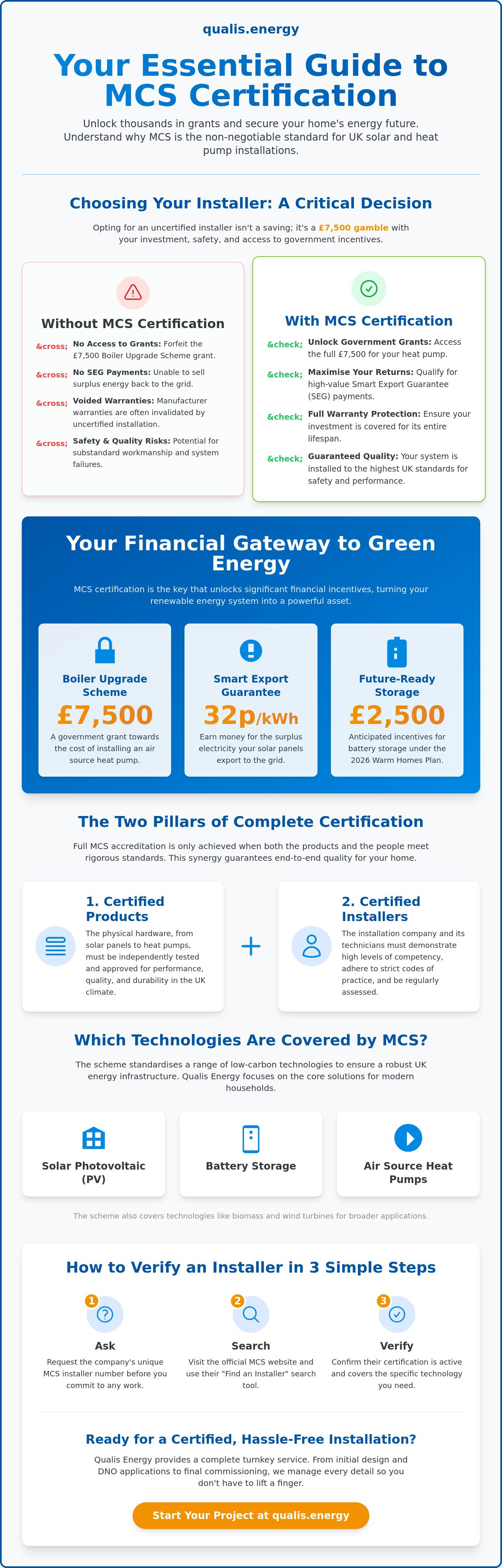
The future of UK energy is no longer a distant ambition; it is happening right now in our neighbourhoods. As we move toward a decentralised grid, the MCS (Microgeneration Certification Scheme) serves as the essential benchmark for quality, safety, and reliability. It's more than just a badge on a van. It is a rigorous standards-based programme that ensures every solar PV panel, heat pump, and battery storage system is installed to a level of technical excellence that protects your home and your investment.
Without this accreditation, the renewables market could easily resemble a "Wild West" of unverified claims and sub-standard workmanship. An uncertified installation might save a few pounds upfront, but it often leads to systemic failure, voided warranties, and a total loss of access to government support. In contrast, an MCS-certified project provides a narrative of completeness. It covers the entire journey from the physical hardware used to the precise methods employed by the installers on your roof or in your plant room. For a modest £30 certificate fee, homeowners gain the assurance that their system is fit for the next twenty-five years of service.
The History and Purpose of the Scheme
Launched to support the UK’s ambitious Net Zero targets, the scheme was designed to organise a fragmented industry into a trustworthy marketplace. By March 2026, with the UK reaching over 2 million solar installations and a total capacity of 22.1 GW, the need for uniform standards has never been more urgent. The primary purpose is twofold: consumer protection and technical competence. It ensures that as we scale up to meet the government target of 450,000 heat pump installations per year by 2030, every homeowner can transition with confidence. It creates a level playing field where technical experts are distinguished from "cowboy builders," ensuring that domestic comfort is never sacrificed for industrial speed.
Which Technologies Fall Under MCS?
The scheme casts a wide net to ensure the UK’s energy infrastructure is robust across all sectors. It standardises a variety of low-carbon technologies, including:
Solar Photovoltaic (PV): Ensuring panels are efficient and safely integrated into the grid.
Battery Storage: Critical for managing the 27,607 new solar installations recorded in March 2026 alone.
Air Source Heat Pumps: The cornerstone of the Boiler Upgrade Scheme (BUS).
Biomass and Wind Turbines: Included for broader industrial and rural applications for completeness.
At Qualis Energy, we hold high the renewable energy flag by focusing on the core technologies that deliver the most value to modern households. We specialise in solar PV, battery storage, and heat pumps, providing a turnkey service that manages every DNO application and technical detail. Whilst the scheme includes residential wind turbines, we choose to focus our expertise where it makes the most significant impact on domestic energy bills and carbon footprints. Our mission is to move you from the initial survey through to final handover without you needing to lift a finger.
The Two Pillars of MCS Certification: Products and Installers
The future of energy has arrived. Excellence in the UK renewable sector is built upon two inseparable foundations: the technology you select and the professionals who install it. A system only achieves full MCS status when both the hardware and the labour meet the scheme's stringent requirements. This synergy is vital because even the most advanced Tier 1 solar panel becomes a liability if wired incorrectly; similarly, a master electrician cannot fix the inherent flaws of an uncertified, low-quality heat pump.
Certification ensures that every component is "fit for purpose" for the specific challenges of the British climate. Products undergo rigorous laboratory testing to prove they can handle everything from coastal salt-mist to the persistent damp of a UK winter. By ensuring both pillars are accredited, the scheme creates a narrative of completeness and reliability for every homeowner. This end-to-end assurance means your investment is protected from the moment the first bracket is fixed to the roof until the final commissioning document is signed.
Installer Competency and Technical Standards
Installers must undergo regular, ongoing audits to prove their technical behaviour and workmanship remain at the highest level. This oversight is essential as the market expands; March 2026 alone saw 27,607 new solar installations across the country. For complex technologies like air source heat pumps, an accredited professional must perform precise room-by-room heat loss calculations before any work begins. These calculations prevent the dangerous practice of "under-speccing," where a system is deliberately undersized to make a quote look cheaper. An undersized system will work harder, fail sooner, and leave your family in the cold. You should always Verify an MCS Certificate to ensure your chosen partner is qualified for the specific technology they are fitting.
Product Reliability and Longevity
Choosing MCS-approved products is your primary defence against inferior, unverified imports that lack long-term support. These certified components are essential because most manufacturer warranties are only valid if the product was installed as part of a certified system. This connection ensures that your solar PV or battery storage operates at peak efficiency for decades. Product certification serves as a definitive barrier against the influx of sub-standard hardware that cannot meet the UK’s rigorous safety and performance benchmarks. It ensures that your system isn't just a collection of parts, but a high-performance asset for your home.
Our team at Qualis Energy manages this entire journey, moving you from the initial technical design through to final commissioning so you won't need to lift a finger. We hold high the renewable energy flag by ensuring every screw, cable, and panel meets the highest national standards.
Why MCS Matters: Protecting Your Investment and Accessing Grants
Is an accredited installation actually worth the investment? This is the most frequent question we hear from homeowners across the UK. When you look at the raw numbers, the answer is an emphatic yes. Whilst an uncertified quote might appear cheaper on paper, it instantly disqualifies you from thousands of pounds in government support. The £30 cost of an MCS certificate is a negligible entry fee for a system that pays for itself through guaranteed grants and monthly export income. Choosing an unaccredited route doesn't just risk your home's safety; it's a financial decision that could cost you over £10,000 in lost incentives over the system's lifetime.
We believe in a future where energy is clean, affordable, and accessible. To reach that goal, your system must be integrated into the national financial infrastructure. Without the proper certification, your high-tech solar array or heat pump is essentially "invisible" to the grid and the Treasury. By ensuring every project meets these national standards, we provide a narrative of completeness that moves you from being a consumer to an active, paid participant in the UK's green transition.
Unlocking Government Incentives in 2026
As of May 2026, the Boiler Upgrade Scheme (BUS) offers a substantial £7,500 grant towards hydronic heat pumps. This funding is strictly ring-fenced for projects managed by certified professionals. If your installer isn't accredited, you won't see a penny of that money. Similarly, the Smart Export Guarantee (SEG) allows you to sell surplus solar power back to the grid at rates reaching up to 32p per kWh. Accessing these lucrative time-based tariffs requires a valid certificate to prove your system meets the standards outlined in the UK Government MCS Information. Without this paperwork, you're essentially "off-grid" for financial rewards, missing out on up to £550 in annual energy bill savings promised by the Warm Homes Plan.
Insurance and Warranty Protection
Your home is your most valuable asset. Most major UK home insurance providers now view renewable installations as significant structural changes that require professional certification. Without it, you may find your policy voided in the event of a fire or electrical fault. The MCS scheme also mandates an Insurance Backed Guarantee (IBG) through consumer codes like RECC or HIES. This protects your deposit and warranty even if an installation company ceases trading, providing a safety net that uncertified builders simply cannot offer. This layer of security is vital when you decide to sell your property. Future buyers and mortgage lenders increasingly demand certification as proof that the technology is safe and legally compliant. We handle all these granular details so you won't need to lift a finger, holding high the renewable energy flag for your home's long-term value.
How to Verify an MCS Certificate for Your System
The future of energy is built on transparency. Whilst the UK reached the milestone of 2 million solar installations in March 2026, the rapid growth of the sector has attracted some providers who bypass essential standards. Verifying your installer's MCS credentials is the most vital step you will take before any equipment arrives at your property. It’s a simple process that ensures your investment is legally sound and technically superior. We believe every homeowner in Nottingham, Sheffield, and the surrounding regions deserves absolute certainty that their transition to green energy is handled by true experts.
To ensure your project is fully compliant, follow these four critical steps:
Step 1: Access the official installer database before signing any contract. Search for the company name to confirm their active status and registration.
Step 2: Check the specific technology listing on their profile. A company certified for air source heat pumps is not automatically qualified to install solar PV; each technology requires its own rigorous accreditation.
Step 3: Demand a written quote that explicitly states the installation will be MCS-compliant. This document serves as your primary evidence should you ever need to verify the project's scope.
Step 4: Confirm that your certificate will be issued within 10 working days of the system being commissioned. This document is essential for your SEG payments and the activation of your manufacturer warranties.
Red Flags to Watch Out For
Vigilance is your best defence against sub-standard work. Beware of companies using "subcontracted" accreditation numbers, often referred to as umbrella schemes. In these cases, the company selling you the system isn't the one holding the credentials, which creates a dangerous gap in accountability and safety oversight. Another warning sign is a quote that appears "too good to be true" by skipping the mandatory registration fee. Some rogue installers may even provide "phantom" certificates, which are professional-looking documents that haven't actually been registered on the central database. If it isn't on the official registry, it doesn't exist in the eyes of the grid or the government.
The Role of Consumer Codes (RECC and HIES)
Accreditation does not exist in a vacuum. It works alongside consumer codes like RECC (Renewable Energy Consumer Code) or HIES (Home Insulation & Energy Systems Quality Control Scheme) to protect your deposit and ensure fair behaviour. For our clients across Nottingham and Sheffield, we maintain strict adherence to these codes to provide a narrative of completeness and trust. These organisations offer free dispute resolution services and ensure your Insurance Backed Guarantee is valid. They act as a silent partner in your corner, ensuring that from the initial design to final maintenance, your interests are shielded. By choosing a partner who respects these codes, you ensure that your journey to sustainability is as comfortable as looking after the children on a quiet afternoon. If you want to ensure your home meets these rigorous national standards, book a consultation with our accredited team today.
Qualis Energy: Excellence in Accredited Renewable Installations
The future of energy has arrived. At Qualis Energy, we act as your Visionary Facilitator, turning the complex transition to renewables into a seamless reality for your home. Our end-to-end approach is designed for complete peace of mind, moving you logically from the initial site survey and bespoke technical design through to the final commissioning and handover of your system. Throughout this journey, our promise remains constant: you won't need to lift a finger. We handle every granular detail, including the complex G98 and G99 DNO applications and the final MCS registration that secures your financial future.
Our roots are firmly planted in the East Midlands. From the historic streets of Nottingham to the industrial heart of Sheffield, we are proud to serve our local communities with grounded, reassuring professionalism. We understand that a home installation isn't just a technical project; it's an investment in your family's comfort, much like the care you put into looking after the children or maintaining a family barn. By choosing a local expert, you ensure that your system is designed specifically for our regional climate and grid requirements. We take pride in our role as a leader in this critical national transition, ensuring every partnership we build is based on undeniable expertise and compliance.
Our Commitment to Technical Standards
We don't just meet the minimum requirements of the national scheme; we consistently exceed them to ensure your home operates at peak efficiency. Our team is dedicated to solar panels and installation that stands the test of time, providing a high-performance asset for your property. To maintain this level of excellence, we operate a rigorous internal auditing programme that scrutinises every cable run, mounting bracket, and heat loss calculation. This dedication to precision ensures that your mcs certified system isn't just a collection of parts, but a masterfully engineered solution that holds high the renewable energy flag for decades to come.
Ready to Start Your Journey?
Choosing the right partner is the most important decision you'll make in your energy transition. We invite you to view our portfolio of successful projects across Southwell and Newark, where we've helped neighbours show off their green credentials whilst slashing their monthly energy bills. Whether you require a turnkey EPC service for a new-build or a complex retrofit for a period property, we provide the CDM project management and technical authority needed to deliver success. Our involvement is a long-term commitment to our community rather than just a series of transactional installs. Contact us today for a professional consultation and discover how easy the future of energy can be when you have an expert hand managing every step of the way.
Securing Your Home's Energy Future Today
The transition to a low-carbon home is a defining moment for any UK household. As we've explored, MCS certification is the essential thread that connects technical safety, manufacturer warranties, and significant financial returns. By choosing an accredited path, you move from the uncertainty of unverified quotes to the absolute clarity of a system that qualifies for the £7,500 Boiler Upgrade Scheme grant and lucrative SEG export payments. With over 2,003,000 solar installations across the UK as of March 2026, the path to energy independence is more reliable and accessible than ever before.
Qualis Energy stands ready to act as your expert partner in this critical national transition. We are fully MCS accredited installers and proud RECC members, ensuring every project across Nottingham, Sheffield, and the East Midlands meets the highest standards of technical excellence. Our turnkey approach means we handle everything from the initial design through to the final paperwork, ensuring you won't need to lift a finger. We take pride in holding high the renewable energy flag for our community, providing a narrative of reliability for every client we serve.
It's time to take control of your energy bills and future-proof your property. Book your MCS-compliant renewable consultation with Qualis Energy today and start your journey toward a cleaner, more affordable future. We're here to ensure your home remains a sanctuary of domestic comfort for decades to come.
Frequently Asked Questions
Is MCS certification a legal requirement for solar panels?
No, it is not a legal requirement to have an MCS certificate to install solar panels on your property. However, choosing an uncertified route means you cannot access government grants or sell your surplus electricity back to the grid. It's essentially a choice between a safe, income-generating asset and an unverified system that lacks essential consumer protection.
Can I get an MCS certificate after the installation is finished?
You cannot typically obtain a certificate retrospectively if the installation was completed by an unaccredited worker. The scheme requires the certified installer to oversee the entire project, from the initial technical design to the final commissioning. If you've already had work done by an uncertified builder, you'll likely need a full technical audit and potentially a complete re-installation to meet national standards.
How much does an MCS certificate cost for a homeowner?
An MCS certificate costs exactly £30 per installation as of May 2026. This fee is paid to the scheme to register your system on the national database and is almost always absorbed into your installer's initial quote. It's a tiny investment that unlocks thousands of pounds in potential savings and export income over the lifespan of your renewable system.
Does MCS cover battery storage systems in 2026?
Yes, the scheme fully covers battery storage, and certification is now a prerequisite for the latest government incentives. Under the 2026 Warm Homes Plan, a valid certificate is required to access the new £2,500 grant for battery installations. This ensures that your storage setup is safely integrated with your solar PV and eligible for the most lucrative time-based export tariffs.
What happens if my MCS installer goes out of business?
You are protected by a mandatory Insurance Backed Guarantee (IBG) if your accredited installer ceases trading. This protection, linked to consumer codes like RECC or HIES, ensures that your deposit and workmanship warranty remain valid regardless of the company's future. It provides a level of security that uncertified contractors simply cannot offer to homeowners in Nottingham and Sheffield.
Can I get the Smart Export Guarantee (SEG) without an MCS certificate?
It is nearly impossible to access the Smart Export Guarantee (SEG) without a valid MCS certificate. Whilst a handful of energy suppliers may accept "equivalent" proof, the process is notoriously difficult and often results in lower payment rates. To guarantee access to the top export rates of up to 32p per kWh, having the official certificate is the only reliable route.
How long does an MCS certificate last?
An MCS certificate does not expire; it is a permanent record of a compliant installation at a specific property. It remains valid for the entire functional lifetime of the technology, serving as proof that the system was fitted to national standards at the point of commissioning. You should keep this document safe as it is a vital part of your home's technical history and value.
Is an MCS certificate required to sell my house?
An MCS certificate isn't a legal requirement for selling your property, but it's a critical document for the buyer's solicitor and mortgage lender. Without it, you may struggle to prove the system is safe or compliant, which can lead to significant delays or a reduction in your property's valuation. Most modern buyers in the East Midlands expect to see this accreditation as a signal of quality and long-term reliability.


Comments