
Commercial Solar Panel ROI Calculator UK: 2026 Business Savings Guide
- James

- Apr 24
- 12 min read
Updated: Apr 26
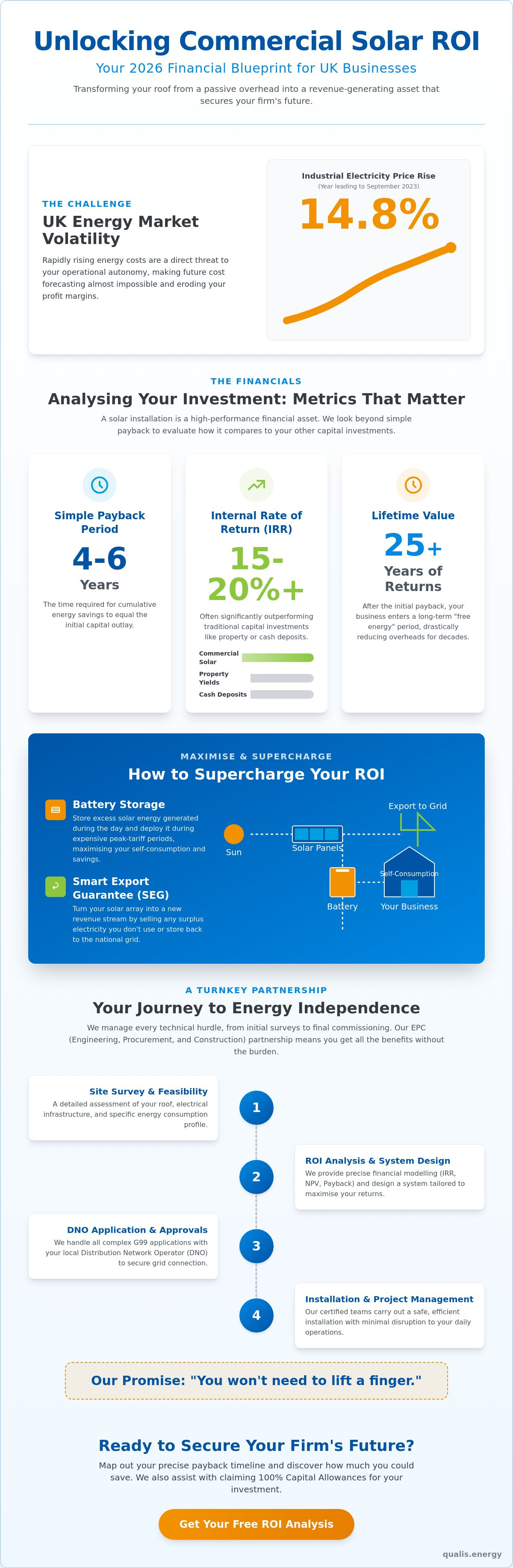
Energy volatility isn't just a line item on your balance sheet; it's a direct threat to your operational autonomy. You've likely felt the impact of industrial electricity prices rising by 14.8% in the year leading to September 2023, making it difficult to forecast future costs without a commercial solar panel ROI calculator UK to guide your 2026 investment. It's a frustrating position to be in, especially when the path to energy independence feels blocked by high upfront costs and complex regional grid constraints from your local DNO.
We understand that whilst you want to lead the charge in the UK's green transition, you need the numbers to stack up before you commit. This guide empowers you to master the financial metrics of your project and map out a precise payback timeline. You'll discover how to transform your industrial roof or agricultural barn from a passive overhead into a revenue-generating asset that secures your firm's future in the Midlands and South Yorkshire.
We'll walk you through the entire journey, from the initial site survey and G99 DNO applications to claiming 100% Capital Allowances, ensuring you can hold high the renewable energy flag without needing to lift a finger during the transition.
Key Takeaways
Understand why solar has transitioned from a sustainability goal to a critical financial asset for UK businesses in the 2026 energy landscape.
Discover how to look beyond simple payback periods by using a commercial solar panel ROI calculator UK to evaluate Internal Rate of Return (IRR) against other capital investments.
Learn how regional irradiance in Nottingham and Sheffield, combined with NGED grid constraints, directly impacts your project’s ultimate profitability.
Explore strategies to maximise returns through battery storage and smart export, shifting energy usage to eliminate peak-tariff costs.
Gain clarity on financing models, from CAPEX to PPAs, and see how a turnkey EPC partnership ensures you will not need to lift a finger during the transition.
Understanding Commercial Solar ROI in the UK (2026 Context)
The era of solar as a mere corporate social responsibility checkbox is over. By 2026, British businesses view onsite generation as a fundamental fiscal strategy. A robust Solar power in the United Kingdom has evolved from a niche alternative into a cornerstone of national infrastructure. Return on Investment (ROI) in this context measures the speed at which your energy savings and export revenues exceed the initial capital outlay. It is no longer about "green vanity"; it is about protecting your margins against a volatile grid.
Many businesses rely on a generic commercial solar panel ROI calculator UK to estimate their payback. These tools often fail because they ignore specific demand profiles. A manufacturing facility running 24/7 shifts captures far more value from solar than a commercial office that sits empty on weekends. We focus on the granular data. We look at when your machinery starts and when your lights dim. This precision ensures that your projected five to seven year payback period is a reality, not a guess.
The Components of a Commercial Solar Investment
A professional installation involves more than just bolting glass to a roof. Hardware costs include Tier 1 monocrystalline panels and high-efficiency inverters designed for industrial loads. Soft costs are equally vital. These include G99 DNO applications to clear your connection with the local grid, structural surveys for large-span roofs, and CDM project management to ensure site safety. We manage every single one of these technical hurdles. You will not need to lift a finger as we move your project from the initial survey through to the final handover. Ongoing operational costs, such as remote monitoring and annual thermal imaging, ensure your system continues holding high the renewable energy flag for decades.
2026 Energy Market Projections
The UK energy market in 2026 is defined by a transition toward a decentralised network. Commercial electricity tariffs remain sensitive to global gas prices, making self-generation a vital fixed-cost hedge. By generating your own power, you effectively lock in an electricity rate for the next 25 years. This stability is a massive competitive advantage. As the national grid integrates more intermittent renewables, businesses with their own generation and storage capabilities will be the most resilient. We are seeing a shift where decentralised energy isn't just an option; it's a requirement for any firm looking to stabilise its long term overheads. Our role is to facilitate this transition, providing the visionary leadership your business needs to thrive in a low-carbon economy.
The Financial Metrics: Beyond the Simple Payback Period
The UK's energy infrastructure is undergoing a radical transformation. Smart businesses recognise that a solar installation is a high-performance financial asset rather than a simple utility upgrade. While a commercial solar panel ROI calculator UK provides an essential starting point, understanding the deeper metrics ensures your capital works with maximum efficiency. We look beyond the surface to evaluate how solar compares to other internal investments.
Simple Payback remains the most common metric. It represents the specific number of years required for the cumulative energy savings to equal the initial £100,000 or £500,000 capital outlay. However, savvy finance directors prioritise the Internal Rate of Return (IRR). This percentage allows you to compare solar against other business capital investments; often, solar IRR exceeds 15% to 20%, significantly outperforming traditional cash deposits or property yields. We also calculate the Net Present Value (NPV), which factors in the time value of money over a 25-year period. This ensures that the future pounds you save are accurately valued against today's spending power. The UK government's renewable energy policy underpins this investment climate, creating a stable framework for long-term financial planning.
Simple Payback vs. Lifetime ROI
A typical payback period of 4 to 6 years is merely the opening chapter. Once the system has paid for itself, your business enters a "free energy" period from year 7 through to year 25 and beyond. This creates a massive injection of bottom-line profit. Levelised Cost of Energy (LCOE) is the total cost of the system divided by its total lifetime energy generation. This metric often reveals a cost per kWh as low as 4p or 5p, providing a permanent hedge against volatile grid prices.
Tax Incentives and Capital Allowances
The 2023 Spring Budget introduced Full Expensing, allowing companies to deduct 100% of the cost of qualifying plant and machinery from their taxable profits. This can be combined with the Annual Investment Allowance (AIA) for immediate relief. Most rooftop installations are currently exempt from business rate increases until 2035 under specific relief schemes. For VAT-registered entities, the 20% tax on the installation is usually recoverable, significantly lowering the effective entry price. Our turnkey EPC service ensures these tax efficiencies are fully integrated into your project design.
Qualis Energy manages the entire journey for you. From the initial feasibility study and G99 DNO applications to the final CDM project management, we hold high the renewable energy flag so your team can focus on core operations. You won't need to lift a finger while we transition your facility into a powerhouse of self-sufficiency. By using a sophisticated commercial solar panel ROI calculator UK, we move your business from energy dependence to sovereign power generation, securing your financial future for decades.
Key Factors Affecting Business Solar ROI in Nottingham and Sheffield
The future of British energy is decentralised. Your postcode dictates your profit. While using a commercial solar panel ROI calculator UK provides a vital baseline, local nuances across the East Midlands and South Yorkshire can shift your break-even point by several months. We don't just look at the sun; we look at the soil, the streets, and the local substations.
Regional Solar Yield and Performance
Solar irradiance isn't uniform across the North and Midlands. Nottinghamshire typically enjoys a specific yield of approximately 980 kWh per kilowatt peak (kWp). Sheffield, influenced by its rugged topography and the "rain shadow" of the Pennines, often sits closer to 930 kWh/kWp. These 5% variances directly impact your annual generation figures. We rely exclusively on MCS-certified data to ensure your projections are bankable forecasts rather than optimistic guesses. Sheffield’s industrial units often face unique microclimates, requiring precise panel positioning to capture every available photon during the shorter winter days.
Grid Constraints and Export Limitations
The National Grid Electricity Distribution (NGED) network manages the infrastructure across much of Nottinghamshire. In towns like Newark or Mansfield, the grid is frequently "congested." This leads to export caps that can throttle your potential ROI if you aren't consuming 100% of your generation on-site. Understanding these limitations is where our partnership adds the most value. Qualis Energy manages the entire journey, from the initial survey to the complex G99 DNO applications required for larger systems. We negotiate with grid operators so you don't have to, ensuring your site capacity is maximised from day one.
Optimising Architecture and Regional Funding
Roof pitch changes the financial game. Sheffield’s vast industrial warehouses offer expansive south-facing opportunities, while Nottingham’s compact office blocks often require east-west mounting systems to balance energy loads throughout the working day. By 2026, regional decarbonisation funds have become more targeted. Local businesses can often access specific pots of capital, such as:
South Yorkshire Net Zero Grants: Targeted at manufacturing hubs in Sheffield and Rotherham to offset initial Tier 1 hardware costs.
East Midlands Decarbonisation Fund: Providing up to 25% match-funding for energy efficiency projects in Nottingham and Derby.
Smart Export Guarantee (SEG) 2026 Tiers: Regional variations in what suppliers pay for your excess energy.
When you input your data into a commercial solar panel ROI calculator UK, these local grants can slash years off your payback period. We help you secure this funding as part of our turnkey EPC service. Our team holds high the renewable energy flag, moving your project from a technical drawing to a commissioned asset without you needing to lift a finger. This end-to-end reliability ensures your investment is protected by both technical expertise and local market knowledge.
Maximising Your Return: Batteries, ASHPs, and Smart Export
The future of British business energy is integrated. To achieve the shortest payback periods, you must look beyond the panels on your roof and focus on how that energy is managed. Every unit of solar power consumed on-site is worth approximately 28p in avoided costs; whilst exported energy via the Smart Export Guarantee (SEG) typically returns only 5p to 15p. This price gap is why self-consumption is the primary driver of your financial return. When using a commercial solar panel ROI calculator UK, the most significant variable is often the ratio of energy you keep versus the energy you sell back to the grid.
Integrated Energy Systems
Solar PV achieves its highest value when it powers your heating and cooling requirements. Integrating your array with an air source heat pump installation allows you to "electrify" your thermal load. This synergy is particularly potent for industrial units in the Midlands and North, where gas consumption remains a heavy overhead. By shifting from volatile gas markets to solar-powered ASHPs, businesses have seen carbon footprints drop by 70% whilst securing long-term price stability. We manage the entire transition from initial survey to final commissioning, ensuring you won't need to lift a finger during the process.
Battery Storage as an ROI Multiplier
Battery storage is no longer an optional luxury; it's a strategic necessity for modern commercial sites. A Tesla Powerwall or a bespoke commercial rack system allows you to capture surplus midday generation for use during expensive 4pm to 7pm peak windows. This practice, known as peak shaving, avoids the highest DUoS (Distribution Use of System) charges that often inflate commercial bills. Beyond simple savings, intelligent battery systems open new revenue streams through:
Grid Balancing: Earning payments for providing frequency response services to the National Grid.
Time-of-Use Arbitrage: Charging batteries from the grid during low-cost overnight periods to use during the day.
PPA Options: Securing long-term Power Purchase Agreements for excess energy that exceed standard SEG rates.
The 2026 energy market rewards flexibility. By combining high-efficiency panels with smart storage, your commercial solar panel ROI calculator UK projections will reflect a resilient, multi-layered investment. We are proud to be holding high the renewable energy flag by helping UK businesses turn their rooftops into active revenue generators.
Ready to see the data for your specific site?
Navigating the Investment: Financing and Next Steps with Qualis Energy
The future of British energy has arrived. Qualis Energy provides a comprehensive turnkey EPC service that moves your business from the initial desktop feasibility study through to G99 DNO applications and final commissioning. We believe in holding high the renewable energy flag by making the transition for UK businesses as seamless as possible. Our approach ensures your system delivers peak yield for its 25-year lifespan; we manage the complex technical requirements and CDM project management so your team can focus on core operations.
Choosing the Right Financing Model
Capital expenditure (CAPEX) offers the highest long-term return because your business owns the asset outright. This model maximises the figures you see in a commercial solar panel ROI calculator UK by eliminating interest or service fees. However, many firms prefer Power Purchase Agreements (PPAs) where a third party funds the installation. You simply buy the generated electricity at a lower rate than the grid, protecting your cash flow without any upfront cost. Asset finance provides a middle ground; it allows you to spread the cost and often makes the project cash-flow positive immediately. Qualis Energy manages the entire process so you don’t lift a finger.
Your Commercial Solar Roadmap
Moving from a digital estimate to a physical installation requires precision. While a commercial solar panel ROI calculator UK provides an excellent baseline, a professional site survey is essential to validate those results against 2026 energy price modelling and local grid constraints. Our roadmap is designed for clarity and speed:
Step 1: We conduct a desktop feasibility study and a deep-dive analysis of your current energy bills to identify potential savings.
Step 2: Our engineers perform a detailed site survey, including structural roof checks and electrical infrastructure reviews.
Step 3: You receive a customised ROI proposal that accounts for the latest 2026 market data and specific site conditions.
Our commitment to social engagement and education means we don't just install panels; we build lasting partnerships. Maintenance contracts are the final piece of the puzzle, ensuring that your investment remains a high-performing asset for decades. Regular monitoring and cleaning prevent the gradual degradation that can cost agricultural or industrial sites thousands in lost revenue. Ready to transform your roof into a revenue generator? Book your free commercial solar feasibility survey with Qualis Energy today.
Secure Your Energy Autonomy and Future-Proof Your Bottom Line
The UK's energy landscape is shifting rapidly. By 2026, the transition to renewables will be the defining factor for resilient industrial and agricultural operations. Investing in solar isn't merely a purchase; it's a strategic move from grid dependency to total energy autonomy. Whilst a commercial solar panel ROI calculator UK provides a vital initial estimate, a truly visionary solution requires a bespoke approach that integrates batteries and smart export technology. Our MCS-accredited team specialises in these complex East Midlands projects, managing everything from G99 DNO applications to the final handover of your turnkey system.
We're dedicated to helping businesses in Nottingham and Sheffield hold high the renewable energy flag. Our full project management service means you won't need to lift a finger as we transform your factory roofs or agricultural barns into high-yielding assets. It's time to turn your infrastructure into an engine for growth and sustainability.
Request a Personalised Commercial Solar ROI Analysis
The future of British energy is here, and your business is ready to lead it.
Frequently Asked Questions
What is the average payback period for commercial solar in the UK in 2026?
Most UK businesses see a full return on investment within 4 to 7 years. This timeframe depends on your specific energy consumption patterns and the current price of grid electricity. By 2026, improved panel efficiency and stable installation costs mean many industrial units reach the break-even point even faster. We handle everything from the initial site survey to the final handover, ensuring your capital starts working for you immediately.
Can I install solar panels if my business doesn’t own the building?
You can certainly install solar panels on a leased property provided you obtain landlord consent. Many modern commercial leases now include Green Lease clauses to facilitate these upgrades. We often work with tenants and landlords to create mutually beneficial agreements that increase property value whilst slashing your operational overheads. It's a partnership that secures the energy future for both parties without any friction or complex legal hurdles.
How do capital allowances affect the ROI of solar panels for my business?
Solar installations qualify for significant tax relief through the Annual Investment Allowance and Full Expensing rules. These government incentives allow businesses to deduct 100% of the cost of qualifying plant and machinery from their taxable profits in the first year. This immediate tax saving can effectively reduce the net cost of your system by up to 25%. It's a powerful tool to accelerate your commercial solar panel ROI calculator UK projections.
Do solar panels work efficiently in the Sheffield and Nottingham climate?
Solar technology thrives in the North and Midlands, producing substantial power even on typical overcast days in Sheffield and Nottingham. Modern photovoltaic cells use daylight, not just direct sunlight, to generate electricity. Our local installations on agricultural barns and warehouses in South Yorkshire prove that regional irradiance levels are more than sufficient to power heavy machinery. You'll see consistent performance from January through to December regardless of the cloud cover.
What happens to my ROI if energy prices drop in the future?
Your ROI remains protected because solar acts as a long-term hedge against market volatility. Even if grid prices fluctuate, your fuel remains free for the 25-year lifespan of the system. We design your array to maximise self-consumption, meaning you avoid the retail price of electricity regardless of where the market moves. You're locking in a fixed, low energy rate for decades, providing your business with much-needed financial certainty.
Is battery storage necessary for a commercial solar installation to be profitable?
Battery storage isn't strictly necessary for a profitable installation, but it often enhances the financial outcome for businesses with high night-time usage. If your operations run 24/7, storing excess daytime generation for use after sunset can significantly increase your savings. For standard 9-to-5 businesses, a well-sized solar-only system often provides the fastest payback. We'll help you decide based on your specific half-hourly meter data and operational habits.
How long does a commercial solar installation take and will it disrupt my operations?
A typical commercial installation takes between 1 and 3 weeks to complete depending on the system size. We manage the entire process, including CDM project management and DNO applications, so you won't need to lift a finger or halt production. Most of the work happens on the roof, meaning your daily operations continue as normal. We ensure a seamless transition from the grid to your own clean energy source without downtime.
What is the difference between a PPA and a direct purchase for business solar?
A direct purchase involves an upfront capital outlay where you own the asset and keep 100% of the savings. A Power Purchase Agreement allows you to host a system with zero upfront cost whilst buying the generated electricity at a lower rate than the grid. Both options provide a better result on your commercial solar panel ROI calculator UK than doing nothing. We'll guide you through the financial benefits of each model to find your fit.


Comments