
Cost to Run Air Source Heat Pump vs Gas Boiler UK 2026: The Definitive Comparison
- James

- May 31
- 12 min read
The traditional logic that electricity is four times more expensive than gas is quickly becoming an outdated myth in the British energy market. As we examine the cost to run air source heat pump vs gas boiler UK 2026, the data reveals a landscape where system efficiency and smart integration are far more influential than raw fuel prices alone. This is a critical national transition, and understanding the numbers is the first step in taking control of your home energy future.
You likely feel the weight of the 13% energy price cap increase arriving in July 2026, or perhaps you're concerned that even a £7,500 Boiler Upgrade Scheme grant won't fully offset the initial investment. It's a pivotal moment for UK homeowners who want to move away from fossil fuels without risking their financial stability. We're here to provide a definitive financial breakdown that compares these technologies under the latest Ofgem rates, whilst showing you how solar PV and battery storage can fundamentally tilt the scales in your favour. You'll discover how to maximise your return on investment and gain the confidence to choose a heating system that protects both your comfort and the planet for decades to come.
Key Takeaways
Learn why the Coefficient of Performance (COP) allows heat pumps to deliver multiple units of heat for every unit of electricity, far surpassing the thermodynamic limits of even the most modern gas boilers.
Discover the specific annual cost to run air source heat pump vs gas boiler UK 2026 by comparing current Ofgem price caps against real-world heating demands for a standard family home.
Understand how to access the £7,500 Boiler Upgrade Scheme grant and why future-proofing your heating system is becoming a vital factor in maintaining property resale value.
Explore how combining solar PV and battery storage can drastically reduce your reliance on the grid, effectively creating a self-sustaining and cost-effective domestic energy ecosystem.
Identify why professional system design and regular maintenance are the keys to ensuring your low-carbon transition remains efficient and reliable for the long term.
Table of Contents
The UK Heating Landscape in 2026: Why the Choice Matters Now
The UK is currently navigating a fundamental shift in how we power our homes and lives. We've moved beyond the era of cheap, abundant fossil fuels into a period defined by carbon targets and national energy security. For homeowners, this isn't just a policy debate. It's a practical question of domestic comfort and financial foresight. The year 2026 marks a genuine tipping point for the country. With the 0% VAT incentive on clean energy installations still in place and the government targeting 450,000 heat pump installations annually by 2030, the momentum is undeniable. Choosing between a traditional boiler and modern technology now involves weighing the long-term cost to run air source heat pump vs gas boiler UK 2026 against the backdrop of a shrinking gas network.
The 2035 Gas Boiler Ban and Future-Proofing
The government's roadmap is clear. The installation of new natural gas boilers will be phased out by 2035. This deadline is already influencing the property market today. Homes with high Energy Performance Certificate (EPC) ratings are increasingly viewed as lower-risk investments and more attractive to buyers. By installing a heat pump now, you effectively bypass the inevitable "panic-buying" rush and potential supply chain bottlenecks predicted for the early 2030s. It's about securing your home's value whilst others wait for the deadline to arrive. Understanding how air source heat pumps work and their integration into modern building standards is no longer optional for the savvy homeowner. It's essential for long-term asset protection and ensuring your property remains a desirable, future-ready home.
Energy Price Caps and Market Volatility
The July 2026 Ofgem price cap highlights the ongoing challenge of market volatility. With electricity at 26.11p per kWh and gas at 7.33p per kWh, the raw numbers tell only part of the story. The UK is making steady progress in decoupling electricity prices from gas, reducing the impact of wholesale gas spikes on our power bills. This shift is vital. Relying solely on a single fossil fuel source is becoming a significant financial gamble. As the grid becomes greener and more self-reliant, electricity becomes a more stable, domestic commodity. When you analyse the cost to run air source heat pump vs gas boiler UK 2026, you're not just looking at today's bill. You're assessing your exposure to international gas markets versus the relative stability of a diversifying British electrical grid. Diversification is the only logical path toward true energy independence and long-term financial security for your household.
Decoding Efficiency: Why 1kWh of Electricity Outperforms 1kWh of Gas
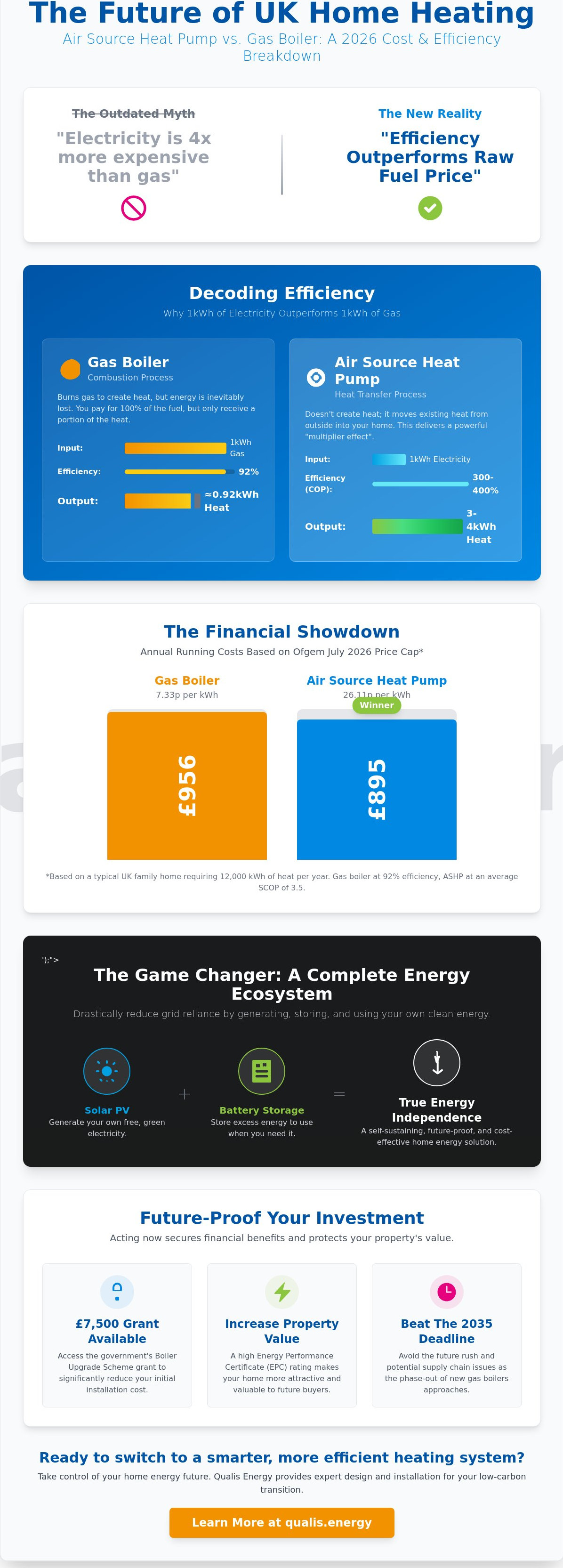
Raw fuel costs are often deceptive. If you look purely at the pence per kilowatt-hour, gas appears significantly cheaper than electricity. However, this comparison ignores the fundamental physics of how each system operates. A gas boiler relies on combustion. It burns a fuel source to generate heat, a process where waste is an unavoidable byproduct. Even the most advanced A-rated condensing boilers struggle to exceed 92% to 94% efficiency because energy is always lost through the flue. You're paying for 100% of the gas, but only feeling 92% of the warmth.
Heat pumps operate on an entirely different principle. They don't create heat; they move it from the outside air into your home using a refrigerant cycle. This allows for a "multiplier effect" that defies traditional combustion logic. For every 1kWh of electricity the system consumes, it can deliver between 3kWh and 4kWh of heat. This ratio is known as the Coefficient of Performance (COP). This efficiency is the primary reason why the cost to run air source heat pump vs gas boiler UK 2026 is becoming a competitive reality for modern households. An independent analysis of running costs demonstrates that this efficiency effectively bridges the price gap between the two fuels.
COP vs SCOP: Measuring Real-World Performance
The Seasonal Coefficient of Performance (SCOP) represents the average efficiency of a system across an entire UK heating season. Performance naturally fluctuates as temperatures drop in regions like Nottingham or Sheffield, yet modern units are engineered for resilience. A well-designed system maintains high efficiency even when external temperatures hit -5 degrees. The common myth that heat pumps "stop working" in the British winter is a misunderstanding of the technology's ability to extract energy from cold air.
The "Flow Temperature" Secret
Maximising efficiency requires a shift in how we think about heat delivery. Heat pumps perform best at lower flow temperatures, providing a steady and consistent warmth rather than the "on-off" blasts of a traditional boiler. This makes underfloor heating or larger radiators the favourite partners for an ASHP installation. When combined with adequate insulation, these lower temperatures reduce the strain on the system. If you want to ensure your current system is operating at its peak, regular maintenance & servicing is the most effective way to protect your investment and keep running costs low.
The Financial Showdown: Annual Running Costs Compared
The numbers don't lie. Financial clarity is paramount when you're deciding on a multi-decade investment for your home. While the previous section established the technical superiority of heat pump efficiency, we must now translate those percentages into pounds and pence. In 2026, the landscape has shifted. We're no longer just comparing two different boxes on a wall. We're comparing two entirely different energy philosophies. When you calculate the cost to run air source heat pump vs gas boiler UK 2026, you're looking at a combination of unit rates, standing charges, and the significant impact of government support. It's a calculation that requires precision and a long-term perspective.
Direct Bill Comparison: Gas vs Electricity
For a typical three-bedroom semi-detached home requiring 12,000 kWh of heat annually, the fuel choice dictates your monthly outgoings. A modern gas boiler operating at 90% efficiency will consume roughly 13,333 kWh of gas. At the July 2026 rate of 7.33p per kWh, this results in a fuel bill of approximately £977. However, an air source heat pump with a Seasonal Coefficient of Performance (SCOP) of 3.8 would only require 3,158 kWh of electricity. At 26.11p per kWh, the electricity cost sits around £824. The "break-even" efficiency point is currently around 3.5; any system performing above this level is actively saving you money on every unit of heat delivered. Removing the gas standing charge of 29.04p per day further tips the scales for households that choose to go entirely electric.
The Boiler Upgrade Scheme (BUS) in 2026
The capital barrier is falling. The government has extended the Boiler Upgrade Scheme to 2029/30, providing a substantial £7,500 grant for air source heat pump installations. This funding is a cornerstone of the national transition, designed to bring the upfront cost of low-carbon heating into line with traditional gas boiler replacements. To qualify, your property must have a valid EPC with no outstanding recommendations for loft or cavity wall insulation. We understand that paperwork can be a deterrent for many homeowners. To ensure total convenience, Qualis Energy manages the entire grant application process on your behalf. We handle the technical submissions and regulatory compliance, allowing you to focus on the long-term benefits of your new system without the administrative burden. Transitioning to a future-proof home should be a seamless experience, not a bureaucratic hurdle. High-quality maintenance & servicing will then protect that investment, ensuring your system maintains its peak efficiency for years to come.
The Game Changer: Solar PV, Battery Storage, and Smart Tariffs
The true financial potential of a heat pump is unlocked when it stops being an isolated appliance and starts being the heart of a domestic energy ecosystem. In 2026, the cost to run air source heat pump vs gas boiler UK 2026 is no longer a fixed calculation based solely on grid rates. It's a dynamic equation influenced by how much power you can harvest yourself. Solar PV allows you to generate "free" heating fuel directly from your roof, fundamentally breaking the traditional link between energy consumption and monthly bills. This is where the transition moves from a carbon-saving exercise to a masterclass in financial self-reliance.
Maximising Self-Consumption with Solar PV
A typical domestic solar array provides a substantial contribution to the electricity required by an ASHP, particularly during the shoulder months of spring and autumn. By integrating solar panels and installation into your wider heating strategy, you create a permanent shield against grid price hikes. Battery storage represents the next logical step in this evolution. It captures excess solar generation during the day and stores it for the evening heating peak, ensuring your home remains warm without relying on 26.11p per kWh grid power after the sun sets. This synergy allows you to maximise your self-consumption, keeping your generated energy within your own four walls rather than exporting it for a lower return.
Smart Tariffs: Getting Paid to Heat Your Home
The widespread adoption of "Time of Use" and "Agile" tariffs in 2026 has fundamentally changed the ROI for electrified heating. These tariffs offer fluctuating prices based on real-time grid demand, occasionally resulting in "negative pricing" events where smart users are actually paid to consume energy. Modern smart controls can automatically organise your heating cycles to align with these cheapest windows. Your hot water cylinder effectively acts as a thermal battery, storing heat when electricity is at its lowest rate for use during more expensive periods. This process of "load shifting" away from the 4pm to 7pm peak can result in annual running costs that a gas boiler, tethered to a single fuel price, simply cannot replicate. To see how these technologies can be tailored to your specific property, you can explore an integrated solution with Qualis Energy and start your journey toward energy independence.
Transitioning with Qualis Energy: Expert Installation in the East Midlands
National transitions require local leadership. A generic installer might understand the technology, but they rarely understand the nuances of East Midlands architecture. Whether you're in Nottingham, Sheffield, or Newark, the specific characteristics of your property dictate the real-world cost to run air source heat pump vs gas boiler UK 2026. At Qualis Energy, we combine high-level technical expertise with a deep-rooted commitment to our regional communities. We don't just sell equipment; we facilitate a shift in how our neighbours manage their resources and demonstrate their environmental pride. Our mission is to bridge the gap between complex industrial technology and the domestic comfort you deserve.
Bespoke Design for Local Housing Stock
Standardised solutions often fail because they ignore the unique thermal profiles of our local buildings. Sheffield’s iconic Victorian terraces present different challenges compared to Nottingham’s expansive suburban semis. We conduct meticulous, room-by-room heat loss calculations to ensure your system is perfectly sized for your specific environment. This precision is vital. An oversized system wastes energy, whilst an undersized one fails to deliver comfort during a cold snap. We provide a supportive and accessible path for homeowners across Mansfield, Chesterfield, and the wider region, ensuring that every installation is a masterpiece of efficiency and reliability.
Your Journey to Energy Independence
We believe in a narrative of completeness. Our end-to-end approach means we manage every phase of the project, from the initial conceptual design through to the final air source heat pump installation. Reliability is built into our process through MCS accreditation, which is a non-negotiable requirement for grant eligibility and system performance. This certification acts as your guarantee of quality and compliance. Once your system is live, our commitment continues with proactive air source heat pump servicing to maintain peak efficiency. We remove the effort for the client, organising the technical details so you can enjoy the transition with total confidence and peace of mind.
The choice to move away from fossil fuels is a powerful statement of intent. It's about taking control of your home's destiny and contributing to a cleaner, more secure British energy grid. By choosing a partner who understands the local landscape and the evolving cost to run air source heat pump vs gas boiler UK 2026, you're investing in a future that is both sustainable and financially sound. Join the national transition today. Contact us for a bespoke energy proposal and take the first step toward true energy independence.
Securing Your Home’s Energy Future Today
Upgrading your heating system is far more than a simple appliance replacement. It's a strategic move toward domestic independence and long-term financial stability. We've explored how thermodynamic efficiency and smart solar integration have fundamentally rewritten the cost to run air source heat pump vs gas boiler UK 2026. By leveraging modern technology, you aren't just heating your home; you're insulating your household from the volatility of global fossil fuel markets.
Qualis Energy stands ready as your visionary partner in this critical national transition. As MCS Accredited Installers specialising in the unique housing stock of Nottingham and Sheffield, we ensure every system is designed for peak regional performance. We remove the administrative burden by managing the £7,500 BUS Grant application on your behalf, making the journey to low-carbon living entirely seamless. The path toward a sustainable, cost-effective home is clear, and the best time to begin that journey is now.
Book your bespoke 2026 energy consultation with Qualis Energy today and take command of your home's environmental legacy.
Frequently Asked Questions
Is an air source heat pump really cheaper to run than a gas boiler in 2026?
Yes, an air source heat pump is often cheaper to run than a gas boiler in 2026 once you account for high system efficiency and the removal of gas standing charges. With electricity at 26.11p per kWh and gas at 7.33p per kWh, the "multiplier effect" of a heat pump bridges the price gap. When you calculate the cost to run air source heat pump vs gas boiler UK 2026, the financial advantage becomes even clearer if you utilise smart tariffs to shift your consumption to cheaper off-peak windows.
How much does it cost to install a heat pump after the £7,500 grant?
The £7,500 Boiler Upgrade Scheme (BUS) grant is designed to bring the initial capital outlay for a heat pump into the same range as a traditional gas boiler replacement. While we don't quote fixed prices due to the bespoke nature of every property, the grant covers a substantial portion of the equipment and labour. This government support is a cornerstone of the national transition, ensuring that sustainable heating is accessible to a broader range of British homeowners.
Can a heat pump heat an old, poorly insulated UK home?
Heat pumps can certainly heat older properties, but their efficiency is intrinsically linked to how well the building retains that warmth. For Victorian terraces or solid-wall homes, we recommend prioritising loft and cavity wall insulation to ensure the system doesn't have to work unnecessarily hard. A bespoke design that accounts for specific heat loss calculations allows these systems to provide consistent comfort even in challenging East Midlands housing stock.
Do I need to replace my radiators if I switch to a heat pump?
You don't always need to replace your radiators, but larger surface areas are the favourite partners for heat pump technology. Because these systems operate at lower flow temperatures, existing radiators might need to be upgraded to "K3" types or supplemented with underfloor heating to deliver the required warmth. We assess your current emitters during the design phase to determine if they can effectively distribute heat at these more efficient, lower temperatures.
How much can I save if I combine a heat pump with solar panels?
Combining a heat pump with solar PV and battery storage can reduce your reliance on the National Grid for heating by a significant margin. By generating your own "free" electricity, you shield your household from the 26.11p per kWh unit rate. This integration is the ultimate way to lower the cost to run air source heat pump vs gas boiler UK 2026, effectively turning your home into a self-sustaining energy ecosystem.
What is the lifespan of an air source heat pump compared to a boiler?
Air source heat pumps generally offer a longer operational lifespan, typically lasting between 15 and 20 years when properly maintained. In contrast, most modern gas boilers begin to see a decline in reliability after 10 to 12 years. This longevity, supported by regular maintenance & servicing, ensures that your investment continues to deliver value and comfort long after a traditional fossil fuel system would have required replacement.
Are gas boilers being banned in the UK in 2026?
There is no ban on gas boilers for existing homes in 2026, but the Future Homes and Buildings Standards will phase them out for new build properties. This policy ensures that all new UK homes are "zero-carbon ready" from the outset. Whilst you can still install a gas boiler in an older property today—and you can explore Vaillant Boiler Installation for high-efficiency alternatives—the shifting regulatory landscape and property value trends clearly favour the transition to low-carbon alternatives.
How noisy is an air source heat pump for my neighbours?
Modern air source heat pumps are remarkably quiet, typically producing a sound level similar to a domestic refrigerator or a quiet conversation. When installed correctly on anti-vibration mounts, the noise is barely perceptible to neighbours. We carefully select the installation location to comply with permitted development regulations, ensuring that your transition to clean energy doesn't disturb the peace of your local community.


Comments