
Heat Pump Efficiency in Nottingham & Sheffield: The 2026 Homeowner’s Guide
- James

- May 4
- 12 min read
Updated: May 5
A heat pump is only as powerful as the engineering behind it. Whilst many homeowners in Nottingham and Sheffield believe that heat pump efficiency is simply a number on a manufacturer's spec sheet, the reality is that a poorly designed system can lose 30% of its performance during a single sub-zero peak. You're likely concerned about rising electricity prices and whether technical jargon like COP ratings will actually keep your family warm when the South Yorkshire frost sets in. We understand that confusion; it's a frustration shared by many watching the UK's critical transition to a greener grid.
This guide will show you exactly how to maximise your system's performance to slash energy bills and future-proof your home against the 2027 Future Homes Standard. We'll explain how to secure the £7,500 Boiler Upgrade Scheme grant, which, as of April 2026, no longer requires you to have completed loft insulation recommendations to qualify. From understanding local emitter sizing to navigating the 2030 scheme extension, you'll discover how we manage the entire process so you don't have to lift a finger. We're here to help you hold high the renewable energy flag with total confidence in your home's long-term comfort.
Key Takeaways
Master the technical jargon by learning why Seasonal Coefficient of Performance (SCOP) is a more reliable measure of annual running costs than a standard COP rating.
Discover why maintaining a flow temperature of 35°C is the critical "sweet spot" for achieving peak heat pump efficiency in the variable UK climate.
Analyse the 2026 "Spark Gap" to understand the exact point where a 400% efficient system outperforms traditional gas boilers on your monthly energy bill.
Adopt the "set it and forget it" heating philosophy whilst using weather compensation technology to allow your system to automatically adjust to Sheffield’s external temperatures.
Learn how our "Efficiency First" design philosophy handles everything from DNO applications to MCS-certified handover so you never have to lift a finger.
Understanding Heat Pump Efficiency: COP, SCOP, and SFP Explained
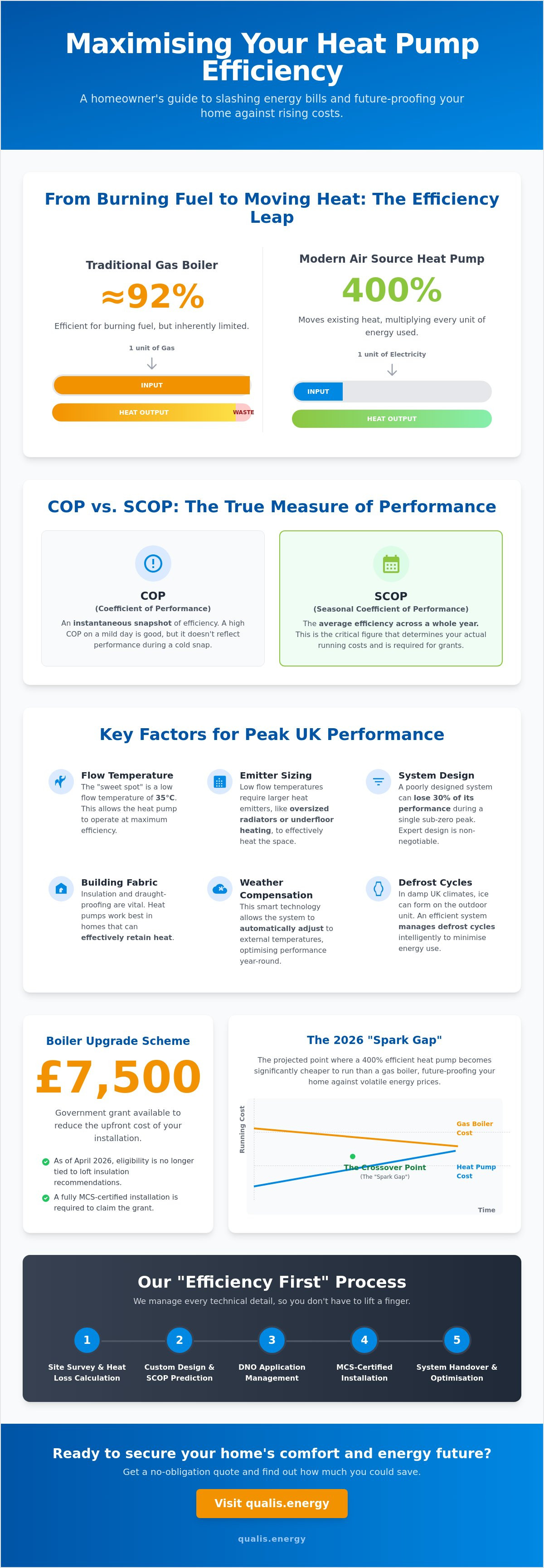
Efficiency isn't just a technical specification. It's the heartbeat of your home's financial and environmental sustainability. Whilst a traditional A-rated gas boiler struggles to reach 92% efficiency, modern air source heat pumps regularly achieve 400% efficiency. This means for every unit of electricity you put in, you get four units of heat out. This isn't magic; it's a fundamental shift in how we power our lives. We're moving from burning finite fuels to intelligently moving existing thermal energy from the air into your living room.
To understand how your system performs, we look at the Coefficient of Performance (COP). This is an instantaneous measurement of heat pump efficiency at a specific moment. If the sun is shining on a mild afternoon and your pump is working at its peak, the COP will be high. However, a snapshot doesn't pay the bills. As the UK transitions toward a cleaner grid, we need to look at the bigger picture of how these systems behave over time, especially when the temperature drops across Nottinghamshire and South Yorkshire.
Why SCOP Matters More Than COP for Your Bills
A high COP on a pleasant Newark morning won't guarantee low running costs in the middle of a Mansfield frost. This is why we focus on the Seasonal Coefficient of Performance (SCOP). This metric provides an average of your system's efficiency across the entire heating season. It accounts for the fluctuating temperatures we expect in the East Midlands, ensuring that your heat pump efficiency remains high even when the mercury dips. At Qualis Energy, we calculate your predicted SCOP during our initial site survey. We don't guess; we use local climate data and precise heat loss calculations to ensure your system is perfectly sized for the local environment.
The Role of System Efficiency in the 2026 Warm Homes Plan
The landscape of government support changed significantly in April 2026. Under the current Warm Homes Plan, eligibility for the £7,500 Boiler Upgrade Scheme grant is now strictly tied to verified performance benchmarks. The government has raised the bar, requiring higher SCOP ratings to ensure that public investment leads to genuine carbon reductions and lower household costs. SCOP is the total heat output divided by total electricity input over a full year. To guarantee these ratings, your installation must be MCS-certified. This accreditation acts as a seal of quality, proving that your system meets the rigorous standards required for 2026 energy infrastructure. We handle all the technical compliance and DNO applications, so you can focus on the comfort of your home whilst we manage the complexities of the national energy transition.
Factors That Determine Heat Pump Efficiency in the UK
Design is the difference between a system that survives and one that thrives. Whilst the vapour compression cycle is a marvel of engineering, its performance is dictated by the laws of thermodynamics. As the outdoor ambient temperature drops, the pressure difference required by the compressor increases. This means heat pump efficiency is intrinsically linked to the local climate. By choosing a system designed to reduce your electricity use for heating, you ensure that even on the coldest January nights in South Yorkshire, your home remains a sanctuary of warmth without the staggering costs associated with fossil fuels.
Humidity plays a silent but significant role in our region. In the Trent Valley, damp air often leads to ice formation on the external evaporator coil. This triggers a defrost cycle, where the pump temporarily reverses its flow to melt the ice. These cycles are essential but they do consume energy. Your building fabric also acts as the container for this captured heat. If your home is riddled with draughts, your pump will work harder to replace lost energy, dragging down your seasonal performance. We believe in a holistic approach where the machine and the building work in perfect harmony.
Flow Temperatures and Emitter Sizing
The "sweet spot" for any air source system is a flow temperature of 35°C. When you run water through your radiators at this lower temperature, the pump operates at its most effortless state. However, this requires larger emitters, such as oversized radiators or underfloor heating, to distribute enough heat. An "Efficiency Gap" occurs when installers try to use existing, small radiators. This forces the pump to run at 55°C, which can drop your COP by as much as 25%. We specialise in bespoke emitter sizing to ensure your system never has to overwork.
Nottinghamshire Climate and Defrost Cycles
Local geography matters more than you might think. Sheffield's hilly terrain can create wind tunnels that strip heat away from the unit, whilst the mist of the Trent Valley increases frost risk. Modern Mitsubishi units use advanced logic to optimise these defrost cycles, ensuring they only occur when absolutely necessary. We often recommend strategic wind-shielding for units in exposed Sheffield suburbs to protect the SCOP. Understanding these micro-climates is part of our commitment to professional local installation. We handle the technical complexities so you can enjoy a reliable, high-performance home.
Heat Pump Efficiency vs Gas Boilers: A 2026 Comparison
The battle for the British boiler cupboard has already been won by technology. Whilst a modern A-rated gas boiler is essentially a machine designed to lose as little energy as possible, it remains physically capped at roughly 92% efficiency. In contrast, heat pump efficiency allows a system to deliver four times more energy than it consumes by harvesting ambient heat from the South Yorkshire air. You can find expert answers on heat pump efficiency that confirm this 400% benchmark is the new gold standard for UK decarbonisation.
Maintenance plays a pivotal role in preserving these technological gains over the long term. A neglected system with clogged filters or debris-filled external fins can see its performance drop by 15% in a single season. We ensure your system remains a high-performing asset through our comprehensive maintenance plans, meaning you won't need to lift a finger to keep your home warm. By treating your heat pump as a precision instrument rather than a "fit and forget" appliance, you protect your investment and maintain peak operational standards.
The Cost-Efficiency Matrix
To understand the "Spark Gap," we must look at the ratio between electricity and gas prices. In 2026, when your heat pump operates at a SCOP of 4.0, it effectively neutralises the higher unit cost of electricity compared to gas. Consider the requirements to generate 10,000kWh of thermal energy for a typical semi-detached home:
Gas Boiler (90% efficient): Requires approximately 11,111kWh of gas.
Air Source Heat Pump (400% efficient): Requires only 2,500kWh of electricity.
Operational costs are further reduced when you integrate agile smart tariffs designed specifically for low-carbon heating. These specialised rates allow you to shift your heaviest heating loads to cheaper, off-peak windows. By allowing the system to "buffer" heat during these times, you maximise the financial return on your investment whilst reducing the strain on the local grid.
Future-Proofing Against Carbon Taxes
Sheffield’s commitment to Net Zero means the regulatory environment is shifting rapidly against fossil fuels. The Future Homes Standard, arriving 24 March 2027, effectively mandates low-carbon heating for all new builds, making gas boilers a legacy technology. By investing now, you avoid the inevitable fossil fuel levies and rising carbon taxes that will eventually make gas heating a significant financial liability. For a deeper look at the transition process, read our comprehensive guide on Air Source Heat Pump Installation in Nottingham & Sheffield. We're here to help you hold high the renewable energy flag whilst securing your family's comfort for the next two decades.
How to Maximise Your Heat Pump Efficiency
True heat pump efficiency is achieved through consistency, not intensity. Many homeowners are accustomed to the "burst" heating style of traditional gas boilers, where the thermostat is cranked up only when the house feels cold. This approach is the enemy of renewable performance. A heat pump is designed to operate as a "set it and forget it" system, maintaining a steady, low-level ambient temperature throughout the day. By avoiding the need for the compressor to work at maximum capacity to "catch up," you significantly reduce the strain on your system and your wallet.
The integrity of the heat exchanger is the final piece of the puzzle. Over time, microscopic debris can coat the internal surfaces, creating a thermal barrier that forces the pump to work harder. Regular servicing ensures that these components remain pristine, preserving the high SCOP ratings we promise during installation. We take pride in our role as a visionary facilitator, managing these technical details so that you can enjoy the domestic comfort of a future-proofed home without ever needing to lift a finger.
Smart Controls and Weather Compensation
Weather compensation technology allows your heating system to think for itself. By using external sensors to monitor the air temperature in Barnsley or Rotherham, the system automatically adjusts the flow temperature before your home even begins to cool down. This proactive adjustment prevents the "cycling" of the compressor, where the unit frequently turns on and off. Constant cycling is inefficient and shortens the lifespan of the hardware. We utilise Mitsubishi’s FTC6 controllers, which provide precise energy monitoring and allow you to track your heat pump efficiency in real-time, ensuring your investment is always performing at its peak.
Integrating Solar PV for Maximum ROI
The synergy between solar power and low-carbon heating represents the pinnacle of modern domestic energy. When you integrate a solar array, you can use excess generation during the day to "pre-heat" your hot water cylinder or slightly raise the indoor temperature. This effectively stores renewable energy as heat, reducing the need to draw from the grid during expensive evening peaks. Adding battery storage further enhances this effect, allowing the heat pump to run on stored sunshine even after the sun has set over the Peak District. For a deeper look at how these technologies work in tandem, see our Solar Panels and Installation Guide.
Ready to see how these integrated solutions can transform your energy bills? You can book a professional system optimisation with our expert team to ensure every component of your home's infrastructure is working in perfect harmony.
Qualis Energy: Expertise in High-Efficiency ASHP Installation
The future of home energy has arrived. We believe that heat pump efficiency is a product of meticulous engineering rather than chance. Our "Efficiency First" design philosophy is specifically tailored to the unique architectural landscape of Nottingham and South Yorkshire. We don't just install hardware; we lead a critical national transition by moving your project logically from the initial heat loss survey through to the final DNO application and MCS-certified handover. This end to end capability ensures that your journey is fully mapped out and professionally managed from start to finish.
Our commitment to your home extends far beyond the initial installation. We provide comprehensive maintenance programmes designed to ensure your SCOP remains at peak performance for 20 years or more. Local expertise matters when it comes to system calibration. The atmospheric conditions in Newark differ from the coastal-influenced air of Lincoln, and these subtle variations affect how a system should be commissioned. This local knowledge allows us to fine-tune your system for maximum heat pump efficiency, ensuring your investment delivers the reliable, low-carbon warmth your family deserves.
Our Precision Design Process
Accuracy is the foundation of every Qualis Energy project. We perform rigorous room-by-room heat loss calculations to ensure your unit is perfectly sized for your specific building fabric. An undersized unit will struggle in the depths of winter, whilst an oversized unit will "cycle" inefficiently. We favour the Mitsubishi Ecodan range for its proven reliability in the variable UK climate and its ability to maintain high flow temperatures when needed. For a detailed look at why this technology is our preferred choice, read our Mitsubishi Heat Pump Installation Nottingham Guide. Our technical experts handle every aspect of the CDM project management, meaning you won't need to lift a finger during the transition.
Start Your Transition Today
We're proud to be the local hero in the East Midlands energy sector. Whether you're looking to upgrade a traditional semi-detached home or looking after the heating requirements of a large agricultural barn, we have the credentials to deliver. We're currently booking local efficiency surveys across Worksop, Doncaster, and Chesterfield for homeowners ready to show off their green credentials. Our team is dedicated to educating the next generation and helping our neighbours secure their energy independence. We invite you to join us in holding high the renewable energy flag. Contact Qualis Energy for a bespoke efficiency assessment and take the first step toward a more sustainable, cost-effective future for your home.
Secure Your Home’s Energy Future Today
The transition to low-carbon heating is a national necessity. We've explored how understanding SCOP and precision emitter sizing can unlock the true potential of heat pump efficiency, allowing your home to outperform outdated gas systems whilst protecting the planet. By integrating smart controls and local weather data, you ensure your system remains a high-performing asset for decades to come.
Since 2021, we've helped families across Nottingham, Sheffield, and the East Midlands secure their energy independence. Our team of MCS Accredited Installers are specialists in Mitsubishi Ecodan technology, providing the technical expertise required to ensure your installation meets the highest regulatory standards. We handle everything from G98 applications to long-term maintenance, ensuring you don't have to lift a finger. Book your bespoke heat pump efficiency survey with Qualis Energy to begin your transformation. We're ready to help you hold high the renewable energy flag and build a more resilient community for the next generation.
Frequently Asked Questions
What is a good efficiency rating for a heat pump in the UK?
A Seasonal Coefficient of Performance (SCOP) between 3.5 and 4.0 is the benchmark for a high-performing UK installation. This rating ensures that your heat pump efficiency is high enough to comfortably offset the price difference between electricity and gas. We target these specific benchmarks in every East Midlands design to guarantee your home remains warm whilst your energy bills stay manageable.
Does heat pump efficiency drop in freezing weather?
Efficiency does decrease as outdoor temperatures fall, but the system won't stop providing heat. Modern units are engineered to extract thermal energy even when the mercury hits -20°C. Whilst the instantaneous COP might dip during a Sheffield cold snap, the system remains significantly more efficient than any electric heater or legacy fossil fuel boiler.
Can I improve the efficiency of an existing heat pump system?
You can certainly enhance performance by fine-tuning your system settings. Lowering your flow temperature and ensuring your weather compensation curve is correctly calibrated can improve SCOP by up to 15%. We recommend a professional system audit to identify these efficiency gains in your existing setup without needing to replace major hardware.
How does radiator size affect heat pump efficiency?
Radiator surface area is the primary driver of system performance. Larger radiators allow the system to deliver the same amount of heat at a lower flow temperature, typically 35°C rather than 55°C. This reduction in flow temperature is the most effective way to boost your heat pump efficiency and significantly lower your annual running costs.
Is a heat pump more efficient than a hybrid system?
A pure air source heat pump is fundamentally more efficient than a hybrid because it relies entirely on renewable energy transfer. Whilst a hybrid system uses a gas boiler as a backup, it still suffers from the 10% energy loss inherent in combustion. Transitioning fully to a heat pump eliminates this waste and removes the need for a standing gas connection charge.
How much can I save on my bills with a 400% efficient heat pump?
Savings are dictated by the "Spark Gap" between gas and electricity prices. When a system operates at 400% efficiency, it typically costs less to run than a gas boiler, particularly when paired with smart time-of-use tariffs. Homeowners using these agile rates often see substantial reductions in their monthly energy expenditure by shifting loads to cheaper off-peak windows.
Does a heat pump need to be serviced to stay efficient?
Annual servicing is essential to maintain peak performance and protect your manufacturer's warranty. Dust and debris on the external evaporator can force the compressor to work 15% harder to achieve the same indoor temperature. Our maintenance programmes keep your system pristine so it continues to operate at its laboratory-rated standards year after year.
Can I run a heat pump efficiently in a Victorian terrace house in Nottingham?
Victorian terraces in Nottingham can be heated efficiently with a bespoke design. Whilst these properties often have higher heat loss, correctly sized radiators and targeted draught-proofing allow a heat pump to thrive. We've successfully installed high-efficiency systems in many period homes across the East Midlands by focusing on the building's specific thermal envelope.


Comments