
How to Finance Solar Panels UK: The 2026 Guide to Grants, Loans, and PPAs
- James

- 4 days ago
- 12 min read
What if the greatest risk to your finances isn't the cost of solar, but the cost of waiting? Understanding how to finance solar panels UK has evolved into a strategic move for liquidity rather than a simple purchase. Many homeowners and directors fear that high interest rates might outweigh energy savings or that they'll miss the latest policy window. We recognise that the path to energy independence must be as fiscally sound as it is environmentally responsible.
This guide will show you how to achieve a cash-flow neutral installation where your monthly savings cover your repayments. You'll gain absolute clarity on the £15 billion Warm Homes Plan and the 0% VAT extension currently set until March 2027. We'll also preview the latest 0% interest green mortgages from lenders like Nationwide and the Power Purchase Agreements that are helping businesses secure energy for as little as 12p per kWh. From initial design to final implementation, we've mapped out your route to a lower carbon footprint without the capital strain.
Key Takeaways
Learn why the 2026 market has transitioned toward "energy-as-a-service" models that focus on immediate cash-flow benefits rather than large capital outlays.
Navigate the latest eligibility requirements for the £15 billion Warm Homes Plan and discover how to finance solar panels UK through interest-free government initiatives.
Evaluate the financial advantages of green mortgages versus 0% APR installer credit to ensure your energy savings consistently exceed your repayments.
Discover how commercial Power Purchase Agreements allow UK businesses to install solar with zero capital expenditure whilst securing long-term price stability.
Understand how a bespoke design strategy from Qualis Energy creates a seamless, cash-flow positive transition to renewable power from day one.
Table of Contents
The 2026 Solar Landscape: Why Financing is the New Standard
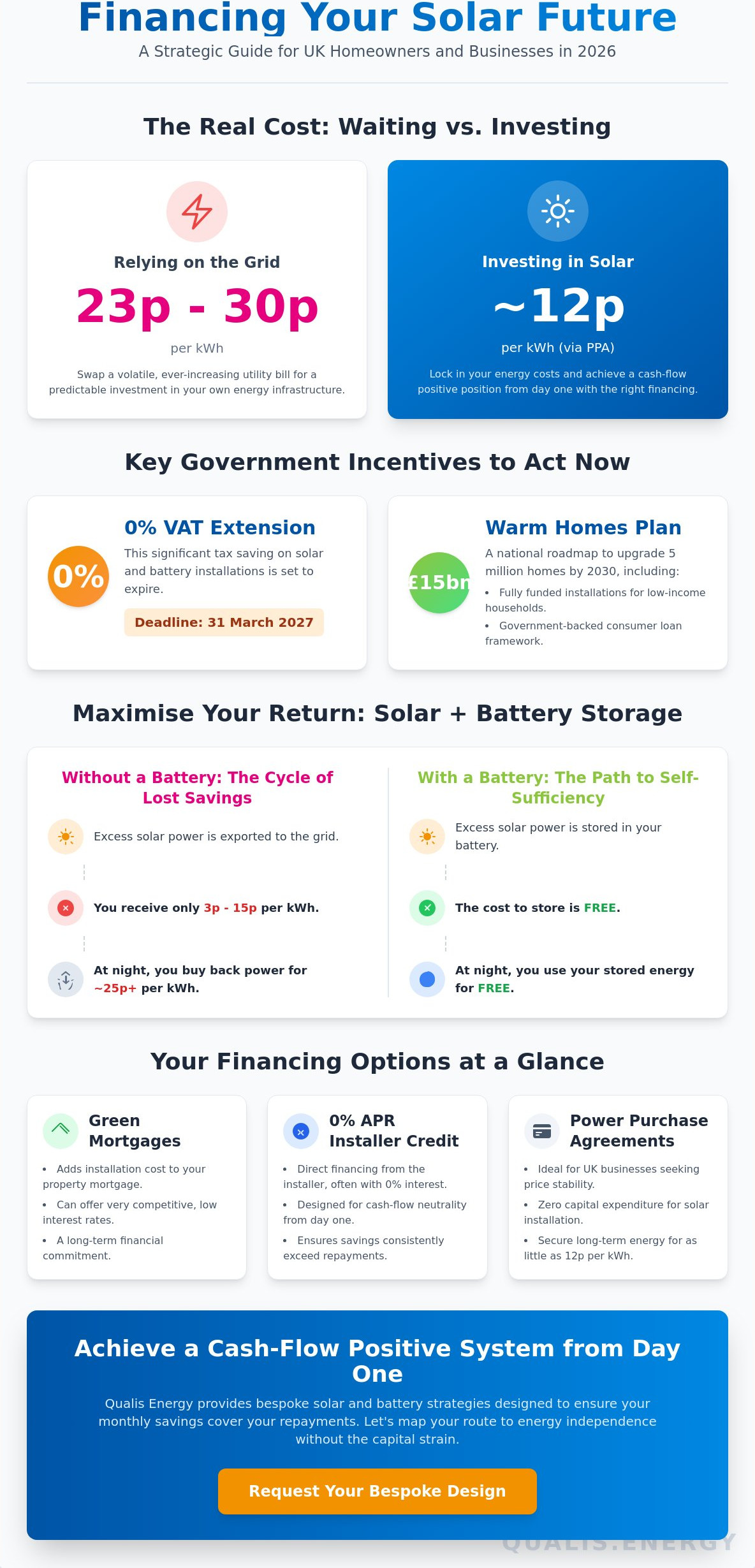
Energy independence has reached a critical tipping point. In 2026, the conversation around renewable energy has shifted from "can we afford to install it?" to "can we afford not to?" With average grid electricity rates for businesses and homes hovering between 23p and 30p per kWh, the reliance on traditional utility providers is an increasingly expensive habit. Financing is now the primary vehicle for this transition because it allows you to swap a volatile monthly utility bill for a fixed, predictable investment in your own infrastructure. This "energy-as-a-service" model ensures that the capital stays in your pocket whilst the technology pays for itself through immediate overhead reduction.
The growth of Solar power in the United Kingdom has proven that these systems are no longer experimental; they are essential national infrastructure. Understanding how to finance solar panels UK is now a requirement for any savvy homeowner or business owner looking to hedge against inflation. Because 2026 market prices for hardware have stabilised, the real financial gains are found in the financing structure itself. By leveraging low-interest green loans or government-backed schemes, you can achieve a cash-flow positive position from the first month of operation. The savings generated by your panels don't just offset the loan; they often exceed it.
The Economic Shift: From Capital Expense to Operational Saving
Waiting for technology prices to drop further is a common mistake that often results in "lost saving" costs that far outweigh any minor price decrease. The 0% VAT incentive on solar installations is currently set to expire on 31 March 2027, making the 2026 window particularly lucrative. By using a long-term, fixed-rate green loan, you effectively lock in your energy costs at today's rates. As inflation continues to impact the wider economy, your fixed repayments stay the same, meaning your "real-term" energy costs actually decrease every year the system is in place.
Integrated Systems: Financing Solar and Batteries Together
The most successful financial strategies in 2026 involve a holistic approach. Financing a combined Solar PV and Battery Storage system typically offers a superior return on investment compared to solar alone. Without a battery, you're forced to export surplus energy to the grid via the Smart Export Guarantee (SEG) for as little as 3p to 15p per kWh, only to buy it back later at 25p or more. Qualis Energy focuses on designing integrated systems that allow you to store your own power for 24/7 use. This approach maximises your self-consumption and ensures your financing repayments are supported by the highest possible level of energy savings.
Government Grants and the 2026 Warm Homes Plan
The UK's energy strategy underwent a seismic shift in January 2026 with the launch of the £15 billion Warm Homes Plan. This isn't just a grant; it's a comprehensive national roadmap designed to upgrade 5 million homes by 2030. For those researching how to finance solar panels UK, this plan represents the most significant public investment in domestic energy security to date. It partitions support into two primary streams: fully funded installations for low-income households and a robust consumer loan framework for the wider population. This dual-track approach ensures that the transition to renewable energy is inclusive, moving the nation away from fossil fuel dependency whilst protecting the most vulnerable residents.
Whilst the national framework provides the skeleton, regional councils in Nottinghamshire and South Yorkshire often layer additional support through local carbon-reduction funds. These local initiatives can sometimes bridge the gap for households that sit just outside national eligibility brackets, making the transition even more accessible. If you're unsure which tier of the Warm Homes Plan applies to your property, you can speak with our regional specialists for a tailored eligibility assessment.
Interest-Free Loans: Who Qualifies in 2026?
The government-backed Consumer Loan Scheme is the cornerstone of the new strategy for the average homeowner. Detailed application criteria are being finalised throughout 2026, with the full scheme launching in April 2027. These loans are designed to be cash-flow neutral, allowing you to pay back the infrastructure cost using the money saved on your utility bills. You can further enhance this financial model by registering for the Smart Export Guarantee (SEG), which allows you to earn between 3p and 15p per kWh for surplus energy sent back to the grid. By combining interest-free repayments with SEG income, the "net cost" of your system can often become a monthly surplus.
The Role of MCS Accreditation in Securing Funding
Securing government-backed finance is strictly contingent on technical compliance. To qualify for the Warm Homes Plan or the SEG, your system must be installed by a provider with Microgeneration Certification Scheme (MCS) accreditation. This isn't just a regulatory hurdle; it's a guarantee of structural integrity and performance. At Qualis Energy, we maintain rigorous standards to ensure our clients remain eligible for every available incentive. You can read more about why this matters in our guide on Professional Solar Installation: Why MCS Accreditation Matters. Choosing an accredited installer protects your investment and ensures that your path to how to finance solar panels UK remains clear of administrative roadblocks.
Private Finance Options: Green Mortgages vs Installer Credit
Private capital is the engine driving the 2026 solar revolution. Whilst government schemes provide a vital safety net, many homeowners are discovering that private banking products offer the flexibility needed for a truly bespoke installation. The secret to how to finance solar panels UK successfully lies in achieving a "cash-flow neutral" state. This is where your monthly energy savings effectively cancel out your finance repayments, leaving your household liquidity untouched. Achieving this balance requires a strategic choice between mortgage-backed borrowing and point-of-sale installer credit.
Lenders have responded to the climate crisis with unprecedented competitive rates. As of early 2026, the UK's green mortgage market has expanded significantly, with products designed to reward energy efficiency. Nationwide Building Society, for instance, offers 0% fixed interest for up to five years on loans between £5,000 and £20,000 for existing mortgage customers. Other institutions like The Co-operative Bank and Leeds Building Society provide preferential rates, often ranging from 4.10% to 4.69% depending on your loan-to-value ratio. These "further advances" allow you to spread the cost of your solar and battery system over the remaining life of your mortgage, often resulting in the lowest possible monthly payment.
Green Mortgages: Leveraging Your Home Equity
Integrating solar technology into your mortgage does more than just fund the hardware. By improving your property’s EPC rating, you may unlock lower interest rates across your entire mortgage balance. Most lenders now view solar-equipped homes as lower-risk assets with higher resale value. When you apply for a further advance, the bank typically conducts a desk-based valuation to confirm your equity. This route is often more cost-effective than a standalone personal loan because the interest is calculated at mortgage rates, which remain lower than typical unsecured credit in 2026.
Installer Finance: Convenience and Speed
Installer-led finance offers a different kind of advantage: speed and specific consumer protection. When you choose a finance plan through an installer, you're often protected under Section 75 of the Consumer Credit Act. This makes the lender jointly liable with the installer for the quality of the goods and services. For many, a 24-month 0% APR plan is the most effective way to clear the cost quickly without paying a penny in interest. However, if you prefer to maintain maximum monthly cash flow, a longer-term low-interest plan might be more suitable. At Qualis Energy, we prioritise transparent, jargon-free discussions to ensure the finance matches your long-term goals. Always check the fine print for early repayment penalties; in 2026, the best agreements allow you to pay off your balance early as your energy savings accumulate.
Commercial Solar Financing: Strategy for UK Businesses
Energy security is no longer a peripheral concern for UK industry; it is a core pillar of operational resilience. For directors and stakeholders, the question of how to finance solar panels UK for commercial properties is now answered through sophisticated capital preservation strategies. In 2026, the fiscal environment for commercial solar is exceptionally favourable. Businesses can claim 100% of the installation cost, up to £1 million, against taxable profits in the first year through the Annual Investment Allowance (AIA). Additionally, solar installations remain 100% exempt from business rates until at least March 2035, ensuring that your infrastructure investment does not result in an increased tax burden on your property.
For firms operating in the industrial zones of Nottingham and Sheffield, regional energy constraints make on-site generation a necessity for expansion. Transitioning to solar allows you to bypass the volatile grid market, where rates currently fluctuate between 23p and 30p per kWh. By generating your own power, you lock in a significantly lower levelised cost of energy for the next 25 years. If you are ready to secure your firm’s energy future, you can request a commercial feasibility study from our specialist team.
Power Purchase Agreements (PPA) Explained
A PPA is a financial arrangement where a third-party developer owns and maintains the solar system on a business’s roof. This model is ideal for companies that prioritise zero upfront capital expenditure. You simply buy the electricity generated by the panels at a predetermined rate, which in early 2026 averages around 12p per kWh. This provides absolute energy price certainty amongst volatile market conditions. At the end of the PPA term, which typically spans 10 to 25 years, ownership of the entire system usually transfers to the business for a nominal fee, providing decades of free energy thereafter.
Asset Finance and ROI for Commercial PV
Asset finance allows businesses to spread the cost of a system over several years, often ensuring the project is self-funding from day one. The monthly energy savings and tax benefits typically outweigh the finance repayments, protecting your working capital. Beyond the balance sheet, commercial solar is a cornerstone of modern ESG (Environmental, Social, and Governance) reporting. It provides a verifiable data point for carbon reduction that is essential for maintaining supply chain contracts with major UK firms. You can explore these strategies in depth in our Commercial Solar PV: The 2026 Strategic Guide for UK Businesses. By choosing an MCS-accredited partner, you ensure that your commercial installation meets the rigorous standards required by both lenders and insurers.
Designing Your Solar Strategy with Qualis Energy
The journey toward energy independence is a complex transition that requires more than just hardware. It demands a partnership with a team that views your roof as a critical piece of national infrastructure. Understanding how to finance solar panels UK is the first step, but implementation requires a partner who understands the local landscape. At Qualis Energy, we don't simply fit panels; we architect energy futures. Our approach is fundamentally end-to-end, moving you logically from the initial conceptual phase through to final implementation and lifelong support.
Our local expertise in Nottingham and Sheffield is a vital asset for our clients. Regional councils in these areas often have specific carbon-reduction targets and local funding pots that can supplement national schemes like the Warm Homes Plan. We possess a granular understanding of these regional nuances, ensuring you don't miss out on local incentives that high-street lenders might overlook. By choosing a partner with deep roots in the East Midlands and South Yorkshire, you gain access to an expert hand that manages every administrative and technical step on your behalf.
A Visionary Approach to the UK’s Energy Transition
Qualis Energy acts as a facilitator for a wider mission. We're committed to shifting global perspectives on resource management, one household and one business at a time. This commitment extends far beyond the day of installation. We understand that your financed system is an investment that must be protected to ensure your repayments remain cash-flow positive. This is why we offer comprehensive maintenance and servicing packages to keep your technology operating at peak efficiency. Our expertise isn't limited to solar; you can explore our holistic approach to home energy in our guide on Air Source Heat Pump Servicing: The 2026 UK Homeowner’s Reference Guide.
Next Steps: Your Consultation and Quote
Your transition begins with a professional consultation. We don't believe in generic estimates or high-pressure sales. During a Qualis Energy financial feasibility assessment, we dissect your energy profile to provide transparent ROI projections tailored to your specific roof and consumption patterns. We'll help you weigh the benefits of the 2026 Warm Homes Plan against private green mortgages or commercial PPAs, ensuring the final strategy aligns with your liquidity needs. It's time to take control of your energy costs and demonstrate your environmental commitment with confidence. Book your 2026 solar financing consultation with Qualis Energy today and secure a predictable, sustainable future for your property.
Securing Your Energy Independence in 2026
Transitioning to renewable power has evolved from a simple purchase into a strategic financial decision. In 2026, the roadmap for how to finance solar panels UK is built on the principle of liquidity preservation. Whether you're a homeowner accessing the £15 billion Warm Homes Plan or a business director implementing a zero-upfront Power Purchase Agreement, the focus remains on achieving cash-flow neutrality. By swapping volatile utility bills for fixed, predictable infrastructure investments, you protect your capital whilst contributing to a critical national transition.
Qualis Energy acts as your visionary facilitator throughout this process. As an MCS Accredited installer and specialist in 2026 government compliance, we provide the technical expertise and local knowledge needed across Nottingham, Sheffield, and the East Midlands. Our team is ready to help you navigate the nuances of green mortgages and commercial asset finance with total transparency. Take the first step toward a more resilient energy future today and Request a Personalised Solar Finance Proposal. Your journey to a sustainable, low-carbon home or business is just one consultation away.
Frequently Asked Questions
Can I get solar panels for free in the UK in 2026?
Fully funded solar installations are available for low-income and vulnerable households through the targeted offer within the Warm Homes Plan. This initiative serves as the successor to the ECO4 scheme, which concluded in April 2026. Eligibility typically depends on receiving specific benefits or owning a property with a particularly low EPC rating. For households outside these criteria, the government has shifted its focus toward providing low-interest or interest-free loans.
How does the Warm Homes Plan affect solar panel financing?
The Warm Homes Plan provides the essential framework for how to finance solar panels UK by allocating £15 billion toward domestic energy upgrades. Its primary impact on financing is the introduction of a government-backed Consumer Loan Scheme. This initiative allows homeowners to access 0% or low-interest capital for solar and battery systems, designed so that monthly repayments are offset by the resulting energy savings.
Is it better to pay for solar panels upfront or through finance?
Financing is often the more strategic choice in 2026 for those who wish to maintain liquidity whilst benefiting from immediate energy reductions. Whilst an upfront purchase avoids interest entirely, the current market favours "cash-flow neutral" finance. This model ensures your monthly repayments don't exceed the money you save on your utility bills, effectively allowing the technology to pay for itself without a large capital outlay.
What is a Green Mortgage and how does it help with solar costs?
A Green Mortgage is a lending product that offers preferential interest rates or cashback for energy-efficient homes. Major UK lenders now provide these specialised products to encourage renewable transitions. You can often secure a "further advance" on your existing mortgage at a lower rate than a standard personal loan, allowing you to spread the cost of your solar PV and battery storage over a longer term.
Can businesses get solar panels without any upfront cost?
Businesses can install solar with zero upfront capital through Power Purchase Agreements (PPAs). In this arrangement, a third-party developer manages the installation and maintenance on your commercial roof. You simply purchase the electricity generated at a fixed rate, which early 2026 data shows is approximately 12p per kWh, providing a significant saving compared to standard grid prices.
Does financing solar panels affect the resale value of my home?
Solar infrastructure generally enhances a property's market appeal by improving its EPC rating and reducing long-term running costs. In a market where energy security is a priority, buyers often view solar-equipped homes as premium assets. Most finance agreements are designed to be cleared upon the sale of the property, though the increased valuation often compensates for the remaining balance.
Are there specific solar grants available in Nottingham or Sheffield?
Residents in Nottingham and Sheffield may be eligible for regional carbon-reduction grants managed by their respective local councils. These regional funds often target specific postcodes to help meet local net-zero targets. Qualis Energy maintains a constant dialogue with local authorities in the East Midlands and South Yorkshire to help our clients identify and secure these supplemental funding opportunities.
How do I apply for a government-backed solar loan?
Applications for the Warm Homes Plan loans are processed through accredited installers and official government portals. You must ensure your project is managed by an MCS-certified provider to meet the strict technical compliance required for public finance. As the scheme evolves through late 2026, the application process is becoming increasingly digital, focusing on property energy assessments as the primary qualifying factor.


Comments