
Renewable Energy in the UK: The 2026 Guide to Clean Infrastructure
- James

- 2 days ago
- 13 min read
Updated: 6 hours ago
In March 2026, the UK officially surpassed two million solar installations, marking the moment renewable energy transitioned from a green ambition to our national backbone. You've likely felt the frustration of watching energy price caps fluctuate, most recently settling at £1,641 per year, whilst wondering if the national grid can truly keep pace with modern life. It's exhausting to navigate a sea of technical jargon when all you want is a warm home, a stable business, and a lower monthly bill. We understand that the transition feels complex, but the era of volatile fossil fuels is ending.
At Qualis Energy, we're holding high the renewable energy flag to show you that the future of power has arrived, and it's now the most cost-effective choice for every British property. This guide provides a comprehensive breakdown of how the £15 billion Warm Homes Plan and record-breaking solar strike prices of £65.23/MWh are making clean infrastructure the standard. We'll map out the journey from initial design to final maintenance, showing you how to secure energy independence without needing to lift a finger. You'll learn how to integrate technologies like Air Source Heat Pumps and battery storage to slash your carbon footprint and take control of your costs for good.
Key Takeaways
Grasp the shift from finite fossil fuels to a cleaner UK reality where naturally replenishing power sources now lead the national grid.
Identify the "Big Three" technologies for 2026 and how integrating renewable energy systems maximises your property's efficiency.
Learn why decoupling from global gas volatility is the most effective way to secure lower bills and long-term energy independence.
Follow our professional five-step framework to transition your property seamlessly from the initial survey and design phase to final handover.
Explore the benefits of a turnkey EPC service that handles every technical detail so you won't need to lift a finger during your transition.
Table of Contents
Defining Renewable Energy: From Global Necessity to UK Domestic Reality
Mainstream Low-Carbon Technologies Transforming British Properties
The Economic Argument: Why Renewables Are Now the Cheapest Option
Planning Your Clean Energy Transition: A Strategic Framework
Qualis Energy: Your Visionary Partner in the Renewable Revolution
Defining Renewable Energy: From Global Necessity to UK Domestic Reality
The future of power isn't a distant dream; it's the infrastructure beneath our feet and the light on our roofs. We define renewable energy as power generated from sources that naturally replenish themselves on a human timescale. It's a fundamental shift from the old model of extraction to a new era of harvesting. Whilst fossil fuels like coal, gas, and oil are finite and carbon-heavy, renewables offer a cycle of constant renewal. In 2024, these technologies reached a record 143.7 TWh, proving that the transition is well underway. This movement is fueled by our legally binding commitment to reach net-zero emissions by 2050, with a critical milestone of 95% low-carbon electricity by 2030.
The Core Science: Replenishment vs Extraction
Energy should be a legacy, not a debt. When we extract fossil fuels, we're spending a finite inheritance that creates carbon-intensive waste. In contrast, harvesting the infinite flow of sunlight or the ambient heat in our British air allows us to power our lives without taking from the future. Clean energy is the absence of combustion-based emissions. It's the difference between burning something to stay warm and intelligently capturing the energy already moving around us. This process moves us from being passive consumers to active participants in a healthier ecosystem, protecting our local environment whilst securing our national power supply.
The UK’s National Transition in 2026
The map of British power is changing. We're moving from a rigid system of massive, centralised power stations to a flexible network of localised generation. This evolution has birthed the "prosumer," a homeowner or business owner who both produces and consumes their own power. By the start of 2026, the shift became undeniable as renewable energy sources reached a record 50.4% of the UK's total electricity generation. This transition is about more than just panels and pumps; it's about a total property philosophy. We see this most clearly in the Passivhaus: The Future of Energy-Efficient Living standard, which serves as the gold benchmark for modern efficiency.
Our nation is uniquely positioned to lead this charge. With some of the best wind and solar potential in Europe, the growth of Renewable energy in the United Kingdom is now the fastest way to ensure both national security and domestic comfort. The government's update to the National Policy Statement in January 2026 further streamlines this path, ensuring that clean infrastructure can be deployed at the speed our climate and our economy require. By moving from inspiration to implementation, we're not just changing how we power our homes; we're changing how the world thinks about energy.
Mainstream Low-Carbon Technologies Transforming British Properties
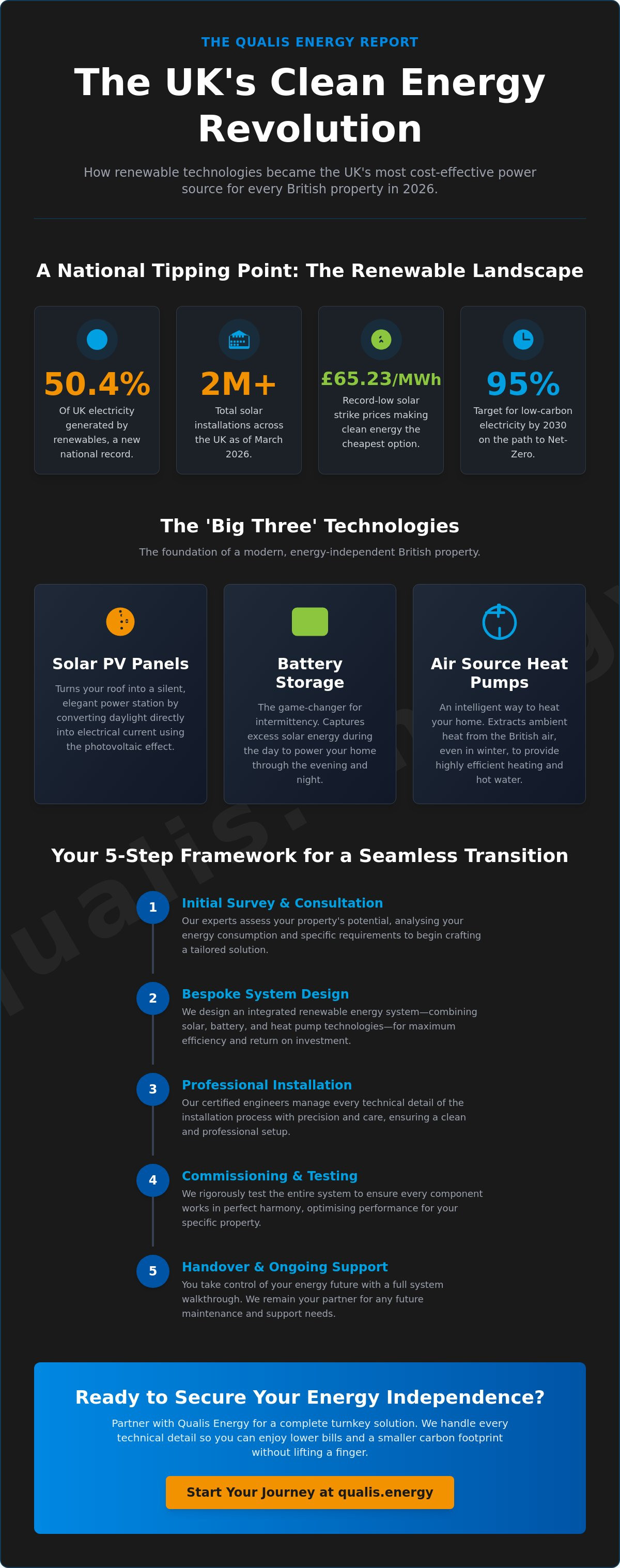
The future of energy is an integrated ecosystem. We've identified the "Big Three" technologies as the foundation of modern British property: Solar PV, Battery Storage, and Air Source Heat Pumps. Whilst each technology is powerful on its own, they're truly transformative when they work in harmony. This isn't just about sticking panels on a roof; it's about a turnkey EPC approach that synchronises renewable energy generation, storage, and consumption. By treating your property as a single, efficient unit, you move from being a consumer to a self-sufficient producer.
Solar PV and Battery Storage: Harvesting Local Daylight
Solar PV works through the photovoltaic effect, where sunlight hits semi-conductive materials within a panel to create an electrical current. It's a silent, elegant process that turns your roof into a power station. However, the sun doesn't always shine when we need to boil the kettle or run the dishwasher. This is where battery storage changes the game. By capturing excess energy during the day, you can power your home through the evening, effectively solving the issue of intermittency. According to official UK renewables statistics, March 2026 saw over 27,000 solar installations completed, a testament to this growing trend. For a deeper look at the hardware and design options, see our Solar Panels and Installation Guide.
Air Source Heat Pumps: The Future of Decarbonised Heating
Heating accounts for a massive portion of domestic carbon emissions. Air source heat pumps provide the solution by acting like a fridge in reverse. They extract heat from the outside air, even in freezing temperatures, and compress it to warm your home and water. The efficiency is remarkable. For every 1 unit of electricity used, a heat pump typically delivers 3 to 4 units of heat, a ratio known as the Coefficient of Performance (COP). This makes them far more efficient than traditional gas boilers. Integrating these with your solar array means you can heat your home using renewable energy you've generated yourself. If you're ready to explore technical specifications, our Air Source Heat Pump Installation Guide covers everything from design to handover.
True energy independence comes from connecting these dots. Imagine your solar panels charging your battery whilst you're at work, which then powers your heat pump to warm the house before you arrive home. This level of automation means you won't need to lift a finger to save money or reduce your carbon footprint. It's a proactive way to manage your property's infrastructure while showing off your green credentials to the neighbourhood. Whether you're upgrading a residential home or large-scale agricultural barns, this integrated approach ensures that every kilowatt is put to its best possible use.
The Economic Argument: Why Renewables Are Now the Cheapest Option
The economic tide has turned. For decades, the cost of British power was chained to the volatility of global gas markets, leaving homeowners and businesses vulnerable to price shocks beyond their control. In 2026, renewable energy has effectively broken those links. Because the "fuel"-sunlight and air-is free, the marginal cost of generating electricity is near zero once the infrastructure is in place. This decoupling means that as the share of clean power grows, we're seeing more stable, predictable pricing that isn't dictated by geopolitical conflict. According to the latest UK renewable energy statistics, this shift is already reflected in the record-low strike prices for new solar and wind projects, which now sit significantly below the cost of gas-fired generation.
Analysing the ROI of Self-Generated Power
Investing in your own infrastructure is no longer just an environmental choice; it's a shrewd financial strategy. For commercial entities, solar panels for business can now pay for themselves within 5 to 7 years. This rapid return is driven by high energy costs and the ability to use nearly 100% of generated power on-site, especially for operations like cold storage or manufacturing. Our Solar Panels for Business Commercial Guide provides detailed ROI models that factor in current tax benefits, such as capital allowances that allow businesses to write off the cost of green technology against their taxable profits. Beyond the initial payback, the reduction in maintenance costs is substantial. Unlike traditional combustion systems with moving parts that wear out, solid-state solar and battery systems require minimal servicing over their 25-year lifespan.
The Role of the Smart Export Guarantee (SEG)
Your property can now act as a micro-power station that generates revenue. Through the Smart Export Guarantee (SEG), homeowners and businesses are paid for every unit of excess electricity they send back to the national grid. In May 2026, the tariff landscape is more competitive than ever, with some suppliers offering rates as high as 32p/kWh for customers with integrated battery storage. This turns a surplus of energy into a literal credit on your bill. To understand how to navigate these tariffs and choose the right provider, consult our Smart Export Guarantee (SEG) Guide 2026. By combining self-consumption with strategic export, you're not just saving money; you're creating a hedge against future price hikes and securing true energy independence.
We're moving from a culture of "paying the bills" to one of "managing an asset." Whether you're looking after a residential home or large-scale agricultural barns, the goal is the same: to move from a position of dependency to one of power. This transition is proactive and highly organised, ensuring that every pound invested in renewable energy today delivers a decade of predictable, low-cost comfort tomorrow.
Planning Your Clean Energy Transition: A Strategic Framework
The future has arrived, but it requires a blueprint. Moving your home or business towards renewable energy is a journey that starts with a clear-eyed strategy rather than a single product purchase. We advocate for a whole-property approach. Piecemeal upgrades often lead to mismatched components or missed opportunities for synergy. Instead, we follow a rigorous five-step roadmap: Survey, Design, Application, Installation, and Maintenance. This end-to-end framework ensures that every kilowatt-hour is accounted for and every regulation is met. By managing the entire process, we ensure you won't need to lift a finger whilst we build your energy independence.
Success in 2026 relies on site-specific data. A design that works for a terraced house in a city centre won't suit a sprawling agricultural barn or a commercial warehouse. Our design phase uses advanced modelling to predict your generation and consumption patterns with precision. This proactive planning allows us to size your battery storage and solar array perfectly, ensuring you don't overspend on capacity you don't need or fall short during peak demand. It's a professional consultation that moves the "why" into a concrete "how."
Technical Surveys and DNO Applications
Technical compliance is the bedrock of a reliable system. Before we can connect your new infrastructure, we must secure permission from your Distribution Network Operator (DNO). These are the organisations responsible for the local power lines and substations. For standard domestic setups, we handle the G98 notification process. However, for larger commercial solar arrays or high-capacity battery systems, we manage the more complex G99 application. This ensures your system is legally compliant and won't disrupt the local grid. Alongside this, we conduct comprehensive structural roof surveys to verify that your building can safely support your investment for its 25-year lifespan.
The Importance of MCS Accreditation
Quality is non-negotiable in the clean energy sector. The Microgeneration Certification Scheme (MCS) serves as the essential quality benchmark for the UK. You must use an MCS-accredited installer to access the £7,500 Boiler Upgrade Scheme grant or to receive export payments through the Smart Export Guarantee. Beyond the financial necessity, MCS accreditation provides a guarantee of technical competence and consumer protection. We strongly advise against unaccredited "cowboy" installers who may offer lower upfront costs but lack the credentials to ensure long-term safety and performance. In a national transition this critical, your peace of mind is worth the investment in professional expertise.
Our turnkey EPC service is designed to take the weight off your shoulders, managing every technical and regulatory hurdle on your behalf. We're here to facilitate your transition with visionary authority and a commitment to your long-term success. If you're ready to secure your property's future, book a professional energy survey with Qualis Energy today.
Qualis Energy: Your Visionary Partner in the Renewable Revolution
The transition to a low-carbon economy is the most significant national project of our generation. At Qualis Energy, we don't just see ourselves as contractors; we are leaders holding high the renewable energy flag for a cleaner, more resilient Britain. Our mission is to change how the world thinks about power by making the transition as seamless as possible for every client. Whether we are retrofitting a family home or designing renewable energy systems for vast agricultural barns, our approach remains the same: visionary authority grounded in practical, expert delivery. We manage the complexity so you can focus on the comfort of your home or the growth of your business.
Our expertise spans the full spectrum of clean infrastructure. We've successfully delivered over 2,000 installations, ranging from domestic solar arrays to large-scale commercial solar projects that power industrial sites across the country. By combining high-level technical knowledge with a supportive, accessible demeanour, we bridge the gap between complex industrial technology and everyday domestic life. We're proud to act as a visionary facilitator, helping our neighbours show off their green credentials whilst securing their financial future.
Our End-to-End Turnkey Service
We believe that a professional energy transition should be effortless for the property owner. This is why we provide a comprehensive turnkey EPC service where we promise you will not need to lift a finger. Our journey together moves logically from the initial site survey and bespoke design phase through to G98 or G99 DNO applications and final CDM project management. We tailor every system to its environment, whether that involves installing solar on chicken sheds or integrating battery storage into modern office blocks. Once the system is live, our commitment continues through 25-year maintenance and servicing contracts. This ensures your investment maintains peak performance from the day of handover through decades of operation.
Supporting the East Midlands Green Transition
Our roots are firmly planted in the East Midlands, with a dedicated focus on Nottingham, Sheffield, and the surrounding areas. This local presence is a vital asset for our clients. We possess the specific regional knowledge required to navigate local planning nuances and specific grid constraints that national providers often overlook. Beyond our technical work, we're deeply committed to Social Engagement & Education. We actively work to educate the next generation about the importance of clean power, ensuring that the transition we lead today creates a lasting legacy for the community tomorrow. This isn't just a series of transactional installations; it's a long-term partnership with our region.
The era of volatile energy is over, and the age of independence has begun. We invite you to join us in this critical national transition and take control of your property's future. Speak to a Qualis Energy expert today to start your transition and discover how we can help you hold high the flag for a greener Britain.
Securing Your Property's Energy Future
The future of power is no longer a distant ambition; it's a domestic and commercial reality. We've explored how renewable energy has decoupled from the volatile £1,641 price cap to become the most stable, cost-effective infrastructure for the modern British property. By integrating the "Big Three" technologies through a strategic five-step roadmap, you aren't just lowering your bills; you're building a resilient asset that protects against future market shocks. Whether you're managing agricultural barns or looking after your family home, the transition from old extraction to new harvesting is the most proactive investment you can make in 2026.
Qualis Energy is ready to facilitate this journey as your professional partner. As MCS Accredited Installers and specialists in complex G99 DNO applications, we provide the turnkey project management required to ensure you won't need to lift a finger. Our commitment moves from the initial design phase through to 25-year maintenance, ensuring your system delivers peak performance for decades. The path to a cleaner, more independent Britain is clear, and we're here to lead the way.
Begin your journey to energy independence with Qualis Energy. It's time to take control of your power and join the neighbours who are already showing off their green credentials with pride.
Frequently Asked Questions
What is the most efficient form of renewable energy for a UK home?
An integrated system combining solar PV and an air source heat pump is currently the most efficient setup for British properties. Solar panels harvest electricity with high efficiency during daylight hours, whilst heat pumps deliver a Coefficient of Performance (COP) of 3 to 4. This means for every unit of electricity used, the pump generates 3 to 4 units of heat, making it far superior to traditional gas or electric heating systems.
How much does a typical solar and battery system cost in 2026?
Costs for renewable energy infrastructure have stabilised significantly due to record-breaking strike prices in recent allocation rounds, such as the £65.23/MWh seen in 2024 prices. Whilst we don't provide flat estimates due to the bespoke nature of every roof and industrial site, the investment now often sees a commercial payback period of 5 to 7 years. We focus on delivering a turnkey service that maximises your return through precise design and high-efficiency hardware.
Can renewable energy completely power my business without grid reliance?
Most businesses can achieve near-total energy independence by combining large-scale commercial solar with high-capacity battery storage. Whilst the national grid usually remains connected as a strategic safety net, many firms now operate as "prosumers," generating 100% of their required power during peak summer months. This transition protects your P&L from the volatility of global gas markets and ensures your operations remain resilient during grid fluctuations.
What happens to my solar power on a cloudy day in the UK?
Solar panels work on light rather than direct heat, meaning they continue to generate power even under the typical overcast British sky. On a cloudy day, a well-designed system will still produce between 10% and 25% of its peak rated capacity. By integrating battery storage, you can capture every watt of generation to ensure your home or business stays powered through the evening without needing to draw from the grid.
Are there still government grants available for heat pumps in 2026?
Yes, the Boiler Upgrade Scheme remains active in 2026 and offers grants of up to £7,500 towards the cost of an air source heat pump. Additionally, the government's £15 billion Warm Homes Plan, launched in January 2026, provides new grants of £2,500 for air-to-air heat pumps and heat batteries. These incentives are designed to accelerate the national shift away from fossil fuel boilers toward cleaner electric heating.
How long do solar panels and air source heat pumps typically last?
Modern solar panels are designed for a 25 to 30-year lifespan, whilst air source heat pumps typically provide reliable service for 15 to 20 years. We provide ongoing maintenance and servicing contracts to ensure these systems maintain peak performance throughout their operational life. This longevity makes renewable energy one of the most stable long-term investments available for both residential homeowners and commercial property managers.
Do I need planning permission for renewable energy installations?
Most domestic and commercial solar or heat pump installations fall under "Permitted Development" and don't require formal planning permission. However, exceptions apply if your property is a listed building or situated within a conservation area. We manage the entire survey and design process, including any necessary local authority consultations, so you won't need to lift a finger to ensure your project is fully compliant.
What is the Smart Export Guarantee and how do I apply?
The Smart Export Guarantee (SEG) is a mandatory scheme where energy suppliers pay you for the surplus electricity you export back to the grid. As of May 2026, competitive rates have reached as high as 32p/kWh for customers with specific battery setups. To apply, you must have an MCS-certified installation and a smart meter, after which you can choose a tariff from any participating UK energy supplier to start earning from your surplus generation.


Comments