
Solar Panels for Business in Nottingham & Sheffield: The 2026 Commercial Buying Guide
- James

- May 2
- 12 min read
Updated: 5 days ago
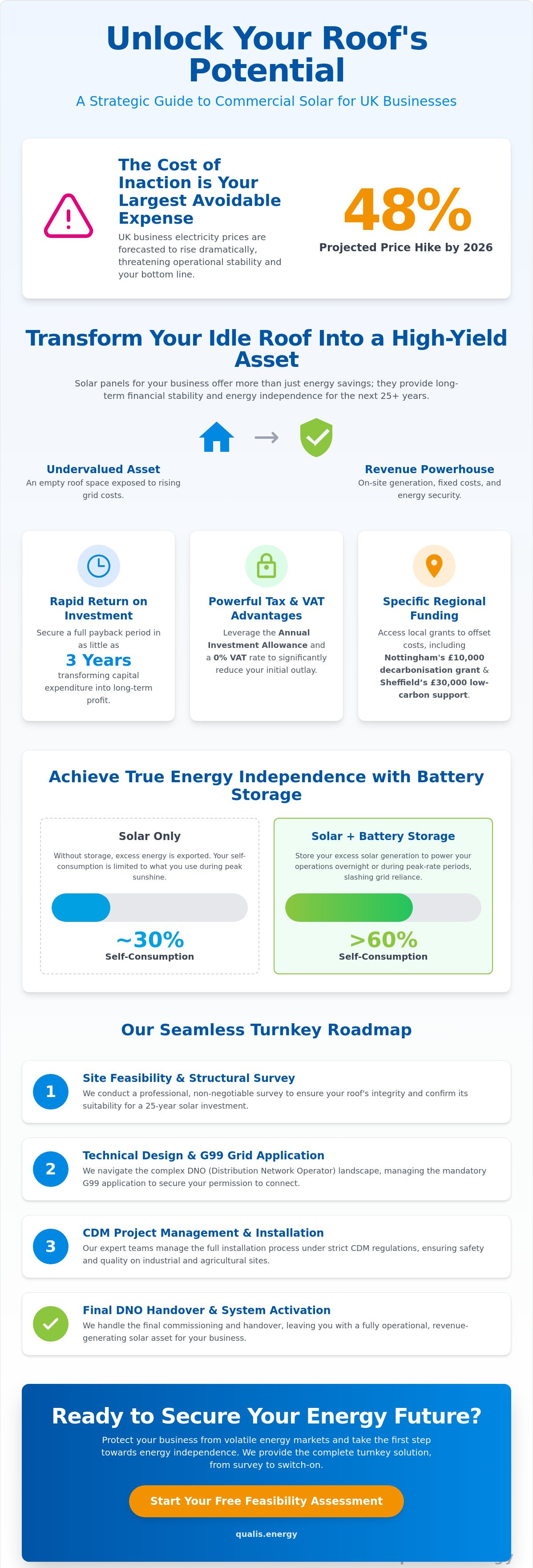
Your commercial roof is no longer just a shelter; it is the most undervalued asset on your balance sheet. With UK business electricity prices forecasted to rise by up to 48% in 2026, the cost of inaction is now your largest avoidable expense. You've likely watched your operational overheads climb whilst wrestling with the technical jargon of G99 grid applications and the search for a local partner who understands industrial infrastructure. It's a complex transition, and the frustration of unpredictable energy hikes is felt by every boardroom across the Midlands and South Yorkshire.
We are here to hold high the renewable energy flag for your organisation. This guide demonstrates how to install solar panels for business to secure energy independence and transform idle roof space into a revenue-generating powerhouse. We provide a complete turnkey roadmap, moving you from initial site feasibility through to final DNO handover. You'll discover how to leverage the 2026 financial landscape, including Nottingham’s £10,000 decarbonisation grants and Sheffield’s £30,000 low carbon incentives, ensuring your business leads the national transition without needing to lift a finger.
Key Takeaways
Understand why installing solar panels for business is now a critical operational strategy to protect your bottom line against forecasted 48% energy price hikes.
Navigate the technical landscape of G99 grid applications and CDM project management to ensure a seamless, turnkey installation on industrial or agricultural sites.
Identify specific regional funding opportunities, including Nottingham’s decarbonisation grants and Sheffield’s £30,000 low carbon support, to offset your initial investment.
Learn how the Annual Investment Allowance and 0% VAT rate can transform your commercial roof into a high-yield asset with a payback period as short as three years.
Discover how integrating battery storage can increase your energy self-consumption from 30% to over 60%, securing long-term energy independence for your organisation.
The Strategic Case for Solar Panels for Business in 2026
The energy landscape has shifted. Renewable energy isn't just a corporate social responsibility checkbox; it's a defensive shield against market volatility. In 2026, UK business electricity prices are forecasted to rise by up to 48%, a figure that threatens the stability of even the most robust industrial operations. This isn't a trend; it's a critical national transition that requires a visionary approach to infrastructure. The era of cheap, predictable grid power has ended, replaced by a new paradigm where self-generation is the only way to ensure long-term profitability.
This economic reality is driving the global growth of solar energy as businesses seek to fix their energy costs for the next 25 years. By installing solar panels for business, organisations in Nottinghamshire and South Yorkshire are transforming their roofs into high-yielding infrastructure. This transition secures your bottom line whilst shielding you from the unpredictable swings of wholesale energy markets. Beyond immediate savings, there is the matter of asset value. Commercial properties equipped with on-site generation command higher premiums. Stringent ESG (Environmental, Social, and Governance) requirements now dictate corporate supply chains; if you aren't decarbonising, you're at risk of being sidelined by major procurement partners who demand transparency in Scope 2 emissions.
Energy Independence and Net Zero Targets
On-site generation provides a level of autonomy that the national grid simply cannot match. By producing your own power, you reduce reliance on an ageing infrastructure and bypass the rising costs of grid-delivered electricity. This is a practical, measurable step toward the UK’s 2050 Net Zero milestones. More urgently, the Future Homes Standard and associated commercial regulations mean that by 2030, buildings must meet higher EPC ratings to remain legally lettable. Investing in solar panels for business is the most direct route to improving these ratings. It moves your property from a liability to a future-proofed asset that meets the demands of a low-carbon economy.
Marketing Your Green Credentials Locally
Visibility matters. A solar array on an industrial roof in Sheffield or a distribution centre in Nottingham is a public declaration of your commitment to the region. It builds trust with a local customer base that increasingly prioritises ethical consumption. This commitment also serves as a powerful recruitment tool. The next generation of talent wants to work for leaders who are proactive about the climate transition. By educating your workforce on your energy-saving journey, you foster a culture of social engagement. You aren't just installing technology; you are holding high the flag for a cleaner, more sustainable local economy. This proactive stance ensures your business remains a leader in the critical shift towards national energy security.
Assessing Your Site: Technical Requirements and DNO Applications
Success in renewable energy begins long before the first panel is lifted onto your roof. A commercial site isn't just a building; it's a structural puzzle that requires technical precision. Whether you are operating from a steel-clad warehouse on a Sheffield industrial estate or an agricultural barn in the Nottinghamshire countryside, your roof's integrity is the starting point. We don't guess. A professional structural survey is non-negotiable to ensure your rafters can handle the dead load of a high-efficiency array for the next 25 years. This is about securing your investment against the elements whilst building a foundation for energy independence.
The real hurdle for many organisations isn't the physical installation; it's the grid connection. In the East Midlands, National Grid Electricity Distribution manages the infrastructure, and navigating their requirements is where most projects stall. You need a partner who speaks the language of DNOs and understands the local constraints of Mansfield, Chesterfield, and the surrounding areas. We take this burden off your shoulders, holding high the flag for a seamless transition to on-site generation.
Understanding G98 vs. G99 Applications
Most installations of solar panels for business exceed the 3.68kW per phase threshold. This makes a G99 application mandatory. Unlike the simpler G98 notification used for small domestic systems, a G99 is a formal request for permission to connect. As of December 2025, non-refundable assessment fees for these applications range from £500 to over £8,000. Timelines can stretch from a few weeks to several months. Our turnkey service ensures you don't lift a finger; we manage the entire liaison process, including securing your right to receive payments via the Smart Export Guarantee (SEG) for any surplus power you return to the grid.
Commercial Roof Types and Solar Fixings
Industrial roofs require bespoke solutions. Modern warehouses often benefit from non-penetrative mounting systems that preserve roof warranties and prevent leaks. For agricultural fibre cement or older industrial steel, we use specialised fixings designed for longevity. If roof space is at a premium, ground-mounted arrays offer a powerful alternative for large-scale operations. We integrate every installation with your existing maintenance schedules to ensure zero disruption to your daily operations. To find out which solution fits your infrastructure, you can request a technical feasibility study from our engineering team.
Calculating ROI: Payback Periods and Revenue Streams
The financial logic for on-site generation has reached a tipping point. In 2026, the typical cost for solar panels for business in the UK ranges between £520 and £810 per kWp installed. For a medium-sized enterprise, a 100kW system generally requires an investment of £70,000 to £90,000. Whilst these figures represent a capital commitment, the returns are immediate. A typical 100kWp installation now generates annual electricity savings between £25,000 and £35,000. This brings the average payback period down to just 3 to 5 years, a timeframe that makes solar one of the most attractive infrastructure investments on the market.
Your "Self-Consumption" rate is the primary engine of this ROI. Without storage, most businesses use 30-40% of the energy they generate. By integrating a Battery Energy Storage System (BESS), you can push this figure to 60-70%. This allows you to store midday generation for use during peak evening tariff periods or even to support overnight operations. We see the most profound efficiencies when solar is paired with air source heat pumps. This synergy allows you to power your heating and cooling systems using your own clean electrons, effectively decoupling your entire site's climate control from the volatile gas and electricity markets. This holistic approach aligns with the UK government's Solar Taskforce objectives to turn commercial rooftops into the backbone of national energy security.
Export Tariffs and the Smart Export Guarantee (SEG)
Revenue doesn't stop at your own meter. Any surplus energy your system produces can be sold back to the grid through the Smart Export Guarantee (SEG). In April 2026, export rates vary significantly; while some suppliers offer fixed rates around 4-15p/kWh, leading flexible providers now offer variable peak rates that can exceed 24p/kWh. Maximising this revenue requires a proactive load-shifting strategy. By timing energy-intensive processes to coincide with peak generation, you ensure every photon is either saving you money or making you money. Our monitoring software allows you to track these revenue streams in real-time, giving you total visibility over your system's performance.
Maintenance and Long-Term Performance
A solar array is a 25-year asset that demands professional stewardship. Routine servicing isn't just about cleaning; it's about electrical health checks and inverter optimisations that protect your yield. We believe local maintenance contracts are vastly superior to national call centres. Having a team in Nottingham or Sheffield who can be on-site within hours ensures that a minor technical glitch doesn't turn into a week of lost generation. Our proactive monitoring service means we often spot and resolve performance dips before you even notice them, ensuring your solar panels for business continue to operate at peak efficiency for decades to come.
Choosing the Right Commercial Solar Partner
Selecting a partner to install solar panels for business is a strategic decision that defines your operational resilience for the next quarter-century. It's not merely about purchasing hardware; you're choosing the steward of your energy future. Whilst many contractors offer basic installations, a commercial project requires a sophisticated understanding of mechanical and electrical (M&E) integration. MCS accreditation is the bare minimum you should expect. It ensures equipment quality and eligibility for export payments, but it doesn't tell the whole story. For industrial sites, Construction Design and Management (CDM) project management is the real differentiator. This framework ensures every phase of the installation meets stringent safety and regulatory standards, protecting your staff and your site from the risks inherent in large-scale infrastructure work.
Proximity matters. Choosing a local specialist in Barnsley, Rotherham, or Worksop isn't just about supporting the regional economy. It's about response times. When your system requires a rapid technical adjustment or an urgent maintenance visit, you don't want to be waiting for a national call centre to dispatch a sub-contractor from the other side of the country. You need an expert hand that is already part of the local landscape. A partner who understands the specific grid nuances of South Yorkshire and the East Midlands will move your project from the drawing board to the roof far more efficiently than a distant national firm.
The Qualis Energy Approach: Visionary and Grounded
We see ourselves as more than contractors; we are facilitators of a critical national transition. Our process is mapped out from the first feasibility survey to the final DNO handover, ensuring you won't need to lift a finger throughout the journey. We've seen first-hand how on-site generation transforms local organisations, as detailed in our latest review of Solar panels for commercial buildings in Nottingham & Sheffield. Beyond the technicalities, we hold high the flag for community education, helping your team understand the value of the energy they're producing right above their heads. This grounded approach ensures that your investment delivers both financial and social returns.
Selection Checklist for 2026
Before signing any contract, verify that your installer holds membership with the RECC or HIES. These bodies provide essential protection and ensure ethical business conduct. You should also demand evidence of experience with your specific site type. The requirements for a high-tech manufacturing facility in Rotherham differ vastly from an agricultural barn in rural Nottinghamshire. For a deeper dive into the vetting process, read our Commercial Solar Installers Selection Guide. Once you're ready to secure your energy independence, request a consultation with our commercial engineering team to begin your site assessment.
Future-Proofing Your Business Energy Strategy
The UK’s energy infrastructure is undergoing a fundamental transformation. By March 2027, the Future Homes Standard will mandate renewable generation for new builds, a change that signals the direction of travel for the entire commercial sector. Investing in solar panels for business is no longer a static purchase; it's the first step in building a resilient, scalable microgrid. As your operations expand and your energy demand increases, your system must be capable of growing with you. We design with this modularity in mind, ensuring your infrastructure is ready for the next decade of technological advancement.
The most significant shift on the horizon is the electrification of transport. Transitioning your company fleet to electric vehicles (EVs) becomes a profit-centre when you fuel those vehicles with on-site generation. Instead of paying retail rates at public charging hubs, you utilise your own clean electrons to power your logistics. This creates a closed-loop energy system where your roof powers your warehouse, your industrial air conditioning units, and your delivery vans simultaneously. AI-driven management software now allows these commercial microgrids to balance loads automatically, choosing the most cost-effective moment to charge batteries or export surplus power to the grid.
Integrating Solar with EV Charging and HVAC
Industrial HVAC systems are notorious energy drains, particularly during peak summer months when demand and prices are highest. On-site solar aligns perfectly with this demand profile, producing the most power exactly when your cooling systems are working hardest. By synchronising your EV charging infrastructure with your solar array, you effectively eliminate the fuel costs for your fleet. This level of integration turns your premises into a self-sustaining energy hub, shielding you from the external shocks that have historically crippled UK business overheads. It's a visionary approach that transforms a simple roof into a strategic power plant.
Next Steps: Your Journey to Energy Independence
Your transition begins with a bespoke energy audit. We look beyond your roof to understand your operational patterns, identifying where energy is wasted and where it can be harvested. During our initial consultation, we map out a roadmap that respects your daily operations. Our "no-disruption" installation promise ensures that your business continues to thrive whilst we work in the background. We handle every technicality, from structural surveys to DNO approvals, so you don't need to lift a finger. The future of energy has arrived in Nottingham and Sheffield. Contact Qualis Energy today to start your journey toward total energy independence and secure your place at the forefront of the national transition.
Lead the National Transition in Nottinghamshire and South Yorkshire
The future of energy has arrived, and it's time to claim your stake in the national transition. By securing energy independence today, you protect your organisation against the forecasted 48% electricity price hikes of 2026 whilst transforming your industrial roof into a high-yield asset. We move you from the complexity of G99 applications and structural surveys to a final, turnkey handover where you don't need to lift a finger.
As MCS Accredited Installers specialising in Nottingham and Sheffield industrial sites, we provide the full CDM project management required for complex commercial infrastructure. Installing solar panels for business is more than a cost-saving measure; it's a strategic commitment to the resilience of our regional economy. We are ready to hold high the renewable energy flag alongside you, ensuring your facility remains competitive and sustainable for the next 25 years.
Your journey towards a closed-loop energy system starts with a single step. Request Your Bespoke Commercial Solar Audit from Qualis Energy to unlock the untapped potential of your premises. Let's build a cleaner, more profitable future for your business together.
Frequently Asked Questions
How long do solar panels for business take to pay for themselves in 2026?
Solar panels for business typically pay for themselves within 3 to 5 years as of April 2026. This rapid return on investment is driven by forecasted 48% hikes in business electricity prices and the strategic use of the Annual Investment Allowance. By generating your own power, you bypass expensive retail rates and secure long-term energy independence for your facility.
Do I need planning permission for commercial solar panels in Nottingham or Sheffield?
Most commercial installations fall under Permitted Development Rights and don't require a full planning application. The previous 1MW capacity limit was removed in December 2023, though panels must not protrude more than 200mm from the roof surface. If your building is listed or sits in a conservation area within Nottingham or Sheffield, we manage the specific liaison with the local council as part of our turnkey service.
Can solar panels power my business's air conditioning and heating systems?
Solar PV is exceptionally effective at powering energy-intensive systems like industrial air conditioning and air source heat pumps. Solar generation peaks during the hottest parts of the day, which aligns perfectly with the high demand of cooling units. This synergy allows you to run your climate control systems on free, on-site electrons rather than relying on volatile wholesale energy markets.
What happens to my business energy supply during the solar installation?
Your business will experience almost zero downtime during the installation process. The vast majority of the work is external, involving the mounting of frames and panels to your roof structure. We only require a short, pre-planned shutdown of a few hours for the final connection to your electrical distribution board, which we organise to suit your operational schedule.
Is there a minimum roof size required for a commercial solar PV system?
There is no legal minimum size, but a 10kWp system is generally the starting point for commercial viability. This requires approximately 50 to 60 square metres of roof space. For larger industrial sites, we frequently design systems exceeding 100kWp to maximise the 100% Annual Investment Allowance and accelerate your path to energy independence.
How much maintenance do commercial solar panels actually require?
Commercial solar systems are low-maintenance but require an annual professional health check to ensure peak performance. This involves an electrical inspection and a visual check of the mounting hardware. We provide real-time monitoring software that alerts us to any performance dips, ensuring your 25-year asset continues to operate at maximum efficiency without you needing to lift a finger.
Can I get solar panels for my business if I rent my commercial premises?
You can certainly benefit from solar energy even if you rent your commercial premises. This often involves a multi-party agreement where the landlord benefits from an increased property EPC rating and higher asset value. Alternatively, some businesses opt for asset finance or Power Purchase Agreements (PPAs), allowing them to utilise the energy at a lower rate than the grid with zero upfront capital.
What is the difference between a G98 and G99 grid connection application?
The primary difference lies in the system's capacity and the complexity of the grid connection. G98 is a simple "fit and inform" process for small systems under 3.68kW per phase, typically used for domestic properties. G99 is the mandatory application for almost all solar panels for business, requiring formal permission from the local Distribution Network Operator (DNO) before the system is commissioned.


Comments