
Solar Panels on Roof: The 2026 Nottingham and Sheffield Homeowner’s Guide
- James

- Apr 20
- 13 min read
Updated: Apr 21
What if your roof wasn't just a shelter against the Peak District winds, but a sophisticated engine room generating a 70% reduction in your annual utility bills? Homeowners across Nottingham and Sheffield are feeling the pinch of energy costs that have climbed steadily since 2021. You likely want to embrace the future by installing solar panels on roof surfaces, yet the jargon surrounding MCS accreditation and the fear of structural damage to your property can feel like a significant barrier.
The future of energy has arrived in the North. This guide will show you how to transform your home with systems specifically engineered for the unique light levels of the East Midlands and South Yorkshire. We'll take you from the initial technical survey through to the final handover; explaining 2026 planning regulations, debunking installation myths, and mapping out your journey toward total energy independence. You won't need to lift a finger whilst we hold high the renewable energy flag for your household.
Key Takeaways
Future-proof your home against the evolving energy landscape by understanding why self-generation is the ultimate investment for 2026.
Master the "Golden Rule" of orientation and pitch to ensure your property is optimised for maximum light conversion in the East Midlands climate.
Compare the sleek aesthetics of integrated systems against the cost-effective performance of installing solar panels on roof structures to find your perfect fit.
Navigate the technical complexities of G98 and G99 DNO applications with a professional roadmap that takes you from initial survey to final grid connection.
Discover how our turnkey "Local Hero" approach allows you to secure your energy independence across South Yorkshire and Nottinghamshire without needing to lift a finger.
Table of Contents
Why Solar Panels on Your Roof are the Best Investment for 2026
The future of energy has arrived on our doorsteps. By 2026, the UK's commitment to net-zero has transformed from a distant policy into a domestic necessity. Solar Photovoltaic (PV) technology allows homeowners to capture daylight and convert it into usable AC electricity via a high-efficiency inverter. Rooftop solar power systems provide a decentralised solution to the rising volatility of the national grid. You aren't just installing hardware; you're securing your family's autonomy. From the initial technical survey through to the final commissioning, we ensure your transition to self-generation is seamless.
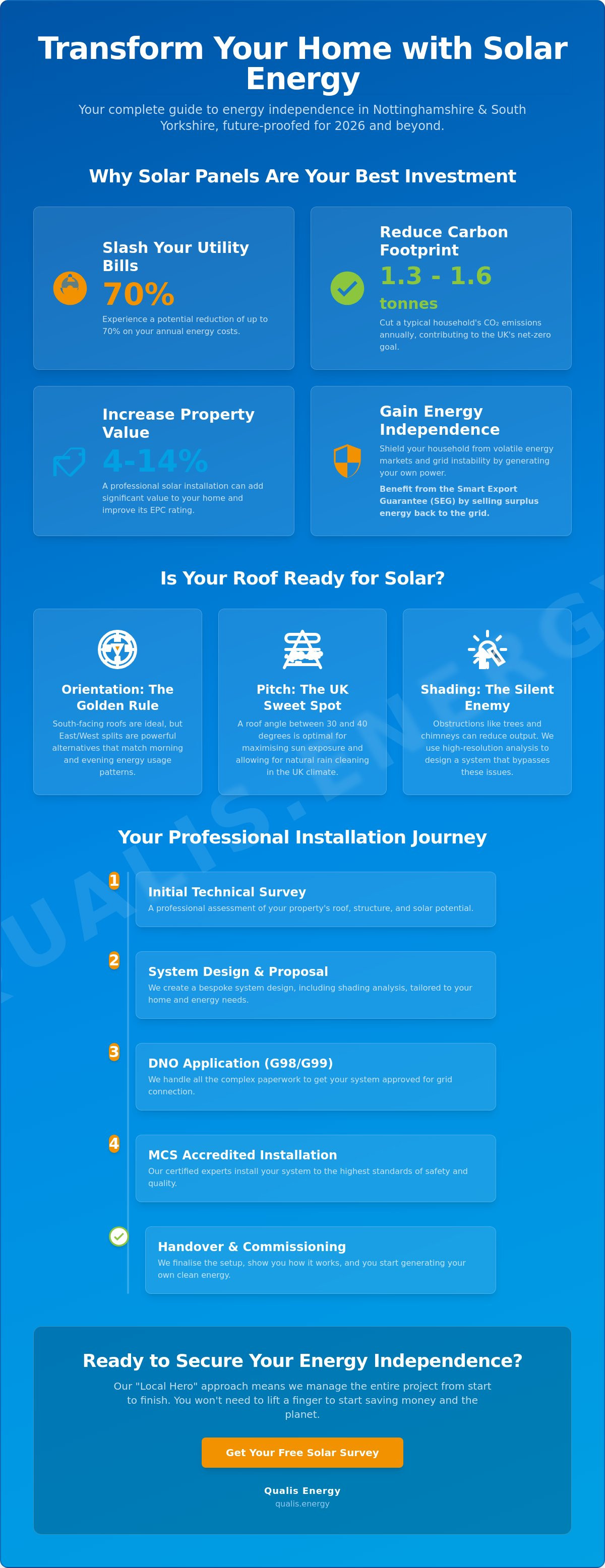
Energy independence is the priority for 2026. With the UK targeting a 68% reduction in emissions by 2030, generating your own power is the most effective way to shield yourself from global market spikes. Installing solar panels on roof structures reduces a typical household carbon footprint by approximately 1.3 to 1.6 tonnes of CO2 annually. You also benefit from the Smart Export Guarantee (SEG), which pays you for every unit of surplus energy you feed back into the grid. It's a transition from being a passive consumer to an active producer, holding high the renewable energy flag for the East Midlands.
The Local Energy Context in Nottingham and Sheffield
South Yorkshire and the East Midlands offer a surprisingly robust environment for solar generation. Sheffield receives roughly 1,450 to 1,550 hours of sunshine per year, which is more than enough to maintain high panel efficiency. Local weather patterns in the North and Midlands, often characterised by cooler breezes, actually help prevent panels from overheating. This ensures they operate at their peak voltage more consistently than in hotter, stagnant climates. Whether you are looking at solar panels on roof surfaces in a suburban Nottingham street or an agricultural barn in the Peak District, the yield remains impressive.
Increasing Property Value with Renewable Technology
Renewable technology is now a primary driver of property value. An upgraded EPC rating, often jumping two grades after a professional installation, makes a home significantly more attractive to the 2026 buyer. Research from organisations like Solar Energy UK suggests that solar installations can add between 4% and 14% to a home's market value. We handle the entire journey, from the first rooftop assessment to the moment you start tracking your savings on an app. You won't need to lift a finger as we manage the G98 or G99 DNO applications and the full CDM project management. It's a 25-year investment that pays dividends from day one, balancing domestic comfort with industrial-grade reliability.
Assessing Your Roof for Solar Potential: Orientation and Structure
The roof of your home is the foundation of your energy independence. It serves as the primary platform where the UK’s national transition to renewables becomes a personal reality. For solar panels on roof installations to deliver maximum value, orientation is the first technical hurdle to clear. The "Golden Rule" has long favoured south-facing elevations, which capture the highest intensity of light throughout the day. However, an East/West split is a powerful alternative for 2026 homeowners. This configuration provides a dual-peak generation profile, matching the morning school run and the evening meal preparation when domestic demand is highest.
Pitch is equally vital. In Nottingham and Sheffield, a roof angle between 30 and 40 degrees is the UK sweet spot. This tilt ensures that rain naturally cleans the glass surface while maintaining the optimal angle of incidence for the sun’s rays. Shading remains the silent enemy of efficiency. A single chimney stack, a neighbouring gable, or a mature tree can cast shadows that significantly reduce output. We utilise high-resolution shading analysis to map these obstructions, ensuring your system is designed to bypass local obstacles. If you're unsure about your specific site, a professional assessment from Qualis Energy can provide the technical clarity you need.
Pitched vs. Flat Roof Solar Installations
Homeowners in Newark and Mansfield often reside in properties featuring traditional slate or rosemary tiles. These materials require specialist mounting brackets that hook beneath the tiles to maintain a 100% watertight seal. Flat roofs, common on modern extensions or garage conversions, offer a different opportunity. We utilise bespoke mounting frames to create the perfect 35-degree angle, even on a level surface. While some look toward DIY kits, professional integrated systems provide the durability required to withstand British winters. A high-performing setup often integrates an Energy Saving Trust guide to battery storage to ensure that every kilowatt generated on your roof is stored for later use.
Structural Surveys and Load-Bearing Calculations
Older Victorian properties across South Yorkshire and Nottinghamshire weren't built with the weight of modern glass-on-glass modules in mind. A professional structural survey is non-negotiable to ensure the rafters can support an additional 18kg to 25kg per square metre. This isn't just about weight; it's about wind loading. In exposed sites near the Pennines, wind can create significant uplift forces that threaten the integrity of the installation. We manage the entire process, from initial load-bearing calculations to the final handover. We believe in holding high the renewable energy flag by doing the heavy lifting for you. From the first survey to the final connection, you won't need to lift a finger.
Choosing the Right Solar System: In-Roof vs. On-Roof Panels
The future of British energy has arrived. Deciding how to install solar panels on roof structures is a pivotal step in your journey toward independence. Most homeowners in Nottingham and Sheffield opt for on-roof systems. These are the most cost-effective retrofitting method because we mount the panels onto rails fixed to your existing tiles. It is a proven, reliable solution that allows for natural airflow behind the panels, which helps maintain high conversion efficiency during the warmer months. You can expect a standard installation to be completed swiftly, often in just one or two days.
In-roof, or integrated systems, offer a different aesthetic altogether. These panels sit flush with your tiles, replacing a section of the roof itself. They are a sleek choice for new builds or if you are already planning a full re-roof. While they look incredibly modern, they involve more complex labour and higher initial material costs. We ensure every installation handles the UK wind and rain with absolute resilience. If a panel needs servicing in 2035, on-roof systems are generally easier to access. You won't need to disturb your home's primary weather seal to replace a single unit.
Aesthetics and Local Planning Regulations
Most residential properties enjoy Permitted Development rights for solar installations. This means you won't usually need formal planning permission. However, conservation areas in Southwell or Lincoln require a more nuanced approach. We often recommend "all-black" panels for these projects. These feature black cells, frames, and backsheets to complement traditional architecture and local stone. Keeping track of UK government solar initiatives is vital as standards evolve to make green energy more accessible in heritage locations. We handle all the technical paperwork and compliance, so you won't need to lift a finger during the approval process.
Maximising Efficiency with Battery Storage
Energy is only truly valuable if you can use it when you need it. A battery is the perfect partner for your solar panels on roof. It allows you to store the midday sun to power your home after the sun goes down. This maximises your self-consumption and slashes your reliance on the national grid. It also future-proofs your property for high-load demands like electric vehicle (EV) charging. Our team manages everything from G98 and G99 DNO applications to the final handover. We are holding high the renewable energy flag, ensuring your home becomes a beacon of efficiency while you focus on looking after the children and enjoying your domestic comfort.
The Professional Installation Journey: From Design to DNO
The transition to renewable energy is a landmark moment for any property. It begins with a bespoke site survey where our engineers map the unique contours and orientation of your home. We don't believe in generic solutions. Instead, we design a system that maximises every square inch of space for your solar panels on roof, ensuring peak performance for decades to come. This initial phase sets the foundation for a system that isn't just an addition, but a structural evolution of your home's energy profile.
Our team handles the heavy lifting of regulatory compliance. Managing the G98 and G99 DNO application process requires technical precision and a deep understanding of the local grid infrastructure in Nottingham and Sheffield. We coordinate these complex interactions with the Distribution Network Operator so you don't have to lift a finger. This process ensures your system is legally permitted to export surplus energy, protecting your ability to earn from your investment.
The physical installation is a coordinated effort of safety and skill. Our project management covers everything from the initial scaffolding to the final electrical commissioning. Once the hardware is securely mounted and wired, we provide a comprehensive handover. This includes your MCS certification and the setup of your monitoring app, giving you real-time visibility of your home's energy production and independence from the palm of your hand.
Why MCS Accreditation is Essential for UK Homeowners
MCS accreditation is the gold standard for quality and safety in the United Kingdom. It provides the assurance that your system has been installed to the highest industry benchmarks. Crucially, an MCS certificate is a mandatory requirement if you wish to access the Smart Export Guarantee (SEG). Without this accreditation, you cannot get paid for the excess energy you send back to the grid. Qualis Energy maintains a strict commitment to these standards, holding high the renewable energy flag for compliance and excellence.
Integrating Solar with Air Source Heat Pumps
Creating a "whole-home" energy system represents the pinnacle of domestic efficiency. By combining your solar panels on roof with a heat pump, you create a symbiotic relationship where your roof directly powers your heating system. This configuration can significantly reduce the running costs of a heat pump, often by as much as 30% to 50% depending on your usage patterns. Explore our guide on air source heat pump installation for more details on this integrated approach.
For homeowners aiming for the highest standards of efficiency, integrating heat recovery ventilation also plays a vital role in maintaining air quality while reducing heat loss; you can learn more about how these systems complement modern renewable energy setups.
Ready to lead the energy transition in your neighbourhood? Contact Qualis Energy for a bespoke solar design today.
Qualis Energy: Your Local Solar Experts in Nottinghamshire and Beyond
The future of energy has arrived in the East Midlands. At Qualis Energy, we aren't just contractors; we are partners in a national transition that begins on your street. From the historic terraces of Barnsley to the newer developments in Worksop, we act as local heroes holding high the renewable energy flag. Our mission is to fundamentally change how our region perceives power. We move beyond simple transactions to build a sustainable legacy that secures your home for the next generation.
You won't need to lift a finger. We provide a comprehensive turnkey EPC service that handles every technical and regulatory hurdle on your behalf. This includes managing complex G98 and G99 DNO applications and strict CDM project management. Whether we are installing solar panels on roof structures for a family home, a chicken shed, or a large agricultural barn, our team oversees the entire process. We protect your 25-year investment with expert maintenance and servicing. This proactive approach ensures your system performs at peak efficiency from the moment of activation through to the middle of the century. For homeowners looking to maintain high standards across all areas of their property, Key Qualities provides expert maintenance and locksmith services to keep your home secure and in top condition.
Serving the Heart of England
Our local presence spans the vital hubs of Chesterfield, Doncaster, and Rotherham. We've recently completed a series of roof-mounted projects that have transformed energy profiles for homeowners across South Yorkshire and Nottinghamshire. Our aftercare isn't a secondary thought; it's a core promise to our community. We look after our neighbours with the same technical precision we apply to large-scale commercial contracts. By choosing a local specialist, you ensure that expert help is always nearby if your system requires a performance health check or optimisation.
Ready to Power Your Future?
Your transition starts with a professional roof survey. Our technical team will visit your property to assess structural integrity and solar potential using precision equipment. During your initial consultation, we translate complex industrial technology into a clear, domestic plan. We'll explain how solar panels on roof systems can integrate with the latest battery storage to maximise your independence from the National Grid. The shift to renewables is an urgent national priority, but for your family, it’s about comfort and security. Join the renewable revolution today. Contact Qualis Energy to book your technical survey and take the first step toward energy independence.
Secure Your Energy Independence Across the East Midlands
The transition to renewable energy isn't a distant prospect anymore. It's a national priority that starts on your own doorstep. By 2026, the UK's energy landscape will have shifted significantly, making this the ideal window to future-proof your home against rising costs. Installing solar panels on roof systems offers a direct path to shielding your household from volatile wholesale market prices whilst contributing to the 2050 net-zero target. We've explored how orientation and structural integrity dictate your generation potential, alongside the aesthetic choice between sleek in-roof designs and high-efficiency on-roof arrays.
Qualis Energy manages the entire process from the first site survey to the final G99 DNO notification. You won't need to lift a finger. As an MCS Accredited Installer and NAPIT Registered specialist, we bring technical authority to every project in Nottingham and Sheffield. We're committed to holding high the renewable energy flag in our local communities, ensuring your investment is backed by grounded, professional expertise. The future of East Midlands energy is being built today, one rooftop at a time. It's time to bring that vision home.
Start your journey to energy independence with Qualis Energy
Frequently Asked Questions
Do I need planning permission for solar panels on my roof in the UK?
Most homeowners don't need planning permission because solar installations fall under Permitted Development rights established in 2015. You only need to seek formal approval if your property is a listed building or situated within a Conservation Area. We manage the entire verification process from the initial site survey to final certification, ensuring your project meets all local building regulations in Nottingham and Sheffield without you needing to lift a finger.
How long does it take to install solar panels on a standard house roof?
A standard residential installation typically takes 1 to 2 days to complete. Our MCS-certified teams handle everything from the initial scaffolding assembly to the final G98 grid connection. While the physical mounting of the solar panels on roof structures often concludes within 6 to 8 hours, we dedicate additional time to configuring your inverter and battery storage systems. This ensures a seamless transition from traditional grid reliance to renewable independence.
Can solar panels damage my roof tiles or cause leaks?
Professional installation actually protects your roof tiles by shielding them from UV degradation and direct weather impact. We use specialist stainless steel roof hooks that fasten directly to the rafters rather than the tiles themselves. This method maintains the structural integrity of your home. By choosing a turnkey EPC service, you ensure that every flashing and seal is weather-tight, backed by a 10-year workmanship guarantee for total peace of mind.
What happens to my solar energy generation on cloudy or rainy days?
Your panels continue to generate electricity on overcast days by utilising diffused light. While peak output occurs in direct sunlight, modern photovoltaic cells in the UK typically operate at 10% to 25% of their rated capacity during heavy cloud cover. Rain is actually beneficial; it naturally washes away dust and debris. This keeps your system running at maximum efficiency without the need for manual cleaning or constant oversight.
How much maintenance do solar panels on a roof actually require?
Solar panels are incredibly low-maintenance because they have no moving parts to wear out. You'll generally only need a professional health check every 3 to 5 years to ensure the electrical connections and inverter remain optimal. Most owners find that UK rainfall is sufficient to keep the glass clear. We take pride in holding high the renewable energy flag by providing comprehensive aftercare, so you can focus on looking after the family instead of your energy system.
Can I install solar panels on a flat roof or a garage?
Yes, flat roofs and garages are excellent locations for solar arrays. We use bespoke ballast mounting systems or A-frames to tilt the panels at an optimal 10 to 15 degree angle for maximum yield. This setup transforms underutilised spaces like agricultural barns or domestic garages into powerhouse assets. Our design team maps out the exact placement to ensure your solar panels on roof surfaces capture the maximum available irradiance regardless of the roof's pitch.
Will solar panels work if my roof is shaded by trees or a chimney?
Your system will still function, though shading on even one panel can traditionally reduce the performance of the entire string. To solve this, we install power optimisers or micro-inverters that allow each panel to operate independently. This technology ensures that if a chimney casts a shadow at 3pm, the rest of your array continues to produce at 100% capacity. We use precision shading analysis during our survey to guarantee your investment delivers the promised returns.
How long will it take for my solar panels to pay for themselves?
The average UK solar investment currently pays for itself within 6 to 10 years. According to 2024 data from the Energy Saving Trust, a typical 4kWp system can save a household up to £400 per year on electricity bills, plus additional earnings from the Smart Export Guarantee (SEG). As energy prices remain volatile, your system acts as a hedge against inflation. We provide a detailed financial forecast from the design phase to the final handover, showing your projected path to energy independence.


Comments