
What Size Heat Pump Do I Need for a 4-Bed House in the UK? (2026 Guide)
- James

- May 26
- 13 min read
Choosing a heat pump based solely on the number of bedrooms in your home is the quickest way to end up with a freezing living room and a staggering electricity bill. You're likely asking yourself, what size heat pump do I need for a 4-bed house UK, because you've encountered a maze of conflicting rules of thumb online. It's a common concern. You want to embrace the future of home heating without the fear that your family will be left shivering when the temperature drops.
We understand that this transition feels like a significant milestone for your household. This guide provides the precise kilowatt ranges typically required for four-bedroom properties, moving beyond guesswork to technical accuracy. You'll discover why professional heat loss calculations are the secret to maintaining a warm, efficient home throughout the winter. We also outline how to access the £7,500 Boiler Upgrade Scheme grant, which increases to £9,000 for those replacing oil or LPG systems from July 2026.
By the end of this article, you'll have the clarity to move from confusion to a concrete plan. We'll walk you through the professional sizing process, the impact of the 2027 Future Homes Standard, and the exact steps to take before booking your home survey with total confidence.
Key Takeaways
Understand why thermal output in kilowatts (kW) is a far more accurate measure than bedroom count when heating your home during a peak winter load.
Identify the typical 7kW to 12kW range for most properties and discover what size heat pump do I need for a 4-bed house UK based on your specific insulation levels.
Learn how critical architectural factors, such as solid brick walls or high glazing ratios in modern extensions, dictate your property's unique heat loss profile.
Explore the professional surveying process that uses room-by-room measurements and U-values to eliminate guesswork and ensure your system is perfectly specified.
Discover how to create a future-proof energy ecosystem by pairing your heat pump with Solar PV and battery storage to significantly reduce your long-term running costs.
Table of Contents
Understanding Heat Pump Sizing: Why kW Matters More Than Bedrooms
Precision is the hallmark of the new energy era. When we discuss "size," we aren't referring to the physical footprint of the unit on your patio, but the thermal output measured in kilowatts (kW). An Air Source Heat Pump (ASHP) is a sophisticated piece of technology designed to match the thermal demands of your home exactly. To truly grasp what is a heat pump? and how it functions, you must understand that it doesn't just "turn on" like a kettle; it manages a complex refrigerant cycle to move heat into your living space with maximum efficiency.
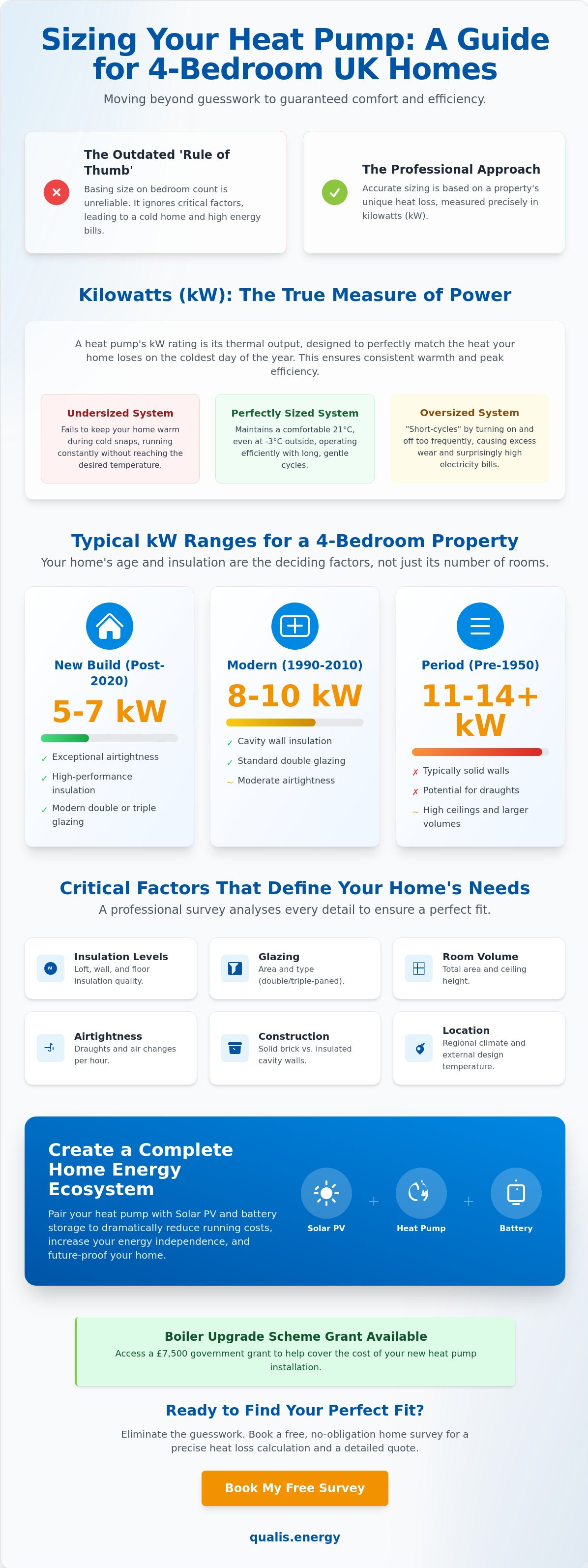
Traditional gas boilers are often installed with a "bigger is better" mentality, frequently reaching 30kW for a standard home. This is vastly oversized for actual heating needs. Heat pumps require a more disciplined approach. They're sized to meet the "peak load," which is the maximum amount of heat your property loses on the statistically coldest day of the year. If you find yourself asking what size heat pump do I need for a 4-bed house UK, remember that an oversized unit is just as detrimental as an undersized one. Excess capacity leads to "short-cycling," where the unit starts and stops too frequently, causing unnecessary wear and skyrocketing your electricity bills.
The "kW" vs "Physical Size" Confusion
Higher kW ratings don't necessarily translate to a massive outdoor unit. Modern manufacturers like Mitsubishi and Daikin have engineered high-output systems into remarkably compact chassis. The output is determined by the efficiency of the internal components and the volume of refrigerant processed, not just the size of the fan. This means a 12kW unit might look nearly identical to an 8kW model, allowing for a discreet installation that doesn't compromise your property's aesthetic whilst delivering the power required for a larger family home.
Why "Rules of Thumb" Often Fail 4-Bed Homes
The old "1kW per bedroom" rule is a dangerous myth that leads to poor performance and cold winters. British housing stock is incredibly varied; a Victorian 4-bed with high ceilings and solid walls has a completely different volume and heat loss profile compared to a modern, open-plan semi-detached house. Factors such as room volume and the rate of air changes per hour are far more important than the number of doors in your hallway. Heat pump capacity is defined as the system's ability to maintain 21°C indoors when it is -3°C outdoors. Achieving this requires a move away from guesswork toward professional, data-driven calculations that respect the unique architecture of your home.
Typical Heat Pump Sizes for 4-Bedroom UK Homes
Standard output ranges for 4-bedroom homes usually sit between 7kW and 12kW. This spectrum allows for the vast variations in thermal efficiency found across the British housing stock. A modern 4-bedroom home built to high insulation standards might only require a 5kW to 7kW unit to maintain a comfortable environment. Conversely, a sprawling 19th-century farmhouse with solid stone walls and original windows could demand 14kW, or even a cascade system where two units work in tandem to meet the peak load. Determining what size heat pump do I need for a 4-bed house UK is ultimately about balancing the property's age with its total volume.
Flow temperature is a critical factor that many homeowners overlook. Systems designed for underfloor heating often operate at a low 35°C, which is highly efficient. If you're keeping existing radiators, the system might need to run at 55°C. Lower flow temperatures allow the pump to operate more efficiently, but they require a precise match between the unit's output and the size of your radiators. This Energy Saving Trust guide provides additional context on how these temperatures influence your seasonal performance and long-term running costs.
The 4-Bed Sizing Matrix
Floor area in square metres (m²) is a far more reliable metric than bedroom count. A 150m² new build requires significantly less energy than a 150m² Victorian terrace. You can generally categorise needs based on the era of construction:
New Build (Post-2020): Exceptional airtightness and insulation typically require a 5kW-7kW unit.
Modern (1990-2010): Properties with cavity wall insulation and double glazing usually fall into the 8kW-10kW range.
Period (Pre-1950): Solid walls and high ceilings often necessitate 12kW-14kW or more.
For exceptionally large or complex properties, we often distinguish between Air-to-Water systems for whole-house central heating and Air-to-Air units for targeted climate control in specific zones. A professional assessment helps define these boundaries before you commit to hardware. You can speak with our technical team to begin mapping your home's requirements.
Domestic Hot Water (DHW) Requirements
Your hot water needs are distinct from your space heating. In a 4-bedroom house with three or four bathrooms, the demand for simultaneous showers can be high. This influences the size of your unvented hot water cylinder rather than just the heat pump's kW rating. The "reheat time"—how quickly the system can bring a full tank back to temperature—must be factored into the total energy demand. Understanding the nuances of air source heat pump installation ensures that your cylinder and pump are perfectly matched for your lifestyle, preventing any morning rushes for the last drop of warm water.
Critical Factors: Why Two 4-Bed Houses Are Never the Same
Your neighbour's 4-bedroom detached home is not your home. Even if the floor plans are mirrored, the thermal behaviour of the building fabric dictates the required output of your heating system. Wall construction is the primary differentiator. A solid brick Victorian villa loses heat at a rate significantly higher than a 1990s property with insulated cavity walls. This disparity means a one-size-fits-all approach is impossible. When asking what size heat pump do I need for a 4-bed house UK, you must account for the "Glazing Ratio" of your property. Modern bifold doors are a staple of 4-bed extensions, yet even high-performance glass loses more heat than a well-insulated wall. These architectural choices act as thermal bridges that your heat pump must overcome.
Geography also plays a silent but vital role. We often refer to the "Peak District Factor" for our clients in Sheffield or Chesterfield. Local weather patterns, including higher humidity and lower average temperatures, can increase the frequency of defrost cycles. This is where the unit temporarily reverses its cycle to clear ice from the external heat exchanger. According to official government guidance, modern systems are designed to handle these conditions efficiently, but the local climate must be factored into the initial specification to ensure consistent warmth during a harsh winter. Draught-proofing remains the most cost-effective strategy for system optimisation. By sealing gaps around floorboards, chimneys, and window frames, you effectively lower the peak heat load, often allowing you to specify a smaller, more efficient unit.
Insulation: The Sizing Multiplier
Insulation acts as a thermal barrier that directly reduces the required kilowatt output. A 4-bed house with 300mm of loft insulation might require an 8kW pump, whereas the same house with only 50mm could need a 12kW unit to compensate for the escaping heat. Floor insulation is equally transformative, particularly in older homes with suspended timber floors where cold air can rise from the crawl space. To ensure your home is as efficient as possible, you can discover ScotTherm Insulation for specialised loft and underfloor solutions. Your Energy Performance Certificate (EPC) provides a useful baseline for these variables, but a professional survey is the only way to map heat loss with the precision required for a 2026 installation.
Emitter Sizing (Radiators vs Underfloor Heating)
The efficiency of your heat pump is intrinsically linked to your heat emitters. Larger radiators provide a greater surface area, allowing the system to deliver the same amount of heat at a lower, more efficient flow temperature. This often means that upgrading your radiators allows for a smaller pump size. Underfloor heating is the favourite partner for air source heat pumps in 4-bed renovations because it turns the entire floor into a giant, low-temperature radiator. This synergy ensures the pump doesn't have to work as hard, extending the lifespan of the hardware whilst maintaining a steady, comfortable heat throughout the home.
The Professional Heat Loss Survey: Moving Beyond Guesswork
Guesswork has no place in a modern energy transition. While online calculators provide a rough estimate, a professional heat loss survey is a rigorous technical audit that ensures your system operates at peak efficiency. To accurately determine what size heat pump do I need for a 4-bed house UK, a surveyor follows a structured five-step methodology:
Step 1: Room-by-room measurements. We record the precise dimensions of every floor, wall, and window to calculate the total volume of air that needs heating.
Step 2: Material identification. We identify building materials to assign U-values, which measure the rate of thermal transmittance through your building's fabric.
Step 3: Design Heat Loss calculation. Using local design temperatures for areas like the East Midlands or South Yorkshire, we calculate the total Watts required to keep your home warm on the coldest day of the year.
Step 4: System selection. We select a heat pump that matches this load precisely, avoiding the efficiency losses associated with excessive oversizing.
Step 5: Compliance documentation. Every result is documented to ensure MCS accreditation and eligibility for the £7,500 Boiler Upgrade Scheme grant.
This process is about more than just numbers. It is about reliability. By mapping the thermal performance of your home, we remove the anxiety of high bills and ensure your family remains warm regardless of the external conditions. You can book your professional survey with Qualis Energy today to begin this journey with absolute precision.
What an MCS-Accredited Surveyor Looks For
MCS accreditation is the gold standard for low-carbon heating in the UK. It is a non-negotiable requirement for accessing government grants like the Boiler Upgrade Scheme. Our surveyors use advanced software-driven models rather than manual estimates to eliminate human error. At Qualis Energy, we prioritise long-term system performance over a quick sale. Determining what size heat pump do I need for a 4-bed house UK requires a level of technical depth that only an accredited professional can provide, ensuring your radiators and pump are perfectly synced.
Preparing Your 4-Bed Home for the Survey
A little preparation ensures your survey is as accurate as possible. Have your floor plans and any insulation records ready, as these provide critical data on what lies beneath your plasterwork. The surveyor will also inspect your current pipework diameter to ensure it can handle the flow rates required by a heat pump. This attention to detail is part of a lifecycle of care that continues long after the hardware is installed. Understanding the requirements for air source heat pump servicing will help you maintain this efficiency for decades to come.
Future-Proofing Your 4-Bed Home with Qualis Energy
The transition to low-carbon heating is more than a simple hardware swap. It is a fundamental redesign of how your home interacts with the national grid. When considering what size heat pump do I need for a 4-bed house UK, viewing the pump as the heart of a wider renewable ecosystem is essential. A 12kW unit provides the necessary thermal power, but its efficiency is truly unlocked when paired with onsite generation. By taking a holistic view of your property's infrastructure, we ensure your heating system is an investment in long-term energy autonomy.
Professional solar panels and installation can significantly offset the electricity consumption of your heat pump. During daylight hours, your Solar PV array generates the power required to run the compressor and circulation pumps, effectively heating your home for free. Four-bedroom homes typically experience peak energy demand in the evenings. Battery storage allows you to capture surplus solar energy during the day and discharge it when your heat pump is working to maintain temperatures after sunset. This creates a vital buffer against fluctuating energy prices and maximises your 0% VAT benefits, which remain in place until March 2027.
Qualis Energy takes a design-first approach. We ensure your 4-bed home is never under-heated by performing the deep technical work upfront. We remove the complexity from the process, managing the transition from the initial survey to final MCS certification. Our commitment is to provide a system that is perfectly specified, reliable, and capable of meeting the demands of a modern family lifestyle.
Integrating Solar PV and Heat Pumps
There is a powerful synergy between solar gain and domestic hot water. Smart controls can automatically organise your energy use to match solar production, heating your water cylinder when the sun is at its peak. Our teams in Nottingham and Sheffield specialise in these integrated systems, ensuring every component communicates flawlessly. Determining what size heat pump do I need for a 4-bed house UK is the first step toward a home that produces as much energy as it consumes.
Your Next Steps to Energy Independence
Move beyond generic online research. A tailored consultation provides the specific data your property requires to thrive in a post-gas world. We are committed to removing all effort for our clients, providing end-to-end project management that delivers long-term comfort and environmental pride. The future of home energy is integrated; it is a system that works for you. Book your professional heat loss survey with Qualis Energy today to secure your home's future.
Take Control of Your Home's Thermal Future
Transitioning to low-carbon heating is a significant step toward energy independence. We've explored why thermal output in kilowatts is the only metric that truly matters, moving beyond the flawed "rule of thumb" approach that often leaves larger homes under-heated. By understanding the unique relationship between your building fabric and local climate, you can move away from the anxiety of high bills and toward a warm, efficient winter. Determining what size heat pump do I need for a 4-bed house UK is a technical challenge that requires an expert hand to ensure long-term reliability.
As MCS Accredited Installers with a specific focus on 4-bed period property retrofits across Nottinghamshire and South Yorkshire, we provide the clarity you need. Our team manages the entire process, from the first measurement to the final implementation of your renewable ecosystem. Request your bespoke 4-bed heat loss calculation from Qualis Energy today. You're not just installing a heater; you're building a sustainable legacy for your home. We're here to make that transition seamless and successful.
Frequently Asked Questions
Is an 8.5kW heat pump big enough for a 4-bedroom house?
An 8.5kW unit is often sufficient for modern, well-insulated 4-bedroom homes, but it might struggle in older period properties. The suitability is determined by your home's specific heat loss rather than just the room count. A professional survey will confirm if this output can maintain a steady 21°C during the peak of winter when external temperatures drop below freezing.
What happens if I install a heat pump that is too large for my home?
Installing an oversized unit leads to "short-cycling," where the system starts and stops too frequently. This behaviour reduces the operational lifespan of the compressor and significantly increases your electricity consumption. Precision in sizing ensures the pump runs for longer, more efficient cycles at lower power levels, which is the key to maintaining domestic comfort and system longevity.
Will I need to replace all my radiators if I get a 10kW heat pump?
You won't always need to replace every radiator, but some may require upgrading to larger "Type 22" or "Type 33" models. This increase in surface area allows the 10kW system to heat your rooms effectively at lower flow temperatures. Our surveyors assess each room's existing emitters to determine which ones need modernising for optimal performance and efficiency.
Can a heat pump provide enough hot water for two bathrooms in a 4-bed house?
Yes, a correctly specified heat pump system can easily manage the hot water demands of multiple bathrooms. The key is the size and reheat time of your unvented hot water cylinder rather than the pump's kW rating alone. For a 4-bed house with high demand, we typically recommend a 250 to 300-litre cylinder to ensure a consistent supply for the whole family.
How much space does a 12kW air source heat pump take up outside?
A typical 12kW outdoor unit occupies a footprint of approximately one metre in width and one metre in height. It requires a clear zone around it for adequate airflow, usually about 300mm to 500mm from the wall. Modern designs are increasingly compact, allowing for discreet placement even in smaller garden spaces without compromising the aesthetic of your property.
Does the age of my 4-bed house affect the size of the heat pump required?
Property age is one of the most influential factors in determining what size heat pump do I need for a 4-bed house UK. A 19th-century home with solid brick walls will lose heat much faster than a 2026 new build. This disparity means an older property often requires a higher kW output to compensate for the lack of modern thermal barriers and airtightness.
How long does a professional heat loss survey take for a larger property?
A comprehensive heat loss survey for a 4-bedroom property typically takes between two and three hours to complete. This timeframe allows our surveyors to record room dimensions, window sizes, and wall constructions with total accuracy. It is a necessary investment of time to ensure your final system is perfectly matched to your home's unique thermal requirements.
Can I use a heat pump with my existing 4-bed house solar panels?
Your existing solar panels are an ideal partner for a new heat pump installation. The electricity generated by your PV array can directly power the pump's compressor, reducing your reliance on the grid during daylight hours. Integrating these technologies allows you to offset running costs and move closer to total energy independence for your household.


Comments