
.png)
Commercial Solar Installers in Nottingham & Sheffield: 2026 Selection Guide
- James

- 4 hours ago
- 14 min read
Energy independence is no longer a corporate luxury; it's the only way to protect your 2026 bottom line from the persistent volatility of the UK grid. You've likely watched high energy overheads erode your operating margins by as much as 18% over the last two years, leaving your business vulnerable to external shocks. Selecting the right commercial solar installers in Nottingham and Sheffield is the first step toward reclaiming control over your infrastructure and securing your path to Net Zero.
We know that the prospect of managing complex G99 DNO applications and overseeing a major construction site can feel overwhelming, especially when you can't afford a single hour of operational downtime. This guide provides our expert selection framework to ensure you partner with a provider that offers a genuine turnkey EPC service. We'll walk you through the entire journey, from the initial technical survey and design phase to final CDM project management and maintenance. By the end, you'll know how to choose a partner that ensures your business holds high the renewable energy flag whilst you don't have to lift a finger during the installation process.
Key Takeaways
Analyse how 2026 energy price volatility is reshaping the business case for solar amongst East Midlands manufacturers and regional SMEs.
Identify the non-negotiable accreditations and turnkey capabilities required to select the most reliable commercial solar installers for your regional project.
Master the nuances of local grid constraints by understanding the critical differences between National Grid and Northern Powergrid DNO applications.
Follow a robust framework for vetting potential partners, ensuring every site survey and energy audit leads to a bespoke, high-performance system design.
Learn how a dedicated local partner manages the entire journey from design to final handover, so your business can transition to green energy whilst you focus on operations.
Table of Contents The Business Case for Solar in Nottingham and Sheffield (2026) Key Criteria for Evaluating Commercial Solar Installers Navigating Local Grid Constraints: DNO Applications in the East Midlands Step-by-Step: How to Vet a Commercial Solar Partner Qualis Energy: Your Local Partner for Commercial Solar Excellence
The Business Case for Solar in Nottingham and Sheffield (2026)
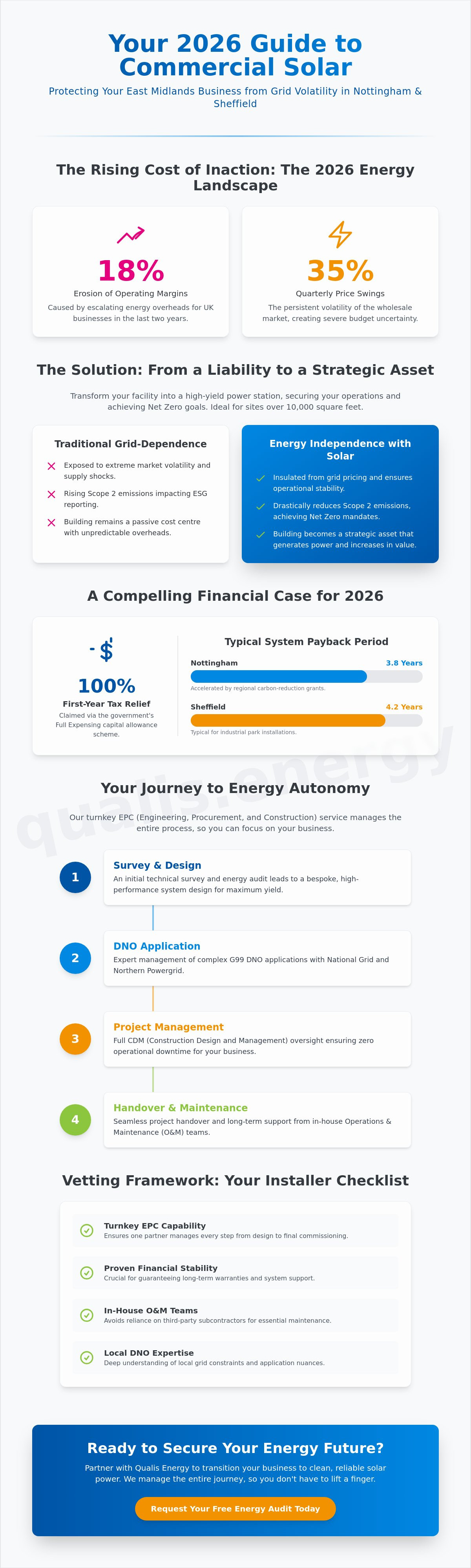
The era of predictable energy costs is over. As we navigate 2026, East Midlands manufacturers are grappling with a wholesale market where prices frequently swing by 35% within a single quarter. This volatility isn't just a line item on a balance sheet; it's a direct threat to the operational stability of Sheffield’s precision engineers and Nottingham’s growing logistics hubs. For these businesses, the transition to renewable power has moved from a "green" luxury to a fundamental requirement for survival.
The UK’s Net Zero mandates now place significant pressure on SMEs to report and reduce Scope 2 emissions. Forward-thinking organisations are moving away from a simple supplier-customer transaction. They're seeking a long-term energy partnership that secures their infrastructure for the next thirty years. High-quality commercial solar installers provide the technical expertise to turn underutilised roof space into a high-yield power station. This shift doesn't just lower bills; it transforms a building from a liability into a strategic asset that increases property value across South Yorkshire’s industrial centres.
Energy Independence for Local Industry
Businesses in Doncaster and Rotherham are leading a quiet revolution in de-risking their operations. By 2026, the shift from total grid-dependence to sophisticated self-generation has become the standard for any firm operating out of a facility larger than 10,000 square feet. This movement is driven by the need for certainty in an uncertain world. To understand the technology behind this shift, it helps to look at the fundamentals of what is solar energy and how it integrates with modern battery storage to provide 24/7 reliability.
In the context of UK commercial law and the updated 2025 Energy Act framework, Energy Independence is defined as the measurable capacity of a business to maintain critical operations through behind-the-meter generation, effectively insulating the entity from national grid volatility and external supply shocks. Our role is to guide you through this transition, from the initial site survey to the final G99 DNO application, ensuring you don't need to lift a finger.
Financial Incentives and ROI in the East Midlands
The financial landscape for solar in 2026 remains highly attractive due to the government’s commitment to capital allowance schemes. Under the current Full Expensing rules, companies can claim 100% tax relief on their solar investment in the very first year. This significantly accelerates the return on investment. Our recent data shows that a typical system in a Sheffield industrial park achieves a full payback in approximately 4.2 years, while Nottingham-based firms often see this drop to 3.8 years due to specific regional carbon-reduction grants.
The logic is simple: every kilowatt-hour generated on-site is a kilowatt-hour you don't have to buy from a volatile market. You can see these principles in action by exploring our solar panels for commercial buildings case study, which highlights how local firms are achieving total energy autonomy. We aren't just fitting panels; we're holding high the renewable energy flag for the entire region. Partnering with experienced commercial solar installers ensures that your system is designed for maximum yield, making the most of every square inch of your South Yorkshire or Nottinghamshire premises.
Key Criteria for Evaluating Commercial Solar Installers
Selecting the right partner for your transition to renewable power is a decision that impacts your balance sheet for the next 25 years. The market for commercial solar installers has matured, moving beyond simple panel fitting into complex energy infrastructure management. You need a partner who holds high the renewable energy flag while managing every technical nuance on your behalf. Grounded professionalism is essential here. Visionary goals must be matched by a "from-to" service model that handles everything from the initial structural survey to the final grid connection.
Financial stability is your first filter. By 2026, the industry has seen a 15% consolidation of firms that lacked the capital to back their long-term warranties. Verify your installer's historical performance and ensure they possess in-house Operations and Maintenance (O&M) teams. Relying on sub-contractors for repairs is a risk you can't afford. A single inverter fault can cost a manufacturing facility over £500 in lost generation daily, making rapid, in-house response times a non-negotiable requirement for protecting your ROI.
Technical Credentials and Accreditations
Expertise in G99 and G100 grid applications is the primary differentiator for modern industrial projects. These applications manage how your system interacts with the local grid; errors here can lead to months of delays or forced capacity reductions. Certifications from NAPIT or NICEIC are mandatory for your commercial insurance providers to validate the installation's safety. MCS accreditation is essential because it remains the primary requirement for businesses to access Smart Export Guarantee (SEG) payments for any surplus energy exported to the grid.
Local vs National: A Comparison for South Yorkshire Businesses
The choice between a national giant and a regional specialist often comes down to accountability. For a business operating in Mansfield or Barnsley, a local team can offer a 4-hour response time for critical maintenance calls, whereas national firms often struggle to meet a 48-hour window. Local knowledge is equally vital for the planning phase. Understanding the specific nuances of Sheffield or Doncaster planning departments can shave six weeks off your project timeline. National scale might offer bulk purchasing power, but local accountability delivers the superior long-term ROI through minimized downtime and tailored system design.
We believe in a partnership that spans from the first roof load-bearing assessment to the final DNO handover. Our comprehensive turnkey service ensures you won't need to lift a finger throughout the process. Recent UK government solar initiatives have highlighted the drive for easier grid access, but professional oversight remains the only way to guarantee a high-yield investment. We manage the entire lifecycle, ensuring your business leads the charge toward a cleaner, more resilient future. Choosing commercial solar installers with this level of end-to-end capability transforms a simple construction project into a strategic corporate asset.
Navigating Local Grid Constraints: DNO Applications in the East Midlands
Energy infrastructure is the silent heartbeat of your business operations. In the East Midlands, the grid is a tale of two distinct territories. Nottingham and its surrounding areas fall under National Grid Electricity Distribution, while Sheffield and the South Yorkshire border are managed by Northern Powergrid. This geographic split isn't just a matter of branding; it dictates the technical parameters of your entire project. Expert commercial solar installers must act as your regulatory vanguard, bridging the gap between your site's potential and the grid's current capacity.
At Qualis Energy, we're holding high the renewable energy flag by removing the administrative burden from your shoulders. Our turnkey approach means you won't lift a finger during the complex G99 application phase. We don't just submit paperwork; we negotiate with the Distribution Network Operators (DNOs) to secure the best possible export terms for your investment. If the grid is congested, we don't walk away. We engineer solutions that bypass these bottlenecks, ensuring your transition to clean energy remains on track and on budget.
The G99 Application Process Simplified
The timeline for grid connection in 2026 has become more structured, yet hurdles remain. In industrial hubs like Chesterfield and Worksop, you should expect a 65-day window for a formal DNO response. A common pitfall is failing to account for Active Network Management (ANM). This 2026 standard allows the DNO to temporarily limit your export during periods of low local demand to protect the network. We mitigate this by providing granular load-profile data, ensuring your system is designed for resilience rather than just raw output. Our team manages the entire CDM project management cycle, preventing the technical delays that often plague less experienced contractors.
Integrating Battery Storage and HVAC
Export limitations are a reality for high-demand sites in Lincoln and Doncaster. When the DNO restricts how much energy you can send back to the wires, battery storage becomes a commercial necessity. By storing excess generation, you maximise self-consumption and protect your ROI. There are powerful synergies to be found when combining PV with an air source heat pump installation. This creates a closed-loop energy ecosystem where your roof powers your climate control.
As planning policy for solar farms and large-scale commercial arrays evolves, the focus has shifted toward site-wide electrification. We help you future-proof your facility for the inevitable demand of EV fleet charging. By integrating these technologies now, commercial solar installers can help you avoid costly grid upgrades in the future. It's about more than just panels; it's about building a visionary energy strategy that serves your business for the next three decades.
Step-by-Step: How to Vet a Commercial Solar Partner
Choosing the right commercial solar installers is a decision that defines your facility's operational efficiency for the next quarter-century. It is a transition from being a passive energy consumer to becoming an active producer. To ensure your investment is protected, you must follow a rigorous vetting process that moves logically from initial curiosity to technical certainty. This ensures that the system installed today remains a high-performing asset in 2050.
Step 1: Request a preliminary site survey and a comprehensive energy audit that analyses your half-hourly settlement data to match generation with demand.
Step 2: Review bespoke system designs that include 3D shading analysis and specific performance projections tailored to your exact roof orientation.
Step 3: Verify recent local case studies from 2025 or 2026, specifically looking for projects in your industry, such as cold-storage facilities in Sheffield or manufacturing hubs in Nottingham.
Step 4: Confirm the project management framework, ensuring a robust CDM (Construction Design and Management) health and safety plan is in place before any equipment arrives on-site.
The Site Survey: What to Look For
Generic quotes delivered via email without a physical visit are a significant red flag for any business. In 2026, professional commercial solar installers utilise drone surveys and LiDAR technology to create a digital twin of your roof. This level of detail is vital for assessing structural integrity in areas like Newark and Southwell, where older industrial stock or agricultural barns may require specific mounting solutions. If a surveyor does not check your distribution board capacity or roof purlin spacing during the audit, the initial quote is likely to balloon later with hidden costs. A drone-led survey ensures that every centimetre of micro-shading from HVAC units or neighbouring trees is accounted for in the final yield calculation.
Reviewing the Proposal and ROI
A visionary proposal focuses on the long-term Performance Ratio (PR) rather than just the initial price tag. You should look for a guaranteed generation figure backed by a 25-year lifecycle support plan. Transparency is paramount in these documents. Ensure the quote explicitly includes scaffolding, plant hire, and DNO application fees. We provide a turnkey EPC service where you will not need to lift a finger, as we handle every technical hurdle from the first design phase to the final handover. By choosing a partner who manages the granular details of CDM and grid compliance, you are free to focus on running your business whilst we help you hold high the renewable energy flag. Our goal is to make the transition to clean power as seamless as the act of looking after your staff or your local community.
Ready to secure your energy future with a partner who manages the entire journey from survey to generation? Book your bespoke commercial site survey with Qualis Energy.
Qualis Energy: Your Local Partner for Commercial Solar Excellence
Qualis Energy isn't just another contractor. We act as a Visionary Facilitator for the UK's regional energy transition. Our roots are firmly planted in Nottingham and Sheffield. This local presence ensures a level of accountability that national firms simply cannot match. We're holding high the renewable energy flag for South Yorkshire and the East Midlands, driving a movement that goes beyond mere installation. We want to change how our region thinks about power. Local businesses deserve a partner who understands the specific grid challenges of the East Midlands and the unique industrial heritage of our cities.
The Qualis Promise is simple: you won't need to lift a finger. We provide a turnkey EPC service that manages every technical hurdle. This includes complex G98 and G99 DNO applications and rigorous CDM project management. Our team handles the entire journey from the first site survey through to final commissioning and long-term servicing. This end-to-end capability transforms a daunting industrial upgrade into a seamless business investment. We manage the complexity so you can focus on running your company whilst we secure your energy future.
Bespoke Solutions for Every Sector
Every roof tells a different story. We've designed bespoke systems for diverse environments, from sprawling agricultural barns in Ollerton to high-output industrial units in Rotherham. We understand that a "one size fits all" approach fails the specific needs of commercial solar installers and their clients. Our work extends into the community through social engagement. We're passionate about educating the next generation, showing them that green technology is the future of their local economy. It's about more than just panels; it's about building a sustainable legacy for our children and our neighbours.
Our maintenance contracts are widely regarded as the gold standard for the industry. We don't just walk away after the panels are live. We provide ongoing monitoring and rapid-response servicing to ensure your investment continues to perform at peak efficiency for decades. It's about protecting your green credentials and your bottom line. Reliability is our hallmark, and we take pride in looking after the systems that power our local economy.
Start Your Energy Transition Today
The path to energy independence begins with a professional consultation. Our technical team conducts a "no-stone-unturned" feasibility study for every site. This isn't a surface-level glance. We analyse structural integrity, grid capacity, and projected yields to ensure your project is viable. As leading commercial solar installers, we ensure that every technicality is addressed before the first bolt is tightened. We'll map out the entire process so you know exactly what to expect from day one.
Our team is ready to guide you through the transition. We provide the expertise needed to navigate the evolving energy infrastructure of the UK. You'll receive a detailed breakdown of potential savings and carbon reductions specific to your location, backed by real-world data and professional insight.
. Our experts are ready to help you join the ranks of forward-thinking businesses leading the charge in Nottinghamshire and South Yorkshire.
Secure Your Commercial Energy Independence by 2026
The energy landscape of 2026 demands more than just hardware; it requires a strategic partnership to navigate the complexities of the UK's transitioning infrastructure. Selecting the right commercial solar installers in Nottingham and Sheffield means prioritising technical depth, especially regarding G99 grid applications and MCS accreditation. By focusing on local expertise and RECC-compliant standards, your business secures an asset that delivers measurable returns whilst supporting the East Midlands’ decarbonisation goals. Industry data suggests that businesses integrating renewables now are essential for meeting the UK's 70GW solar target by 2035.
Qualis Energy stands ready to lead this transition. We handle the entire journey from initial G98 and G99 feasibility studies to final commissioning, ensuring you don't need to lift a finger. Our local Nottingham and Sheffield technical teams provide the grounded support necessary to turn ambitious energy targets into operational reality. We’re proud to be holding high the renewable energy flag across South Yorkshire and Nottinghamshire, helping local enterprises become leaders in the national shift toward self-sufficiency. It’s a commitment to our community that goes far beyond a simple installation.
It’s time to secure your energy independence and build a legacy of sustainability for the next generation.
Frequently Asked Questions
How much does commercial solar installation cost in the UK in 2026?
Commercial solar systems typically cost between £800 and £1,000 per kWp according to 2025 industry benchmarks from the Department for Energy Security and Net Zero. This means a 50kW system on a Nottingham warehouse usually requires an investment of approximately £45,000 to £50,000. These figures include high-efficiency panels and mounting hardware. Your final price depends on specific site complexities like roof material or grid connection requirements.
How long does a typical commercial solar installation take in Nottingham?
Most commercial solar installations in Nottingham take between two and four weeks to complete once the physical work begins. This timeline covers the transition from initial scaffolding setup to the final testing of the DC and AC circuits. Larger projects, such as 250kW systems on industrial units in Colwick, may extend to six weeks. We manage the entire schedule through our CDM project management framework so you won't need to lift a finger during the process.
Do we need planning permission for solar panels on a commercial building in Sheffield?
Most solar installations on Sheffield business premises fall under Permitted Development Rights, meaning formal planning permission isn't required. This applies as long as the panels don't protrude more than 200mm from the roof surface and aren't installed on listed buildings or within conservation areas like the Kelham Island Quarter. If your building is listed, you'll need to apply for Listed Building Consent. We handle all these regulatory checks as part of our turnkey EPC service to ensure total compliance.
What is the difference between G98 and G99 grid applications?
The primary difference lies in the system's capacity, where G98 applies to installations under 16A per phase and G99 covers anything larger. Since most commercial solar installers work on systems exceeding 50kW, G99 applications are the standard for industrial sites. This process involves a formal application to the District Network Operator (DNO) like National Grid Electricity Distribution. We manage this technical paperwork from start to finish to secure your export capacity.
Can commercial solar panels be installed on a flat roof?
Solar panels are frequently installed on flat roofs using ballasted mounting systems or A-frame racks tilted at 10 to 15 degrees. This setup ensures maximum sunlight absorption whilst maintaining the structural integrity of your Sheffield warehouse or office block. We use wind-loading calculations to determine the exact weight required to secure the array without penetrating the roof membrane. It's a proven method for converting unused industrial roof space into a high-performing energy asset.
What maintenance is required for a commercial solar PV system?
Commercial PV systems require an annual professional inspection and cleaning every 12 to 24 months to maintain peak efficiency. Dust and debris can reduce energy yields by up to 15% according to data from the BRE National Solar Centre. Our maintenance packages include thermal imaging to spot "hot spots" and string testing to ensure every panel performs as expected. We take care of the ongoing health of your investment so you can focus on running your business.
Is battery storage worth it for a business in the East Midlands?
Battery storage is highly effective for East Midlands businesses that operate outside daylight hours or face high peak-demand charges. By storing excess generation, companies can increase their self-consumption rates from 30% to over 70% based on typical industrial load profiles. This technology allows you to hold high the renewable energy flag by becoming less reliant on the volatile national grid. It's a strategic move for any firm looking to stabilise long-term energy costs.
How do I choose between different commercial solar installers?
You should prioritise commercial solar installers who provide a full turnkey service, including DNO applications and CDM project management. Check for MCS accreditation and RECC membership to ensure the company meets national quality standards. Look for a partner that offers a clear "from-to" journey, moving from initial feasibility studies to long-term maintenance. Choosing an expert with a proven track record in the Nottingham and Sheffield area ensures your project is handled with local knowledge and professional authority.


Comments