

Passivhaus: The Future of Energy-Efficient Living in Nottingham & Sheffield (2026 Guide)
- James

- 3 days ago
- 13 min read
The future of energy has arrived, and it doesn't involve a boiler. As we approach the full implementation of the Future Homes Standard in 2025, the traditional method of heating our properties is rapidly becoming a relic of the past. You likely feel the mounting frustration of watching energy prices fluctuate whilst living in a home that feels cold despite the thermostat being turned up. At Qualis Energy, we are holding high the renewable energy flag to ensure you don't have to choose between a warm living room and a healthy bank balance. By adopting the passivehaus standard, homeowners across Nottingham and Sheffield are already securing a future where internal temperatures remain a steady 20 degrees Celsius without a radiator in sight.
We're here to guide you through this critical national transition from the initial survey through to the final handover, ensuring you won't need to lift a finger during the process. You'll discover how this rigorous building standard delivers virtually zero heating bills and superior indoor air quality, ensuring your property investment is fully protected against the regulatory shifts of 2026. This guide outlines everything from the technical mechanics of heat recovery systems to the practical reality of living in the most comfortable, energy-independent homes in South Yorkshire.
Key Takeaways
Discover why the passivehaus standard is the gold standard for energy independence, blending superior insulation with exceptional air quality for a healthier home.
Understand how to align your build with the 2026 Future Homes Standard to maximise property value whilst meeting the UK’s ambitious net-zero targets.
Gain insights into the local planning landscapes of Nottingham and Sheffield to perfectly balance solar gain with heat retention in the East Midlands climate.
Learn how integrating solar PV with smaller, more efficient Air Source Heat Pumps can lead to near-total energy autonomy and significantly reduced bills.
Explore the benefits of a visionary end-to-end mechanical service that handles everything from design to commissioning, ensuring you won't need to lift a finger.
Table of Contents What is Passivhaus? Defining the Gold Standard of Efficiency The 2026 Trend: Why Passivhaus is Dominating UK Construction Passivhaus in Nottingham & Sheffield: Local Climate & Planning Integrating Technology: Solar, Batteries, and ASHPs in Passive Homes Embarking on Your Passive Journey with Qualis Energy
What is Passivhaus? Defining the Gold Standard of Efficiency
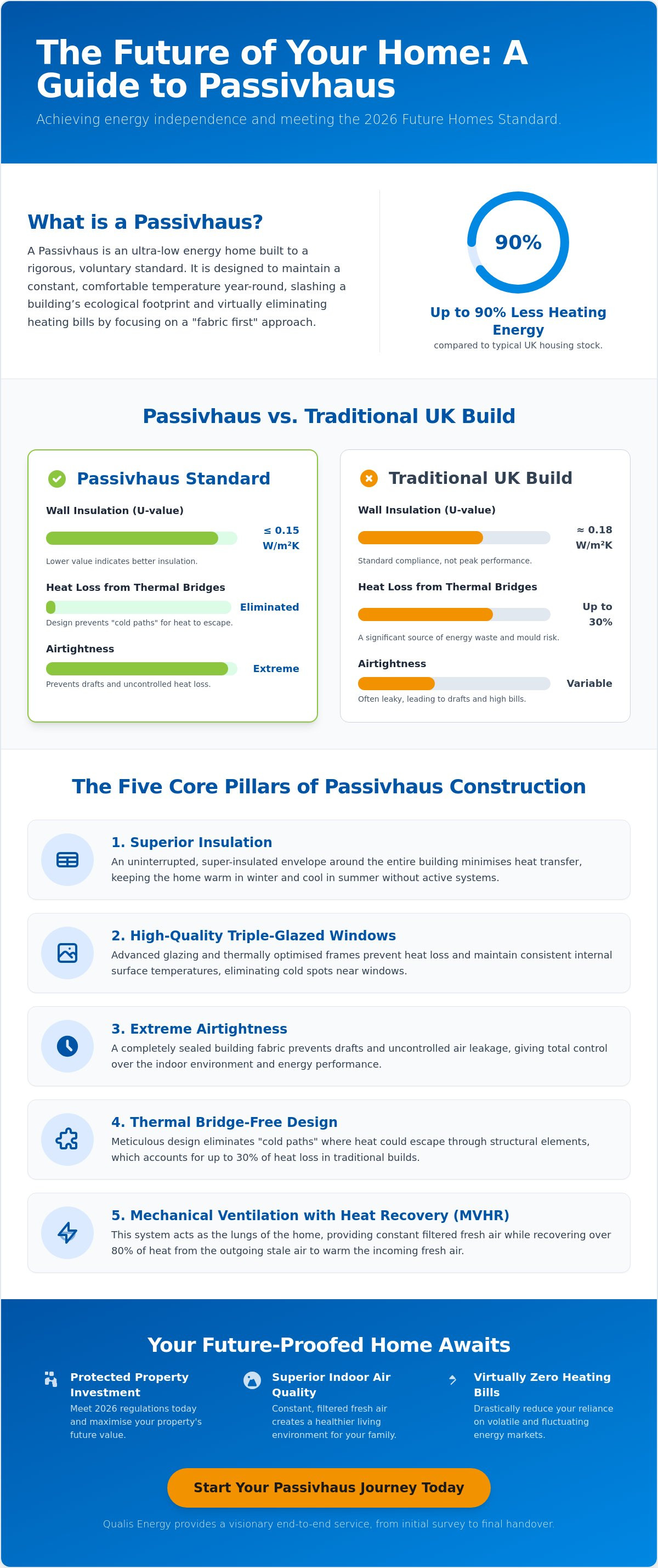
The future of domestic energy has arrived. It isn't just found in solar panels or heat pumps; it lives within the very fabric of the buildings we call home. What is Passivhaus? At its core, it's a rigorous, voluntary standard for energy efficiency that slashes a building’s ecological footprint to near-zero levels. Developed by the Passivhaus Institut in 1996, this methodology creates ultra-low energy homes that require up to 90% less heating energy than typical UK housing stock. You’ll often see it searched as passivehaus. Whilst the official German spelling omits the 'e', the mission remains the same: achieving total thermal comfort without the burden of extortionate energy bills. We are holding high the renewable energy flag by ensuring these high-performance standards become the norm in Nottingham and Sheffield.
The Five Core Pillars of Passive Construction
To achieve this level of performance, we focus on five precise engineering principles. First, we implement thermal bridge-free design. This eliminates the "cold paths" found in traditional builds that account for 30% of heat loss and often lead to mould. We utilise high-quality, triple-glazed windows to maintain consistent internal surface temperatures, even during a harsh South Yorkshire winter. Mechanical Ventilation with Heat Recovery (MVHR) acts as the lungs of the home, providing constant filtered air whilst recovering 80% of the heat from outgoing air. Combined with extreme airtightness and superior insulation, these pillars ensure your home remains a sanctuary of efficiency. Our team manages every detail from the initial survey to final handover, so you won't need to lift a finger.
Passivhaus vs. Traditional UK Building Regulations
Standard UK building regulations represent a baseline for safety, not a ceiling for excellence. While a typical new build might target a U-value of 0.18 W/m²K for walls, a passivehaus build often pushes this to 0.15 W/m²K or lower. Traditional brick and block construction frequently fails to meet modern efficiency expectations because of gaps in the insulation layer and poor junction details. We advocate for a "fabric first" approach. This means the building's shell does the heavy lifting, decarbonising your lifestyle through physics rather than just technology. As Nottingham and Sheffield strive toward net-zero targets by 2030, the shift from basic compliance to the Passivhaus standard is a critical investment in our national infrastructure and your personal comfort.
The 2026 Trend: Why Passivhaus is Dominating UK Construction
The future of British housing has arrived. By 2026, the construction landscape in Nottingham and Sheffield will look radically different than it did even five years ago. We are seeing a massive shift toward the passivehaus standard because it offers a level of certainty that traditional building methods simply cannot match. From the initial site assessment through to the final airtightness test, the industry focus has moved from "how cheap can we build" to "how well can we perform."
We are holding high the renewable energy flag as we guide homeowners through this national transition. The UK government’s Future Homes Standard is the primary driver behind this movement. These regulations are finally aligning with the rigorous principles championed by the Passivhaus Trust UK for decades. It's about more than just saving money on bills; it's about future-proofing our local infrastructure against volatile energy markets and changing climates. In 2024, we saw energy prices remain 60% higher than pre-2021 levels, making energy independence a top priority for families across the Midlands.
Future Homes Standard 2025/26 and Passive Principles
The 2026 regulatory shift mandates that all new residential developments must utilise low-carbon heating systems as the primary source of warmth. This effectively bans gas boilers in new builds. For developers in South Yorkshire, adopting passivehaus principles is the most logical path to compliance. It moves the focus from active heating to passive retention. You won't need to worry about complex retrofits later because the efficiency is built into the fabric of the building from day one. Our turnkey approach ensures that you won't need to lift a finger during this technical transition.
Health, Wellbeing, and the Passive Environment
Living in a high-performance home changes your daily experience. Most residents in Sheffield and Nottingham are used to the 'draughty window' syndrome during the winter months, but those days are ending. A Mechanical Ventilation with Heat Recovery (MVHR) system ensures that 100% of the air in your home is filtered and fresh. This is a game-changer for the 20% of the UK population suffering from hay fever or respiratory issues like asthma, as it removes dust and pollen before they enter the living space.
The psychological impact is equally profound. These homes are incredibly quiet. Thick insulation and triple glazing provide acoustic barriers that turn a busy city-centre street into a silent sanctuary. As UK summers become more intense, with temperatures hitting record highs in 2022, these homes stay naturally cool without the need for energy-hungry air conditioning. Local authorities are already noticing the benefits; social housing projects across the Midlands are adopting these standards to eliminate fuel poverty and improve tenant health. It's a holistic approach that protects your investment whilst looking after your family.
Passivhaus in Nottingham & Sheffield: Local Climate & Planning
Building a passivehaus in the East Midlands requires a strategy that respects our unique regional geography. From the damp, low-lying plains of the Trent Valley to the exposed ridges of the Pennines, our climate demands a building fabric that works harder than standard builds. We don't just build houses; we engineer environments that thrive in Sheffield's mist and Nottingham's variable winds. This transition is already visible across the region. Recent projects in Barnsley and Rotherham have demonstrated that high-performance builds can withstand South Yorkshire's 800mm average annual rainfall whilst maintaining perfect internal air quality.
Understanding the technical nuances is the first step for any homeowner. Many residents start by asking What is Passivhaus? and how it adapts to our specific weather patterns. The standard relies on a "fabric first" approach. This means we prioritise airtightness and thermal bridge-free construction to lock out the North Sea chills that often sweep across Chesterfield and into the city centres. By 2026, these standards will be the benchmark for all sustainable developments in the region.
Managing Solar Gain in South Yorkshire
Sheffield’s famous topography presents both a challenge and a massive opportunity. We use the city's natural slopes to maximise southern exposure, capturing free heat from the sun during the short December days. However, the 2026 climate projections suggest hotter, drier summers. To prevent overheating, we integrate external shading and brise soleil into the design. For properties on the Peak District fringes, where wind speeds can be 20% higher than in the city centre, we specify triple-glazed units with reinforced frames to ensure the thermal envelope remains uncompromised.
Planning Permission for Sustainable Homes
Securing planning permission is often the biggest hurdle for innovators. Thankfully, local councils in Nottingham and Sheffield are increasingly supportive of ultra-low energy builds. They recognise that these homes are essential for meeting 2030 Net Zero targets. In sensitive conservation areas like Southwell or Retford, we work closely with planning officers to ensure modern materials respect the local heritage. A certified passivehaus design often acts as a "golden ticket" in the planning process. It provides tangible proof of environmental responsibility that standard applications lack. We manage the entire process, from the initial site survey through to the final DNO applications, so you won't need to lift a finger.
Integrating Technology: Solar, Batteries, and ASHPs in Passive Homes
The era of oversized, inefficient boilers is ending. In a passivehaus, technology doesn't fight the building; it complements it. We view the home as a single, high-performance engine where every component from the insulation to the inverter works in harmony. This synergy allows for a radical reduction in mechanical complexity whilst delivering a level of comfort that traditional builds simply cannot match.
Air Source Heat Pumps in Air-Tight Environments
A standard 1930s semi-detached home in Nottingham might require an 11kW heat pump to combat constant heat loss. By contrast, a certified passive build of the same size often requires less than 3kW of peak heating power. This massive reduction in demand means a much smaller air source heat pump installation is sufficient. These systems are designed to provide the tiny 'top-up' heat required during the coldest Sheffield winters, operating at low-flow temperatures of approximately 35°C.
Oversizing is the primary error in modern retrofits and new builds. A unit that's too powerful for an airtight envelope will short-cycle, leading to increased wear and reduced efficiency. We focus on precision. By matching the heat pump capacity to the specific 15kWh/(m²a) heating demand of a passivehaus, we ensure the system runs quietly and consistently. From the initial thermal bridge analysis to the final commissioning, we manage the entire process so you don't have to lift a finger.
Maximising Solar ROI with SEG and Passive Efficiency
A passive home is already roughly 90% more efficient than the UK average. When you integrate solar panels and installation, you aren't just offsetting costs; you are moving toward total energy independence. The energy generated by a modest 4kWp solar array is often more than enough to power the Mechanical Ventilation with Heat Recovery (MVHR) system and all domestic appliances during daylight hours.
The Smart Export Guarantee (SEG) turns your home into a revenue generator by allowing you to sell surplus green energy back to the grid. Battery storage captures excess solar generation during the day to power the MVHR system throughout the night, ensuring constant fresh air without drawing from the grid. This creates a circular energy economy within your own four walls.
Smart home controls act as the conductor for this orchestra. These systems allow you to organise your energy consumption, automatically shifting heavy loads like dishwashers or EV charging to peak solar hours. We are holding high the renewable energy flag by showing homeowners that a sustainable future isn't just possible; it's already here.
Ready to take control of your energy future?
to discuss your passive project.
Embarking on Your Passive Journey with Qualis Energy
The future of domestic energy has arrived. At Qualis Energy, we act as the visionary facilitator for your transition to a high-performance home, bridging the gap between complex engineering and everyday comfort. We manage the entire mechanical lifecycle. From the initial thermal design support to the final commissioning of your ventilation systems, our team handles every technical hurdle. You're investing in a legacy of efficiency, not just a building project. Our end-to-end service ensures that whether you're building a new landmark or revitalising a family home, the integration of technology is seamless. We hold high the renewable energy flag for Nottinghamshire and South Yorkshire, ensuring your project meets the rigorous requirements of a passivehaus without the stress of managing multiple contractors.
Our commitment to your project is absolute. We handle the heavy lifting of technical compliance, including CDM project management and complex DNO applications for your solar arrays. The Qualis promise is simple: you will not need to lift a finger during the tech integration. We translate high-level industry terminology into a living, breathing reality that looks after your children's future and your immediate comfort. By choosing a partner that oversees everything from the first site survey to the final handover, you eliminate the risks of performance gaps that often plague standard builds.
Retrofit vs. New Build: The EnerPHit Standard
Can a Victorian terrace in Nottingham really reach these standards? The answer lies in EnerPHit. This is the specific passivehaus standard designed for refurbishments where site constraints make the full certification difficult. For homeowners in Worksop, Mansfield, or Doncaster, the process is a structured evolution. We prioritise the building envelope first. This involves a logical sequence of interventions:
Installing high-performance external or internal wall insulation to eliminate cold bridges.
Replacing existing apertures with triple-glazed windows and insulated frames.
Introducing Mechanical Ventilation with Heat Recovery (MVHR) to manage air quality.
Integrating renewable technologies like air source heat pumps once the heat demand is minimised.
By reducing the heat demand to approximately 25 kWh/m2a, we ensure the mechanical systems we install work at peak efficiency for decades, rather than overcompensating for a draughty shell.
Why a Local Partner Matters for Your Passive Project
Choosing a partner who understands the local climate and specific supply chains in South Yorkshire is vital for long-term success. We don't just install and leave; we provide the ongoing maintenance required to ensure your systems perform for 25 years or more. Our local presence means we're always available to fine-tune your home's "lungs" or optimise your battery storage as your family's energy patterns change. We ground our technical expertise in the community, helping your neighbours see the tangible benefits of green investment.
Ready to lead the transition in your street? Contact Qualis Energy today for a professional consultation on your energy-efficient future. Let's build something that lasts.
Leading the Transition to a Carbon-Zero Future
The future of British housing isn't a distant dream; it's a practical reality we're building right now. Adopting the passivehaus standard represents the ultimate investment in your family's comfort and our planet's health. By 2026, the shift towards total energy independence in Nottingham and Sheffield will be driven by the seamless integration of solar power, battery storage, and air source heat pumps. We move you from the uncertainty of rising grid costs to the security of a self-sustaining home.
As MCS Accredited Installers, we take pride in holding high the renewable energy flag across the East Midlands and South Yorkshire. Our specialists manage every detail through our turnkey EPC and project management services, ensuring you won't need to lift a finger during your renewable transition. We bridge the gap between complex industrial technology and the simple warmth of a family home. Your path to a more sustainable life starts with a partnership built on trust and technical excellence.
We're ready to help you build a home that looks after you as much as you look after it.
Frequently Asked Questions about Passivhaus Living
Is a Passivhaus much more expensive to build than a standard home?
Building a Passivhaus typically incurs a capital cost premium of 4% to 8% compared to standard UK building regulations. This initial investment covers superior insulation, high-performance glazing, and airtight construction techniques. While the upfront price is higher, the standard reduces space heating demand by up to 90%. You'll see a return through drastically lower energy bills and increased property value in the Nottingham and Sheffield markets.
Can I open the windows in a Passivhaus?
You can absolutely open your windows whenever you like. While the Mechanical Ventilation with Heat Recovery (MVHR) system provides a constant flow of filtered fresh air, it doesn't prevent you from enjoying a summer breeze. In fact, opening windows in the evening is a key strategy for "night purging" to keep the home cool during heatwaves. Most residents find they rarely feel the need to open them because the indoor air quality remains so high.
Do Passivhaus buildings still need a heating system like a heat pump?
Most Passivhaus homes require a very small heating source, such as a compact air-source heat pump or an electric post-heater within the ventilation system. Because the building's heat load is limited to 10W per square metre, a traditional boiler is unnecessary. In a 100-square-metre home, you could theoretically heat the entire space with the energy used by a hair dryer. This efficiency allows for a simplified, turnkey heating solution that costs pennies to run.
What is the difference between Passivhaus and a Zero Carbon home?
Passivhaus is a rigorous comfort and energy-performance standard focused on reducing demand, whilst a Zero Carbon home focuses on offsetting its total annual emissions through renewables. A building can be Passivhaus without being Zero Carbon if it doesn't have solar panels. Conversely, a Zero Carbon home might have poor insulation but lots of solar. For the ultimate sustainable home, we recommend combining the passivehaus standard with a solar PV array to achieve a "Plus" or "Premium" rating.
How long does it take to get Passivhaus certification in the UK?
The certification process begins at the design stage and continues through to the final handover. Once the building is finished and the final pressure tests are verified by a registered certifier, it typically takes 8 to 12 weeks to receive the official certificate. This timeline ensures every aspect of the "as-built" performance matches the original energy model. We handle the entire journey from the initial PHPP modelling to the final paperwork so you won't need to lift a finger.
What happens if the power goes out in a Passivhaus?
Your home will remain warm for several days even without power during a winter freeze. Because of the exceptional insulation and airtightness, the temperature drop is limited to roughly 1 or 2 degrees Celsius over a 24-hour period. Standard UK homes often lose heat within hours. Whilst the MVHR system will stop running, you can simply open a window briefly for fresh air until the grid is restored.
Can I retrofit my existing 1930s semi-detached house to Passivhaus standards?
You can retrofit an older property using EnerPHit, which is the specific passivehaus standard designed for existing buildings. This process involves wrapping the structure in high-performance insulation and installing specialist windows to eliminate draughts. While achieving the full new-build standard is difficult for 1930s semis, EnerPHit certification guarantees a heating demand reduction of up to 80%. It transforms a draughty house into a future-proofed investment for your family.
Is the MVHR system noisy to run at night?
A correctly installed MVHR system is virtually silent, operating at sound levels below 25 decibels in living areas. This is quieter than a whisper or a light rustle of leaves. We use acoustic silencers and insulated ducting to ensure there's no vibration or "whooshing" sound while you sleep. The only thing you'll notice is the constant supply of fresh, filtered air that helps the whole family sleep better.


Comments